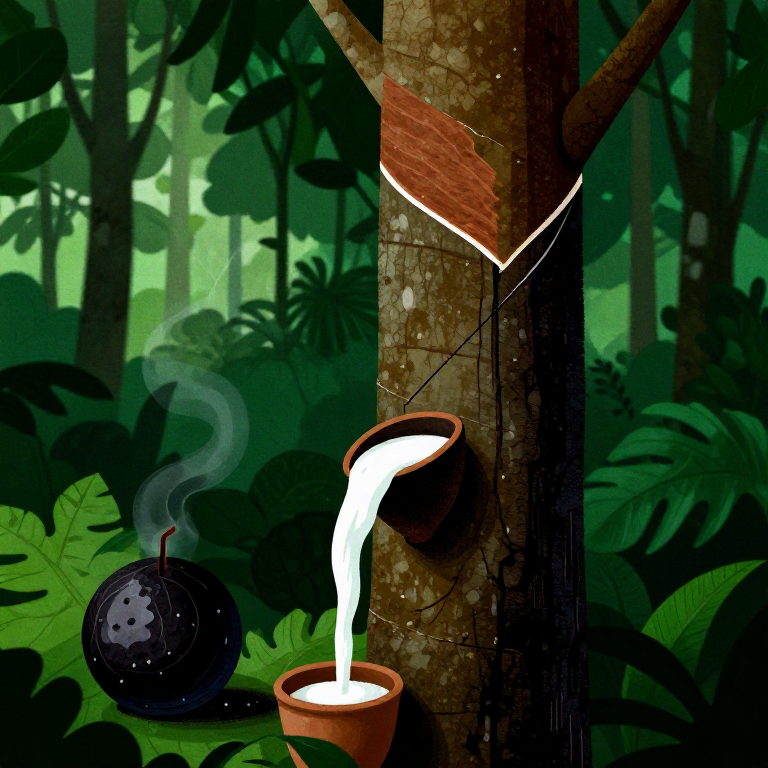


Seringueira e Borracha Natural — Extração Tradicional de Látex na Amazônia
Leiðbeiningar
Conhecer a seringueira (Hevea brasiliensis)
Conhecer a seringueira (Hevea brasiliensis)
A seringueira (Hevea brasiliensis) é uma árvore da família Euphorbiaceae, nativa da bacia amazônica. Atinge 25-30 metros de altura, com tronco reto de 30-60 cm de diâmetro e copa ampla. A casca é lisa, acinzentada, com marcas de cicatrizes foliares. As folhas são compostas trifoliadas (três folíolos) com margens lisas, dispostas alternadamente. A árvore produz frutos capsulares com três sementes que explodem quando maduros, lançando as sementes a vários metros — daí o nome da família (Euphorbiaceae, do grego 'euphorbia'). O látex é produzido nos vasos laticíferos (laticifer vessels) localizados na casca interna (floema secundário). O látex fresco é uma emulsão branca leitosa contendo 30-40% de partículas de borracha (cis-1,4-poliisopreno) suspensas em água, além de proteínas, açúcares, minerais e lipídios.
Entender a história do ciclo da borracha
Entender a história do ciclo da borracha
O primeiro ciclo da borracha (1879-1912) transformou a Amazônia brasileira. A demanda mundial por borracha para pneus de bicicletas e automóveis atraiu milhares de seringueiros, principalmente nordestinos fugindo das secas. Manaus tornou-se uma das cidades mais ricas do mundo — o Teatro Amazonas (1896) foi construído com materiais importados da Europa. O Brasil detinha o monopólio mundial da borracha até 1876, quando Henry Wickham contrabandeou 70.000 sementes de Hevea para o Jardim Botânico de Kew, na Inglaterra. As mudas foram enviadas para o Ceilão (Sri Lanka) e Malásia, onde plantações ordenadas superaram a produção extrativista amazônica. Em 1913 a borracha asiática de plantação já dominava o mercado mundial, e o ciclo amazônico colapsou. Hoje, a Tailândia e a Indonésia são os maiores produtores mundiais. No Brasil, seringueiros como Chico Mendes (1944-1988) lutaram pela criação de Reservas Extrativistas para preservar o modo de vida tradicional e a floresta.
Identificar seringueiras na floresta
Identificar seringueiras na floresta
Na floresta amazônica nativa, as seringueiras crescem dispersas — tipicamente 5-10 árvores produtivas por hectare, nunca em aglomerados densos. O seringueiro deve conhecer sua 'estrada de seringa' — um caminho circular na mata que conecta 100-200 seringueiras, percorrido diariamente. Identificar a Hevea brasiliensis: tronco reto, casca lisa acinzentada com lenticelas (poros) horizontais, folhas trifoliadas com pecíolos longos, e cicatrizes de sangrias anteriores em árvores já trabalhadas. Em plantações (seringais de cultivo), as árvores são plantadas em linhas com espaçamento de 7x3 metros (aproximadamente 470 árvores por hectare). Uma árvore está pronta para sangria quando atinge 50 cm de circunferência na altura de 1 metro do solo — geralmente aos 5-7 anos de idade. Árvores mais jovens não devem ser sangradas pois a casca é muito fina.
Nauðsynleg verkfæri:
 Sveðja
Preparar a faca de seringa e equipamentos
Preparar a faca de seringa e equipamentos
A faca de seringa (faca de sangria) é a ferramenta essencial do seringueiro. É um instrumento especializado com lâmina curva curta, projetada para cortar a casca na profundidade exata sem atingir o câmbio (tecido de crescimento). A lâmina deve estar sempre afiada — faca cega rasga a casca irregularmente, danifica o câmbio e reduz a produção futura. Afie a faca com pedra de amolar antes de cada jornada. A faca tradicional amazônica tem um limitador de profundidade natural no formato da lâmina, que impede cortes mais profundos que 2 mm na casca. Além da faca, prepare: tigelas de coleta (cuias de barro, alumínio ou plástico com capacidade de 200-500 ml), bicas metálicas (calhas) para direcionar o fluxo do látex, arame para fixar as tigelas, e uma poronga (lamparina de querosene fixada na cabeça) para iluminação na madrugada.
Efni fyrir þetta skref:
 Söfnunarbolli fyrir latex20 stykki
Nauðsynleg verkfæri:
 Töppunarhnífur fyrir gúmmítré
 Brýni
Brýni Steinolíuhöfuðlampi
 Málmstútur
 Bindivír
Percorrer a estrada de seringa na madrugada
Percorrer a estrada de seringa na madrugada
O seringueiro acorda por volta das 3-4 horas da manhã e parte pela estrada de seringa ainda no escuro, iluminando o caminho com a poronga. A sangria deve ser feita na madrugada porque a pressão de turgor nas células da seringueira é máxima durante a noite e nas primeiras horas da manhã, quando a transpiração foliar é mínima — resultando em fluxo de látex 30-50% maior do que durante o dia. A umidade elevada da madrugada amazônica (90-100%) também retarda a coagulação natural do látex no corte. Uma estrada típica tem 100-200 árvores e leva 3-5 horas para ser percorrida completamente. O seringueiro faz a sangria em cada árvore (corte + instalação da tigela) e segue para a próxima. Após terminar a última árvore, retorna à primeira para coletar o látex acumulado nas tigelas.
Nauðsynleg verkfæri:
SteinolíuhöfuðlampiTöppunarhnífur fyrir gúmmítréFazer o corte de sangria na casca
Fazer o corte de sangria na casca
O corte padrão é a meia-espiral (half-spiral, S/2): um corte diagonal que percorre metade da circunferência do tronco, inclinado a 30 graus em relação à horizontal, descendo da esquerda para a direita (para destros). Inicie o primeiro corte na altura de 1,50 m do solo. A inclinação de 30 graus é fundamental porque os vasos laticíferos na casca da Hevea estão dispostos helicoidalmente da direita para a esquerda — um corte a 30 graus intercepta o número máximo de vasos. Corte apenas a casca externa até atingir os vasos laticíferos, na profundidade de 1,5-2 mm. O câmbio (tecido de crescimento vivo) fica logo abaixo — NUNCA corte até o câmbio, pois danifica permanentemente a capacidade de regeneração da casca. A cada sangria, raspe uma fatia fina de casca (1-2 mm) ao longo do corte anterior, abrindo novos vasos. O látex branco começará a escorrer imediatamente, fluindo pela inclinação do corte até a bica e a tigela.
Nauðsynleg verkfæri:
Töppunarhnífur fyrir gúmmítréInstalar a bica e a tigela de coleta
Instalar a bica e a tigela de coleta
Na extremidade inferior do corte (ponto mais baixo da diagonal, lado direito), instale uma bica metálica (calha) cravando-a na casca. A bica direciona o fluxo de látex para a tigela. Fixe a tigela de coleta logo abaixo da bica, presa ao tronco com arame. A tigela deve estar limpa e seca — látex contaminado com água de chuva ou sujeira coagula prematuramente e produz borracha de qualidade inferior. Uma seringueira adulta produz tipicamente 30-50 ml de látex por sangria (equivalente a 10-15 gramas de borracha seca). Árvores excepcionalmente produtivas podem render até 80-100 ml. A sangria é feita a cada 2-3 dias (sistema d/2 ou d/3), nunca diariamente — a árvore precisa de tempo para regenerar a casca e repor o látex nos vasos laticíferos.
Efni fyrir þetta skref:
Söfnunarbolli fyrir latex1 stykkiNauðsynleg verkfæri:
 Vírhaldari fyrir bollaMálmstútur
Coletar o látex das tigelas
Coletar o látex das tigelas
O látex flui continuamente por 2-4 horas após a sangria, até que a coagulação natural no corte estanque o fluxo. O seringueiro retorna pela estrada de seringa 3-5 horas após a primeira sangria para coletar o látex acumulado nas tigelas. Despeje o látex de cada tigela em um balde maior de coleta. O látex fresco é branco leitoso, fluido, com odor levemente adocicado. Recolha também a 'cernambi de tigela' — o látex que coagulou dentro da tigela (disco branco/amarelado). A cernambi é borracha de qualidade inferior, vendida separadamente. Retire também a 'cernambi de fita' — a fina camada de látex coagulado sobre o corte, que será raspada na próxima sangria. Limpe as tigelas após cada coleta. O total coletado em uma estrada de 150 árvores é tipicamente 5-8 litros de látex líquido por dia de sangria.
Nauðsynleg verkfæri:
 Söfnunarfata fyrir latex
Coar o látex
Coar o látex
O látex coletado pode conter impurezas: fragmentos de casca, folhas, insetos, e detritos da floresta. Coe o látex através de uma peneira fina de aço inoxidável (malha 40-60) ou pano de algodão limpo, despejando em um recipiente limpo. O látex filtrado deve estar homogêneo, branco leitoso, sem grumos ou partículas visíveis. Impurezas orgânicas degradam a qualidade da borracha final — causam pontos escuros, odor desagradável e fragilidade no produto defumado. Na tradição amazônica, o seringueiro filtra o látex com tecido de algodão esticado sobre a boca do balde. Para preservar o látex líquido por mais tempo antes da defumação, pode-se adicionar 2-3 ml de solução de amônia por litro — a amônia eleva o pH e impede a coagulação natural. Porém, na técnica tradicional de defumação imediata, a amônia geralmente não é necessária.
Nauðsynleg verkfæri:
 Sía úr ryðfríu stáli
 Bómullardúkur
Preparar o fogo para defumação
Preparar o fogo para defumação
A defumação (defumação tradicional) é o método histórico dos seringueiros para coagular e preservar o látex. Construa uma fogueira pequena no chão ou em um forninho de barro (defumador), usando frutos e sementes oleaginosas da floresta que produzam fumaça branca densa. Tradicionalmente usam-se cocos de babaçu (Attalea speciosa), caroços de tucumã (Astrocaryum aculeatum), ou ouriços de castanha-do-pará (Bertholletia excelsa). Estas sementes oleaginosas produzem fumaça rica em ácido acético, formaldeído, e compostos fenólicos que coagulam o látex e funcionam como antifúngicos e antibacterianos, preservando a borracha. Evite madeira resinosa (pinho) que dá cor escura e odor indesejável. A fumaça deve ser densa e branca — fumaça clara e quente indica combustão excessiva. O defumador deve ter uma abertura superior direcionada onde o seringueiro posiciona o espeto com a bola de borracha em formação.
Efni fyrir þetta skref:
 Babassúhnetur5 kilogram
Nauðsynleg verkfæri:
 Reykhús úr leir
 Eldfæri
Defumar o látex para formar a bola de borracha
Defumar o látex para formar a bola de borracha
A defumação é feita girando um espeto de madeira (pau de defumação) horizontalmente sobre a fumaça densa e despejando látex aos poucos sobre ele. O espeto é um bastão reto de madeira dura com 1-1,5 m de comprimento e 3-4 cm de diâmetro. Molhe o espeto com água antes de começar para facilitar a remoção posterior. Mergulhe uma concha (cuia) no balde de látex e despeje uma camada fina sobre o espeto enquanto o gira lentamente na fumaça. A fumaça coagula e seca cada camada fina em 1-2 minutos. Aplique a próxima camada sobre a anterior e continue girando. O processo é repetido dezenas de vezes — camada por camada — até formar uma bola esférica ou oblonga chamada 'bola de borracha' ou 'pela'. Uma bola típica pesa 40-60 kg quando completa e requer vários dias de trabalho com o látex de múltiplas coletas. A borracha defumada tem cor âmbar escuro a marrom, é elástica, e tem odor característico de fumaça. Cada camada deve secar completamente antes da próxima — camadas grossas demais resultam em borracha crua no interior.
Efni fyrir þetta skref:
 Síað latex5 lítrar
Nauðsynleg verkfæri:
 Reykspaði úr tré (pau de defumação)
 AusaReykhús úr leir
Remover a bola do espeto e inspecionar
Remover a bola do espeto e inspecionar
Quando a bola atingir o tamanho desejado (tipicamente 20-60 kg), corte-a ao longo do espeto com uma faca afiada para removê-la. A bola deve ser uniforme na cor (âmbar escuro a marrom), elástica ao toque, sem bolsas de látex cru no interior. Corte uma fatia fina para inspecionar: o interior deve ser homogêneo, sem camadas brancas (látex não coagulado) ou bolhas de ar. A borracha defumada de boa qualidade (borracha fina) é translúcida quando cortada em fatia fina contra a luz. Borracha com camadas cruas ou contaminação é classificada como 'sernambi' — qualidade inferior. A classificação tradicional vai de 'fina' (melhor) a 'entrefina' e 'sernambi' (pior). A borracha fina bem defumada pode ser armazenada por meses sem degradação graças às propriedades antifúngicas da fumaça.
Nauðsynleg verkfæri:
 Hnífur
Cuidar da saúde das seringueiras
Cuidar da saúde das seringueiras
O manejo sustentável das seringueiras é fundamental para a produtividade a longo prazo. Cada árvore deve descansar pelo menos 2 dias entre sangrias (sistema d/3: sangria a cada 3 dias). Sangria diária esgota os vasos laticíferos e pode matar a árvore em poucos anos. O painel de sangria (área da casca onde os cortes são feitos) deve ser renovado sistematicamente: começa-se na altura de 1,50 m e desce-se 2-3 cm por mês de sangria. Quando o painel frontal desce até 30 cm do solo, abre-se um novo painel no lado oposto do tronco. A casca regenera-se em 7-10 anos, permitindo retornar ao painel original. Observe sinais de doença: 'secamento do painel' (bark dryness, brown bast disease) — áreas da casca que não exsudam látex — indica estresse. Reduza a frequência de sangria ou deixe a árvore descansar por 6-12 meses. Evite sangrar durante a desfolha natural (troca de folhas), período em que a árvore é mais vulnerável ao fungo Microcyclus ulei (mal-das-folhas). Uma seringueira bem manejada produz látex por 25-30 anos.
Armazenar e transportar a borracha
Armazenar e transportar a borracha
As bolas de borracha defumada devem ser armazenadas em local seco, coberto, com boa ventilação, longe de luz solar direta. A borracha defumada é higroscópica — absorve umidade em ambiente úmido, o que favorece o crescimento de fungos na superfície. Na tradição amazônica, as bolas eram transportadas de canoa pelos rios e igarapés até os barracões dos seringalistas (patrões), onde eram pesadas e trocadas por mantimentos no sistema de aviamento — um sistema de dívida que prendia o seringueiro à terra. As bolas eram então enviadas rio abaixo até Belém ou Manaus para exportação. Hoje, a borracha natural amazônica é valorizada por programas como o 'Selo de Borracha Nativa' da Reserva Extrativista Chico Mendes. A borracha nativa da Amazônia, embora represente uma fração pequena da produção mundial, tem valor cultural e ambiental inestimável — cada bola de borracha defumada representa a preservação da floresta em pé e o conhecimento ancestral dos seringueiros.
Nauðsynleg verkfæri:
 Vigt
Vigt Yfirbyggt geymslusvæði
Efni
3- 21 stykkiStaðgengill
- 5 kilogramStaðgengill
- 5 lítrarStaðgengill
Nauðsynleg verkfæri
17- Staðgengill
- Staðgengill
- Staðgengill
- Staðgengill
- Staðgengill
- Staðgengill
- Staðgengill
- Staðgengill
- Staðgengill
- Staðgengill
- Staðgengill
- Staðgengill
- Staðgengill
- Staðgengill
- Staðgengill
- Staðgengill
- Staðgengill
Þessi teikning býr til

CC0 opinbert ríki
Þessi teikning er gefin út undir CC0. Þér er frjálst að afrita, breyta, dreifa og nota þetta verk í hvaða tilgangi sem er, án þess að biðja um leyfi.
Studdu smiðinn með því að kaupa vörur í gegnum teikningu hans þar sem hann fær þóknun smiða sem seljendur ákvarða, eða búðu til nýja endurskoðun á þessari teikningu og tengdu hana sem tengingu í þinni eigin teikningu til að deila tekjum.