Samvinna
LIST
FEGURÐ OG VELLÍÐAN
HANDVERK
MENNING OG SAGA
SKEMMTUN
UMHVERFI
MATUR OG DRYKKUR
ÖFUGVERKFRÆÐI
VÍSINDI
ÍÞRÓTTIR
TÆKNI
KLÆÐANLEG TÆKNI
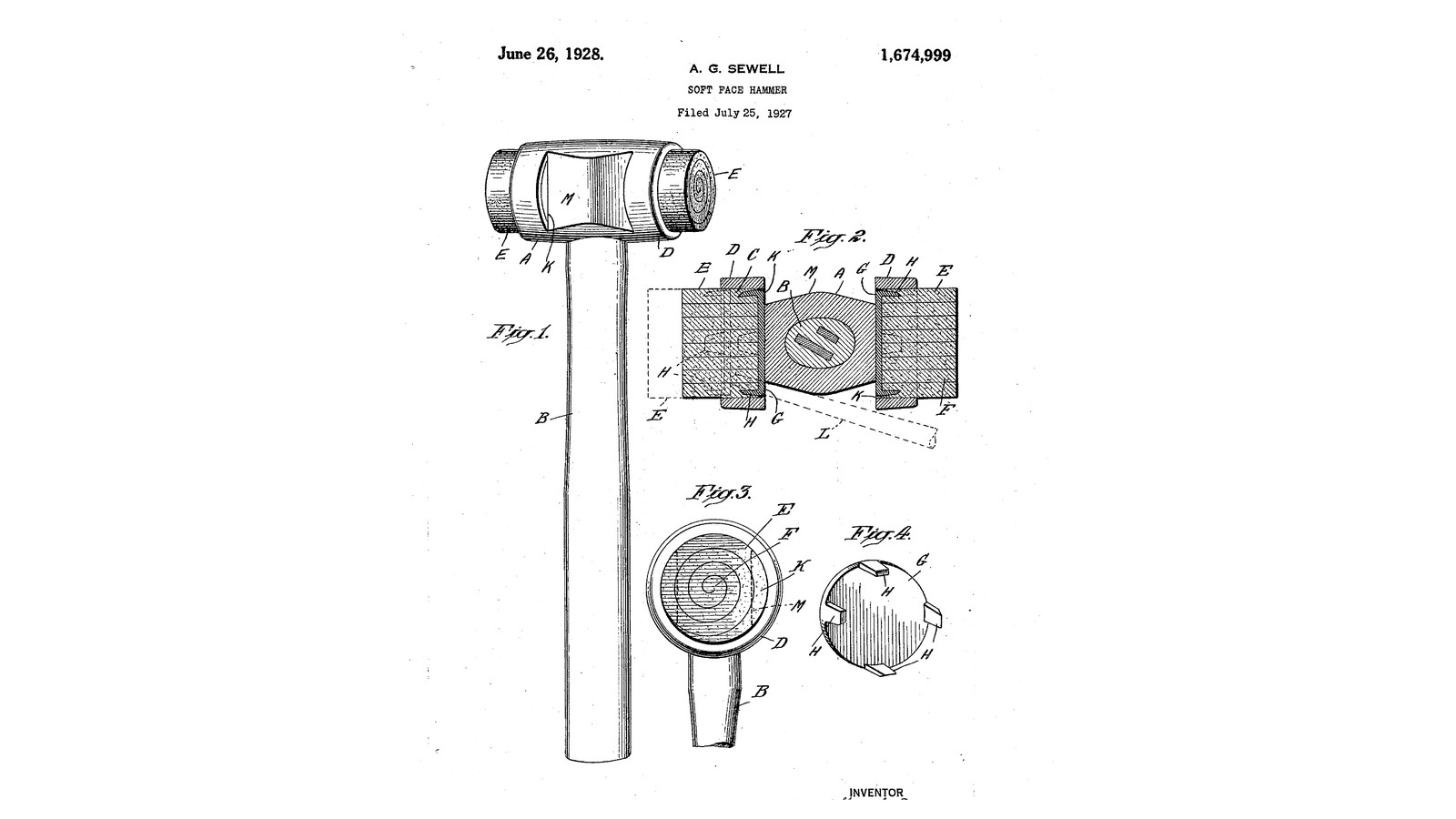


Renewable Rubber-Face Hammer: Rolled Faces Pressed Onto Pronged Discs, Driven Out Through a Notch When Worn (Sewell, 1928)
Albert G. Sewell received US 1,674,999, dated 26 June 1928, for a soft-face hammer whose worn faces can be renewed instead of throwing the hammer away. Each end of the head is a cup. A face rolled from a strip is pressed into the cup onto a loose sheet-metal disc whose prongs bite into it and wedge it tight. When a face is battered, a rod pushed through a notch at the bottom of the cup drives the disc and the face out together, and a new face goes in. He preferred rawhide and named rubber among face materials; ours are rolled from rubber sheet.
The patent gives no sizes; every size here is ours.
Miðlungs
About 1 day
Leiðbeiningar
1
1
Rolling a face plug
Rolling a face plug
Hleð Jupyter-vinnubók…
2
2
Read US 1,674,999
Read US 1,674,999
"Thus, by hammering or otherwise thrusting a rod or suitable device against the wedging member, the latter, with the striking face member, can be forced or driven out of the socket or recess, after which a new striking face member may be forced into the socket, to be secured therein by the wedging member."
3
3
Turn the head
Turn the head
Grip 40 mm steel round bar in the chuck and turn a head 110 mm long: the two ends stay 40 mm across for 26 mm as the flanges D, and the middle is waisted to 30 mm. Bore each end 32 mm across and 22 mm deep for the sockets C, flat at the bottom. Drill a 20 mm eye B through the middle, square to the axis, in a V-block on the drill press.
Efni fyrir þetta skref:
 Sívöl stöng úr mjúku stáli1 stykki
 Skurðarolía1 stykki
Nauðsynleg verkfæri:
 Málmrennibekkur
 Þríkjálka rennibekkspatróna
 Rennibekkjarstál
 Borstöng
 Fráskurðarjárn
 Súlubor
 V-kubbur
 Borasett
 Stafrænn skífmælir 6 tommur
 Öryggisgleraugu
4
4
Cut the notches K
Cut the notches K
On the handle's side of each flange, saw and file a notch 8 mm wide through the flange's wall at the very bottom of the socket, so a rod can be pushed in at a slant against the edge of the disc at the bottom.
Nauðsynleg verkfæri:
 Skrúfstykki
 Járnsög
 Þjalasett
 Körnunardorg
5
5
Pronged discs G
Pronged discs G
Cut two discs of 1.5 mm steel sheet 31.5 mm across. At four places round each rim, snip two cuts 6 mm deep 5 mm apart and bend the tab between them up at a right angle with the pliers: the prongs H. Drop one disc loosely into the bottom of each socket, prongs out.
Efni fyrir þetta skref:
 Plata úr mjúku stáli1 stykki
Nauðsynleg verkfæri:
 Plötuklippur
 FlatkjaftatöngSkrúfstykkiÞjalasett
6
6
Roll and press in the faces E
Roll and press in the faces E
Cut two strips of 3 mm natural rubber sheet 32 mm wide and about 270 mm long. Roll each tightly into a coil, trimming the strip until the coil just enters a socket, and tie it. Press the coil into its socket in the vice, between soft packing, until it bottoms on the disc and its prongs bite in, leaving the face standing about 10 mm out. Cut the tie and trim the face flat with the knife.
Efni fyrir þetta skref:
 Náttúrugúmmíplata1 stykki
Nauðsynleg verkfæri:
 FöndurhnífurSkrúfstykkiStafrænn skífmælir 6 tommur
7
7
Handle
Handle
Turn an ash handle 300 mm long, its end a tight fit in the eye. Saw a slot down its end, drive it into the eye, and glue and drive a hardwood wedge into the slot; saw it off flush.
Efni fyrir þetta skref:
 Harðviðarborð1 stykki
 Trélím1 stykki
Nauðsynleg verkfæri:
 Trérennibekkur
 Rennijárnasett (HSS)Járnsög
 Kúluhamar
8
8
Renew a face
Renew a face
When a face is worn, push a steel rod through the socket's notch against the disc's edge and tap it out with the hammer; the disc and the face come out together. Put the disc back, prongs out, and press in a new rolled face.
Nauðsynleg verkfæri:
KúluhamarSkrúfstykki9
9
Troubleshooting
Troubleshooting
Soft-face hammer troubleshooting.
Flow
Loading...
10
10
History and honest limits
History and honest limits
**Albert G. Sewell**, US 1,674,999, dated 26 June 1928, filed 25 July 1927. He describes a head with a socket at each end formed by annular flanges, a striking face member of relatively soft material rolled from a strip and pressed in as a plug, a loose sheet-metal wedging disc with prongs in the socket's bottom, and openings through which a rod drives the disc and face out. He preferred rawhide and his head was cast iron; ours is turned steel with faces rolled from rubber sheet, which he lists among the face materials in use. He gives no sizes; every size here is ours.
Efni
6- 1 stykkiStaðgengill
- 1 stykkiStaðgengill
- 1 stykkiStaðgengill
- 1 stykkiStaðgengill
- 1 stykkiStaðgengill
- 1 stykkiStaðgengill
Nauðsynleg verkfæri
20- Staðgengill
- Staðgengill
- Staðgengill
- Staðgengill
- Staðgengill
- Staðgengill
- Staðgengill
- Staðgengill
- Staðgengill
- Staðgengill
- Staðgengill
- Staðgengill
- Staðgengill
- Staðgengill
- Staðgengill
- Staðgengill
- Staðgengill
- Staðgengill
- Staðgengill
- Staðgengill
Þessi teikning býr til

Tengd Blueprint
Þessi blueprint deila þekkingu — tækni, efni eða meginreglur
CC0 opinbert ríki
Þessi teikning er gefin út undir CC0. Þér er frjálst að afrita, breyta, dreifa og nota þetta verk í hvaða tilgangi sem er, án þess að biðja um leyfi.
Studdu smiðinn með því að kaupa vörur í gegnum teikningu hans þar sem hann fær þóknun smiða sem seljendur ákvarða, eða búðu til nýja endurskoðun á þessari teikningu og tengdu hana sem tengingu í þinni eigin teikningu til að deila tekjum.