

Sheet Polariser
Polarised light was well understood by 1929, and almost unusable. To polarise a beam you needed a Nicol prism — two pieces of optical-quality Iceland spar calcite, cut at a precise angle and cemented. Good calcite is rare, the prisms are small, and the aperture is a few centimetres at best. You could put one on a laboratory bench. You could not put one in a pair of sunglasses, a camera, or a car windscreen.
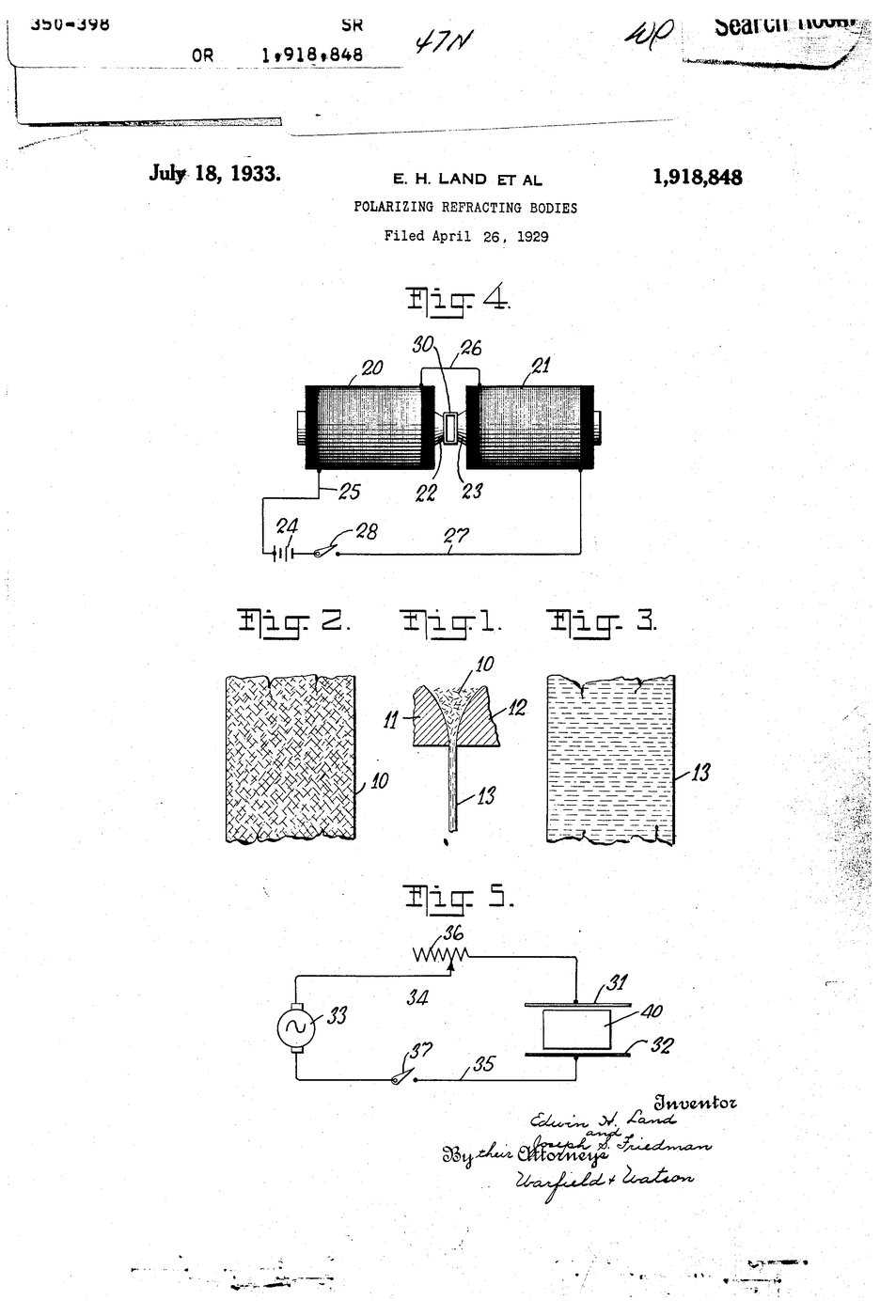
Land's insight is to stop looking for one big crystal and use billions of tiny ones. Suspend needle-shaped dichroic crystals in a liquid plastic, drag the whole mass through a die so shear force lines the needles up in one direction, then set the plastic. Every crystal absorbs one polarisation; aligned, they all absorb the same one — and the sheet can be any size you can extrude.
US Patent 1,918,848, "Polarizing Refracting Bodies", filed 26 April 1929 and granted 18 July 1933 to Edwin H. Land AND Joseph S. Friedman — two names, not one.
Leiðbeiningar
Read US 1,918,848 and note there are two inventors
Read US 1,918,848 and note there are two inventors
The document names Edwin H. Land and Joseph S. Friedman. Land is almost always credited alone — check the inventor field yourself.
Model polarisation with a rope and a slot
Model polarisation with a rope and a slot
Shake a rope through a slotted board. Vertical waves pass; horizontal waves are blocked. A polariser is a slot for light, and this is the whole idea in one object.
Add a second slot at right angles
Add a second slot at right angles
Put a second slotted board after the first, turned 90°. Nothing gets through. Two crossed polarisers behave identically, and you have just predicted the result.
Cross two commercial polarising filters
Cross two commercial polarising filters
Hold one filter over another and rotate. Bright, dim, black, dim, bright, over a half turn. Record the angles where it goes dark.
Nauðsynleg verkfæri:
 Skautunarsíuörk
Confirm the period is 180°, not 360°
Confirm the period is 180°, not 360°
Rotate a full turn and count the dark positions. There are two. A polariser has an axis, not a direction — it does not know up from down.
Scatter needles at random in glue
Scatter needles at random in glue
Stir short fibres or needle-shaped flakes into clear glue and let them settle randomly. Look through it. Nothing is polarised — the particles are the right shape and the wrong arrangement.
Efni fyrir þetta skref:
 PVA-trélím1 stykki
Drag the same mixture through a narrow gap
Drag the same mixture through a narrow gap
Squeeze the wet mixture between two straight edges in one direction. The needles swing to lie along the flow. Shear is what does the aligning, exactly as the patent's extrusion method claims.
Let it set without disturbing it
Let it set without disturbing it
Dry the sheared film flat. Once the medium hardens, the alignment is locked in permanently — the patent's phrase is that it retains its properties "independent of external support".
Compare the two films under crossed filters
Compare the two films under crossed filters
Put the random film and the sheared film between two crossed polarisers. The aligned one changes what gets through as you rotate it; the random one does not.
Find the polarisation in reflected light
Find the polarisation in reflected light
Look at glare off a table or a puddle through one filter and rotate it. The glare dims at one angle. Reflection polarises light by itself — this is why polarised sunglasses work.
Look at a patch of clear blue sky
Look at a patch of clear blue sky
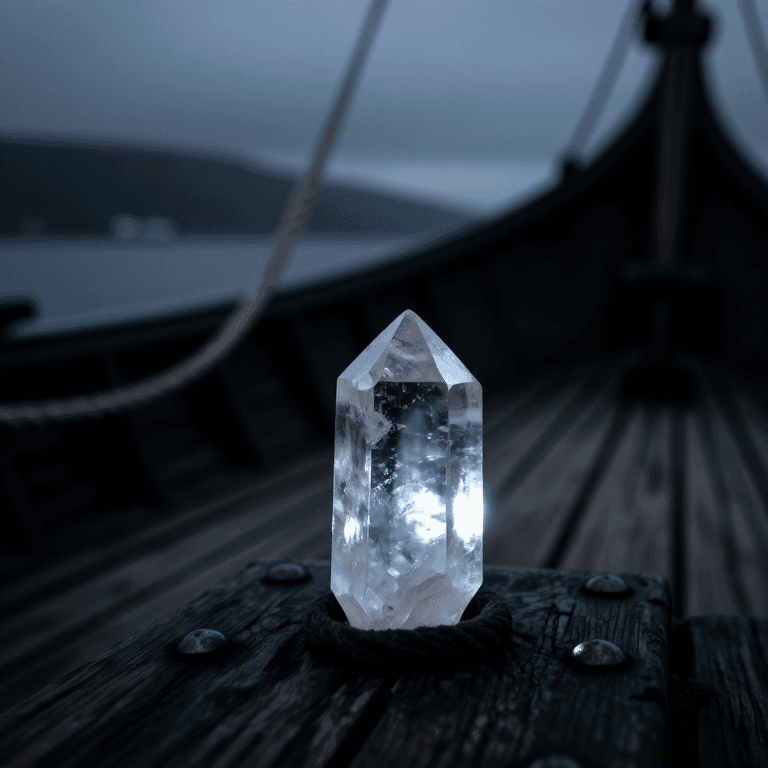
Rotate a filter against blue sky 90° from the sun. It brightens and darkens. Scattered skylight is partly polarised — and this is the effect the Viking sunstone exploits.
Put stressed clear plastic between crossed filters
Put stressed clear plastic between crossed filters
Bend a clear plastic ruler between two crossed filters. Coloured fringes appear where the material is stressed — a free stress-analysis tool that only exists because sheet polarisers are cheap.
Work out why size was the problem
Work out why size was the problem
Measure your filter. Now imagine cutting that aperture from a single flawless calcite crystal. The patent is a manufacturing patent, not a discovery about light.
History & Context — a manufacturing answer to an optics problem
History & Context — a manufacturing answer to an optics problem
The patent. US 1,918,848, "Polarizing Refracting Bodies", filed 26 April 1929 and granted 18 July 1933 to Edwin H. Land and Joseph S. Friedman.
🔴 Two inventors, and the second is routinely erased. Land founded Polaroid, became famous, and is credited with sheet polarisers alone in almost every retelling. Joseph S. Friedman is on this document with him. This is the third consecutive batch in this programme where a celebrated invention turns out to have a second name on the patent — Rice and Kellogg, Beauchamp and Rickenbacker, now Land and Friedman. The pattern is consistent enough to be a rule: when a famous invention has a famous single owner, read the inventor field.
The crystals were not new either. Herapathite — iodoquinine sulfate — was described by William Bird Herapath in 1852, and its strong dichroism, absorbing one polarisation far more than the other, was known from the start. The obstacle was that herapathite grows as tiny needles and nobody could produce a crystal large enough to be a useful window. Land's contribution is not the material and not the physics: it is the realisation that a large number of small aligned crystals behaves like one large crystal, plus three practical ways to align them — mechanical shear through a die, a magnetic field of at least 10,000 gauss, or a high-voltage alternating electric field. Steps 6 and 7 are that idea reduced to glue and a straight edge.
He was nineteen when he started. Land began this work as a Harvard undergraduate, left without finishing, and filed the application at twenty. Polaroid's first products were not cameras but polarising filters — for sunglasses, camera lenses, and a long, unsuccessful campaign to persuade car makers to fit polarised headlamps and windscreens so oncoming headlight glare would be cancelled. The optics were sound; the coordination problem of getting every car changed at once was not solvable.
What cheap polarisers made possible. Almost everything in steps 10 to 12. Glare-cutting sunglasses and photographic filters are the obvious ones. Photoelasticity — reading stress in a transparent model from its colour fringes — became an ordinary engineering technique. And every liquid-crystal display works by placing a controllable twisting layer between two crossed polarisers, so the screen you are most likely reading this on contains two direct descendants of this patent, one on each side of the pixels.
Efni
1- 1 stykkiStaðgengill
Nauðsynleg verkfæri
1- Staðgengill
Tengd Blueprint
Þessi blueprint deila þekkingu — tækni, efni eða meginreglur

CC0 opinbert ríki
Þessi teikning er gefin út undir CC0. Þér er frjálst að afrita, breyta, dreifa og nota þetta verk í hvaða tilgangi sem er, án þess að biðja um leyfi.
Studdu smiðinn með því að kaupa vörur í gegnum teikningu hans þar sem hann fær þóknun smiða sem seljendur ákvarða, eða búðu til nýja endurskoðun á þessari teikningu og tengdu hana sem tengingu í þinni eigin teikningu til að deila tekjum.