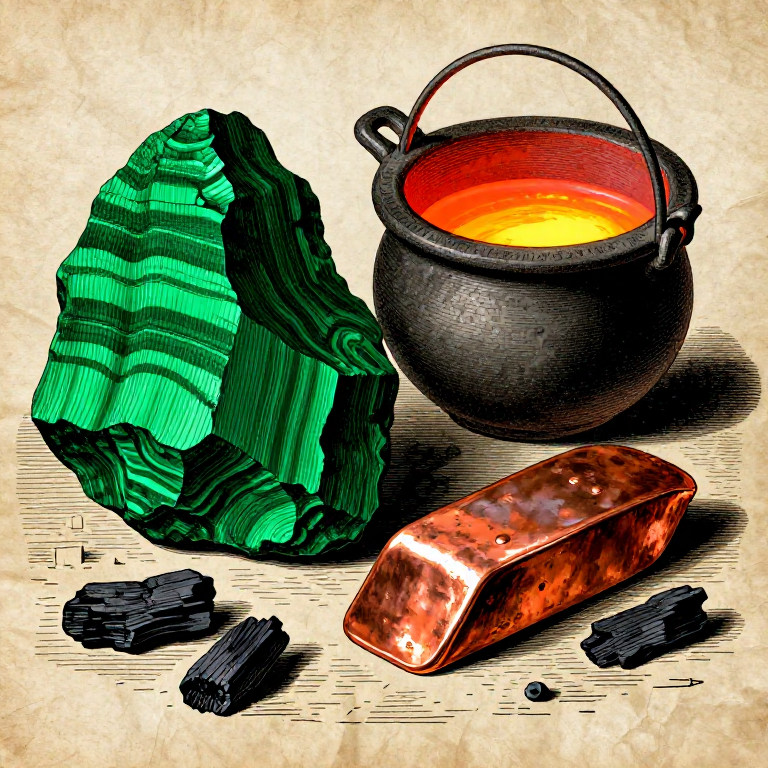
Bræðsla kopars úr málakít — Frá grænum málmi til rauðs málms
Leiðbeiningar
Skildu efnafræðina
Skildu efnafræðina
Malakít sundurleysist við upphitun: Cu₂CO₃(OH)₂ → 2CuO + CO₂ + H₂O (við ~300°C). Koparoxíðið (CuO) sem myndast er síðan afoxað af kolmonoxíði frá brennandi viðarkoli: CuO + CO → Cu + CO₂. Kopar bráðnar við 1085°C. Heildarkoparafköst úr hreinu malakíti er um það bil 57,5%.
Muldu malakítið
Muldu malakítið
Brjóttu malakít í bita minni en 1 cm með hamri og steðja. Því finni sem mulningin er, þeim mun hraðari og fullkomnari verður afoxunin. Notaðu mortel og stautu til lokamulnings ef til staðar. Stefndu á baunastóra eða smærri bita.
Efni fyrir þetta skref:
 Malakítgrýti2 kilogram
Nauðsynleg verkfæri:
 Jarðfræðihamar
 Mortél og mortélstautur
Undirbúðu bræðsluskálina
Undirbúðu bræðsluskálina
Notaðu leirbræðsluskál sem þolir 1200°C+. Grafít-leirbræðsluskál er tilvalin. Bræðsluskálin ætti að rúma að minnsta kosti 500 ml. Ef þú smíðar sjálfur, blandaðu eldföstu leiri við sand (2:1 hlutfall) og brenndu hana hægt í ofni upp í 1000°C áður en hún er notuð. Forbrenndar bræðsluskálar springa sjaldnar.
Efni fyrir þetta skref:
 Deigla úr eldföstum leir1 stykki
Layer ore and charcoal in the crucible
Layer ore and charcoal in the crucible
Place a 2 cm layer of charcoal pieces at the bottom of the crucible. Add a layer of crushed malachite (2-3 cm). Top with another layer of charcoal. The charcoal both provides carbon for reduction and protects the copper from re-oxidation. Fill to about 2/3 full.
Efni fyrir þetta skref:
 Viðarkol5 kilogram
Build or prepare the forge
Build or prepare the forge
You need a forge or furnace capable of reaching 1100-1200°C. A simple charcoal forge with forced air (bellows or blower) works well. The crucible sits in a bed of burning charcoal with additional charcoal piled around and above it. The air supply must be controllable.
Efni fyrir þetta skref:
 Viðarkolaskífa20 kilogram
Nauðsynleg verkfæri:
 Smiðjubelgur
Put on safety equipment
Put on safety equipment
Copper smelting involves extreme heat, toxic fumes, and molten metal. Wear: leather apron, leather gauntlet gloves, face shield, safety boots (no synthetic materials). Work outdoors or in a well-ventilated space. Copper oxide fumes cause metal fume fever if inhaled. Keep a bucket of dry sand nearby for spill containment.
Nauðsynleg verkfæri:
 Leðursvunta
 Leðurhanskar með löngum stúkum
 Andlitshlíf
 Fata með þurrum sandi
Light the forge and preheat
Light the forge and preheat
Light the forge charcoal and bring it to full heat over 30-45 minutes with gentle bellows action. Place the loaded crucible into the forge once the coals are glowing white-hot. Pack charcoal tightly around the crucible. Increase bellows speed gradually.
Maintain temperature for 2-3 hours
Maintain temperature for 2-3 hours
Keep the forge at 1100-1200°C for 2-3 hours. The malachite first decomposes (green changes to black CuO at ~300°C), then the CuO reduces to copper as temperature climbs. Add charcoal to the forge as needed to maintain heat. The crucible contents will shrink as CO₂ gas escapes.
Check for completion
Check for completion
After 2-3 hours, carefully lift the crucible lid with tongs and peek inside. You should see a bright orange-red pool of molten copper beneath a layer of slag (glassy dark material). If you see unmelted green or black chunks, continue heating for another 30 minutes.
Nauðsynleg verkfæri:
 Langskefta töng
Prepare the ingot mold
Prepare the ingot mold
While the copper melts, prepare a sand mold or a flat stone depression for pouring. Preheat the mold with a torch to prevent thermal shock cracking. A simple bar-shaped mold carved into a sandstone block works well. Ensure the mold is completely dry — any moisture causes explosive splattering of molten metal.
Nauðsynleg verkfæri:
 Stangamót úr sandsteini
Pour the copper
Pour the copper
Using crucible tongs, lift the crucible from the forge. Tilt slowly to pour molten copper into the mold. The dark glassy slag floats on top and can be held back with a stick while the copper flows under it. Pour steadily — interrupted pours create cold shuts (weak seams).
Nauðsynleg verkfæri:
 Deiglutöng
Let the ingot cool
Let the ingot cool
Allow the copper ingot to cool in the mold for at least 30 minutes. Do not quench in water — rapid cooling makes copper brittle with internal stresses. Air cooling produces a softer, more workable metal. The copper surface oxidizes to a dark red-brown as it cools.
Remove and clean the ingot
Remove and clean the ingot
Once cool enough to handle (below 100°C), remove the ingot from the mold. Brush off adhering sand and slag with a wire brush. The ingot should have the characteristic salmon-pink color of fresh copper on freshly exposed surfaces. Any dark patches are trapped slag or oxide inclusions.
Nauðsynleg verkfæri:
 Vírburstasett
Weigh and assess yield
Weigh and assess yield
Weigh the clean copper ingot. From 2 kg of good malachite ore, expect 800-1000 g of copper (40-50% yield, accounting for slag losses and impurities). Pure malachite would yield 1150 g, but field-collected ore is rarely pure. Record the yield for future optimization.
Nauðsynleg verkfæri:
 Stafræn eldhúsvog
Test the copper quality
Test the copper quality
Hammer the edge of the ingot on an anvil. Good copper deforms plastically without cracking — it is one of the most malleable metals. If it cracks, it contains too much slag or oxide. File a small area to expose fresh metal — pure copper is salmon-pink. A green tinge indicates incomplete reduction.
Nauðsynleg verkfæri:
 Málmþjöl
Store the copper ingot
Store the copper ingot
Copper oxidizes slowly in air (forming green patina over months). For short-term storage, keep dry. For long-term, coat with a thin layer of oil. Label with date, source ore, and weight. This copper is ready for casting, hammering into sheet, or alloying with tin to make bronze.
Efni
4- 2 kilogramStaðgengill
- 1 stykkiStaðgengill
- 5 kilogramStaðgengill
- 20 kilogramStaðgengill
Nauðsynleg verkfæri
15- Staðgengill
- Staðgengill
- Staðgengill
- Staðgengill
- Staðgengill
- Staðgengill
- Staðgengill
- Staðgengill
- Staðgengill
- Staðgengill
- Staðgengill
- Staðgengill
- Staðgengill
- Staðgengill
Efni úr tengdum teikningum
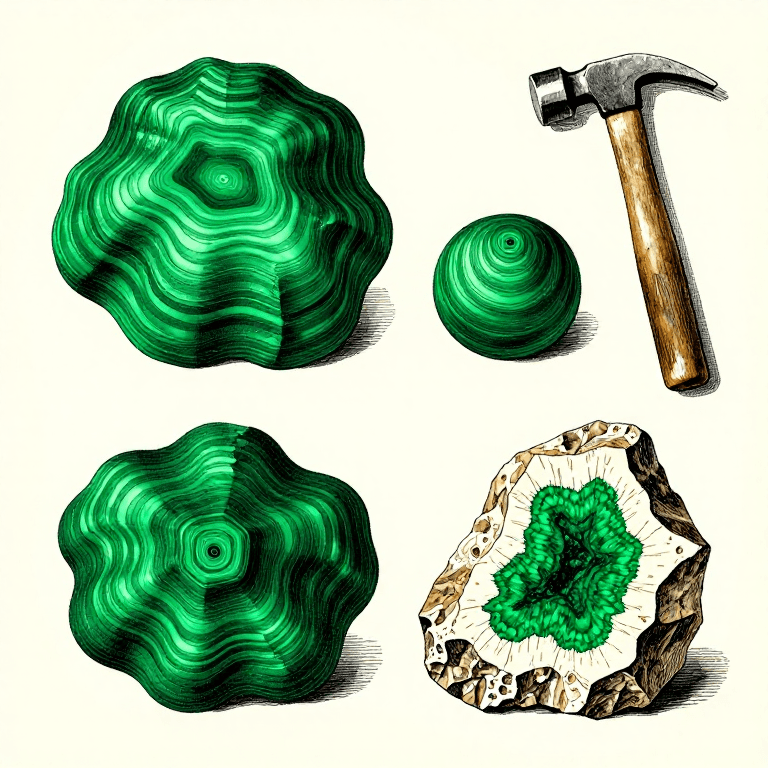
Identifying and Collecting Malachite — Copper Carbonate Ore from the Earth
eftir Peter
Málmsmíði
Recovering Selenium from Copper Refinery Anode Slime — The Photoconductor That Sees Light
eftir Peter
Námuvinnsla
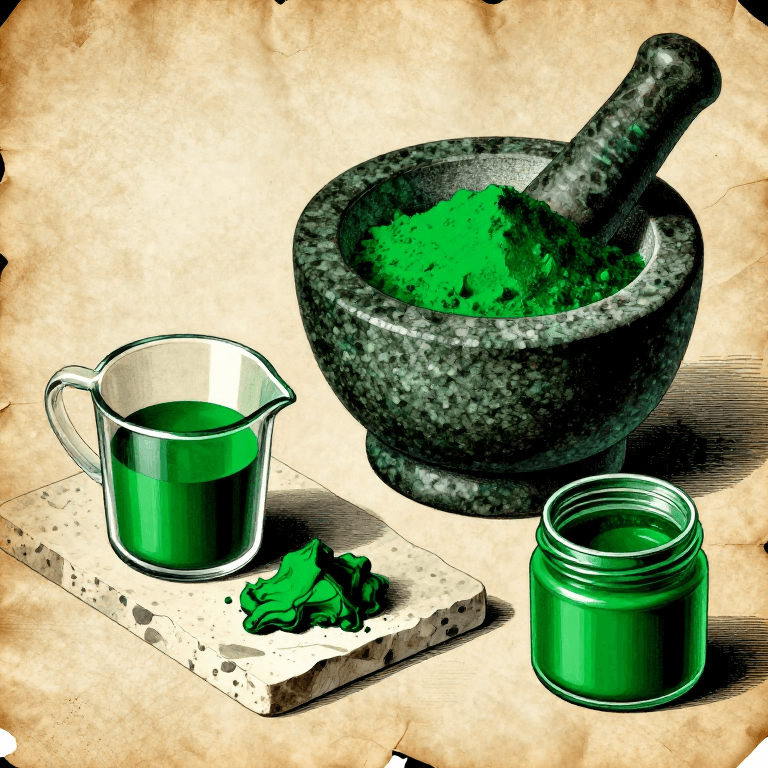
Making Malachite Green Pigment — Grinding the Copper Mineral into Painter's Green
eftir Charlie
LIST
Þessi teikning býr til

Tengd Blueprint
Þessi blueprint deila þekkingu — tækni, efni eða meginreglur
CC0 opinbert ríki
Þessi teikning er gefin út undir CC0. Þér er frjálst að afrita, breyta, dreifa og nota þetta verk í hvaða tilgangi sem er, án þess að biðja um leyfi.
Studdu smiðinn með því að kaupa vörur í gegnum teikningu hans þar sem hann fær þóknun smiða sem seljendur ákvarða, eða búðu til nýja endurskoðun á þessari teikningu og tengdu hana sem tengingu í þinni eigin teikningu til að deila tekjum.