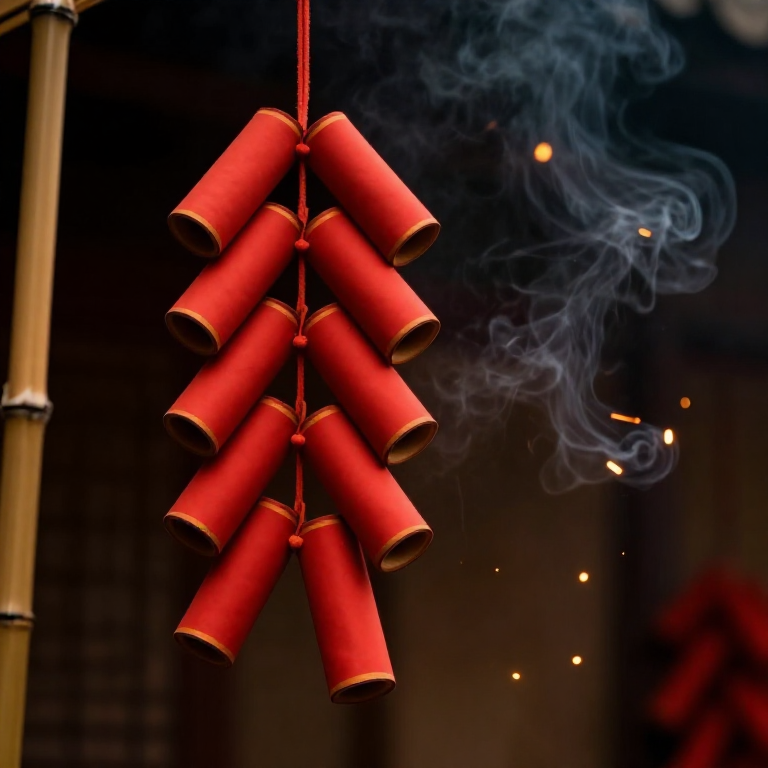


Making Song Dynasty Fireworks — Bamboo Firecrackers and Ground Salutes
Chinese fireworks (烟花, yānhuā — literally 'smoke flowers') evolved alongside military gunpowder applications during the Song dynasty (960-1279 AD). While soldiers were building fire lances and fire arrows, festival organizers discovered that stuffing black powder into sealed bamboo tubes produced spectacular explosions of noise, light, and colored sparks — terrifying evil spirits and delighting crowds.
The earliest firecrackers were literally that: sections of green bamboo thrown into bonfires. The moisture trapped inside the bamboo nodes would boil and burst the tube with a sharp crack — 'bao zhu' (爆竹, exploding bamboo). When gunpowder became available, artisans began filling dried bamboo tubes with black powder and sealing both ends, creating far more powerful explosions. By the 12th century, Chinese pyrotechnicians had developed ground salutes (ground-level crackers strung together on a fuse), aerial shells launched from mortars, and colored spark compositions using iron filings for gold sparks and copper compounds for blue-green effects.
Marco Polo described Chinese fireworks displays with astonishment when he visited the Yuan court around 1275 AD. The technology spread westward along the Silk Road, reaching the Arab world by the 13th century and Europe by the 14th century. Today, China still produces over 90% of the world's fireworks — a craft tradition spanning more than a thousand years from those first bamboo tubes packed with black powder in Song dynasty workshops.
Hættulegt efni
Þessi teikning inniheldur hættulegar aðferðir. Skráðu þig inn og virkjaðu hættulegt efni í stillingum reikningsins til að sjá skref-fyrir-skref leiðbeiningar.
Skrá innÞessi teikning býr til
Tengd Blueprint
Þessi blueprint deila þekkingu — tækni, efni eða meginreglur

CC0 opinbert ríki
Þessi teikning er gefin út undir CC0. Þér er frjálst að afrita, breyta, dreifa og nota þetta verk í hvaða tilgangi sem er, án þess að biðja um leyfi.
Studdu smiðinn með því að kaupa vörur í gegnum teikningu hans þar sem hann fær þóknun smiða sem seljendur ákvarða, eða búðu til nýja endurskoðun á þessari teikningu og tengdu hana sem tengingu í þinni eigin teikningu til að deila tekjum.