Samvinna
LIST
FEGURÐ OG VELLÍÐAN
HANDVERK
MENNING OG SAGA
SKEMMTUN
UMHVERFI
MATUR OG DRYKKUR
ÖFUGVERKFRÆÐI
VÍSINDI
ÍÞRÓTTIR
TÆKNI
KLÆÐANLEG TÆKNI
English


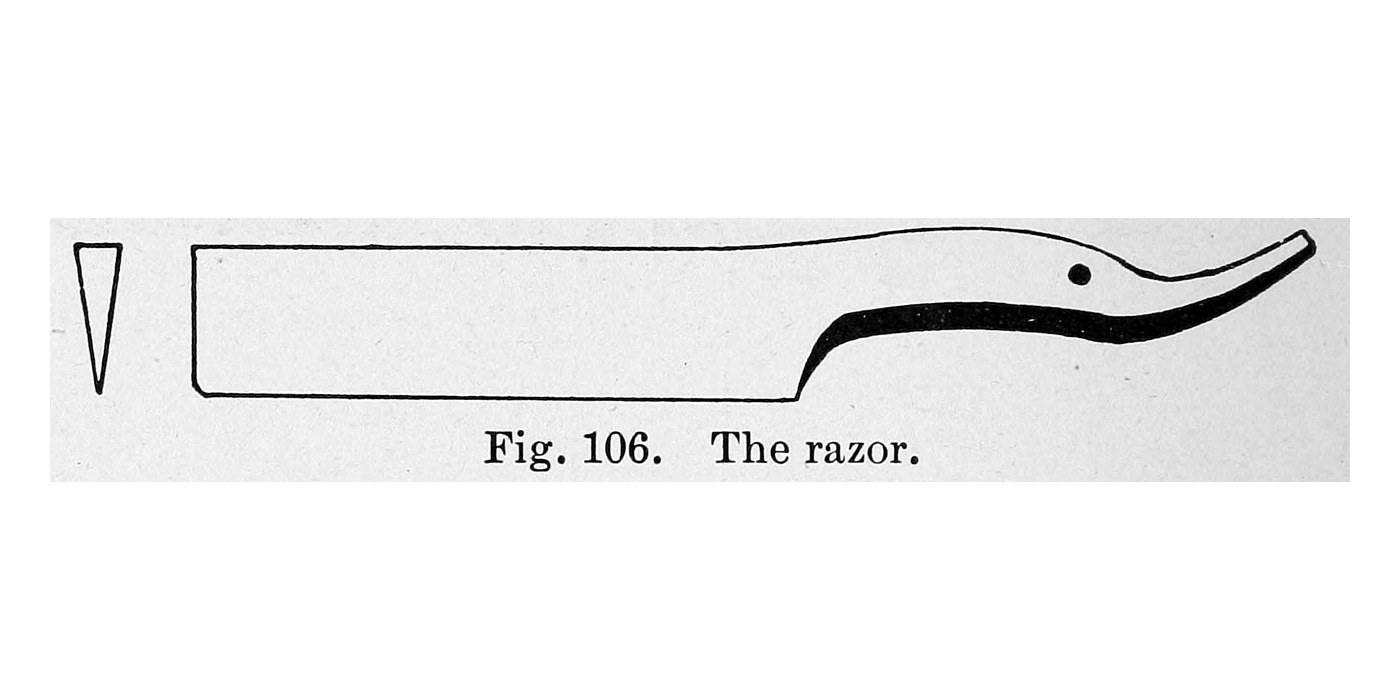
Straight Razor: a Blade Forged from 75-Point Carbon Steel and Hollow Ground (Holford, 1907)
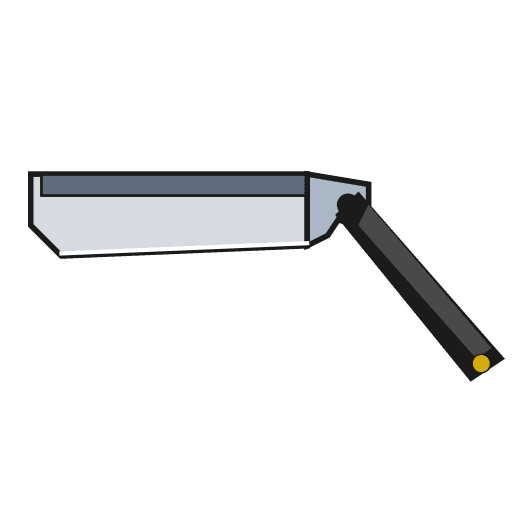
A straight razor forged by hand. Frederick Holford's 20th Century Toolsmith (1907) takes steel 3/16 by 7/16 inch of about 0.75 % carbon, fullers the shank for the finger hold, bends the blade a little edgewise and then forges, hammers and hardens it the way he makes butcher knives, drawing the temper to purple. The razor is hollow ground after tempering, by an expert, without drawing the temper; made so, he says, it "will hold a very keen edge, which will equal any razor manufactured".
He gives no blade length and does not describe the scales or the pivot; those are unknown here.
Source: F. J. Holford, The 20th Century Toolsmith and Steelworker (1907), p. 176 (razor), pp. 80-82 (butcher knives, for forging and hardening), p. 21 (the hardening bath). Picture: his Fig. 106.
Lengra kominn
A day
Leiðbeiningar
1
1
Read Holford
Read Holford
"To make an ordinary razor use steel 3-16 by 7-16 of about 75 points carbon."
2
2
Fuller the shank and shape
Fuller the shank and shape
Fuller the shank in a little for the finger hold and forge it to shape, then form the blade by bending the steel a little edgewise (Fig. 106). The blade length is not given (unknown).
Efni fyrir þetta skref:
 Flatt verkfærastál1 bar, 3/16 x 7/16 in
Nauðsynleg verkfæri:
 Aflinn
 Steðji
 Járnsmiðshamar
 Fuller (rásarjárn)
 Járnsmiðstöng
 Óþekkt mál
3
3
Draw the edge and pack the steel
Draw the edge and pack the steel
As for a butcher knife: at a deep red heat draw the edge thin, hammering evenly from both sides on the inside of the bend, until the bend has come out and the blade is straight. Then at a very low heat hammer equally on both flat sides of the edge to refine and pack the steel; heat again to the same low heat and hammer the centre of the blade, both sides evenly, its full length. Cool and file the edges straight.
Nauðsynleg verkfæri:
AflinnSteðjiJárnsmiðshamar Málmþjöl
4
4
Harden
Harden
Make the fire long so more of the blade heats at once. Put the blade in edge down and move it back and forth for an even heat along its length, just hot enough to harden. Plunge it lengthwise, edge down, into the hardening bath (Holford p. 21: clean water, best made a brine with as much salt as it will dissolve, large and cold) and cool entirely.
Nauðsynleg verkfæri:
AflinnJárnsmiðstöng Mettuð saltlausn
 Hitaþolnir hanskar
5
5
Temper to purple
Temper to purple
Brighten one side. Hold the blade flat about 2 inches above the fire, bright side up, never on the coals, and heat it very slowly, moving it back and forth for an even temper, until the bright side shows purple.
Nauðsynleg verkfæri:
 SmergildúkurAflinn
6
6
Hollow grind and hone
Hollow grind and hone
Hollow grind the blade after tempering, taking care never to draw the temper while grinding; Holford says this should be done by an expert. Then hone the edge.
Nauðsynleg verkfæri:
 Brýnsluhjól
 Brýni
7
7
Scales
Scales
A straight razor folds into a pair of scales on a pivot through the hole in the shank (Fig. 106). Holford does not describe the scales or the pivot; their material and making are unknown here.
Efni fyrir þetta skref:
 Óþekktur efniviður1 scales and pivot
8
8
History and honest limits
History and honest limits
Holford's razor uses the same steel as his butcher knives and harnessmaker's knife, about 0.75 % carbon, but a harder temper: purple instead of the knives' blue.
Blade length, scales and pivot are not given; a flat tool steel bar stands for the 3/16 by 7/16 inch bar of 0.75 % carbon steel.
Efni
2- 1 bar, 3/16 x 7/16 inStaðgengill
- 1 scales and pivotStaðgengill
Nauðsynleg verkfæri
12- Staðgengill
- Staðgengill
- Staðgengill
- Staðgengill
- Staðgengill
- Staðgengill
- Staðgengill
- Staðgengill
- Staðgengill
- Staðgengill
- Staðgengill
- Staðgengill
Þessi teikning býr til
CC0 opinbert ríki
Þessi teikning er gefin út undir CC0. Þér er frjálst að afrita, breyta, dreifa og nota þetta verk í hvaða tilgangi sem er, án þess að biðja um leyfi.
Studdu smiðinn með því að kaupa vörur í gegnum teikningu hans þar sem hann fær þóknun smiða sem seljendur ákvarða, eða búðu til nýja endurskoðun á þessari teikningu og tengdu hana sem tengingu í þinni eigin teikningu til að deila tekjum.