LIST
FEGURÐ OG VELLÍÐAN
HANDVERK
MENNING OG SAGA
SKEMMTUN
UMHVERFI
MATUR OG DRYKKUR
ÖFUGVERKFRÆÐI
VÍSINDI
ÍÞRÓTTIR
TÆKNI
KLÆÐANLEG TÆKNI
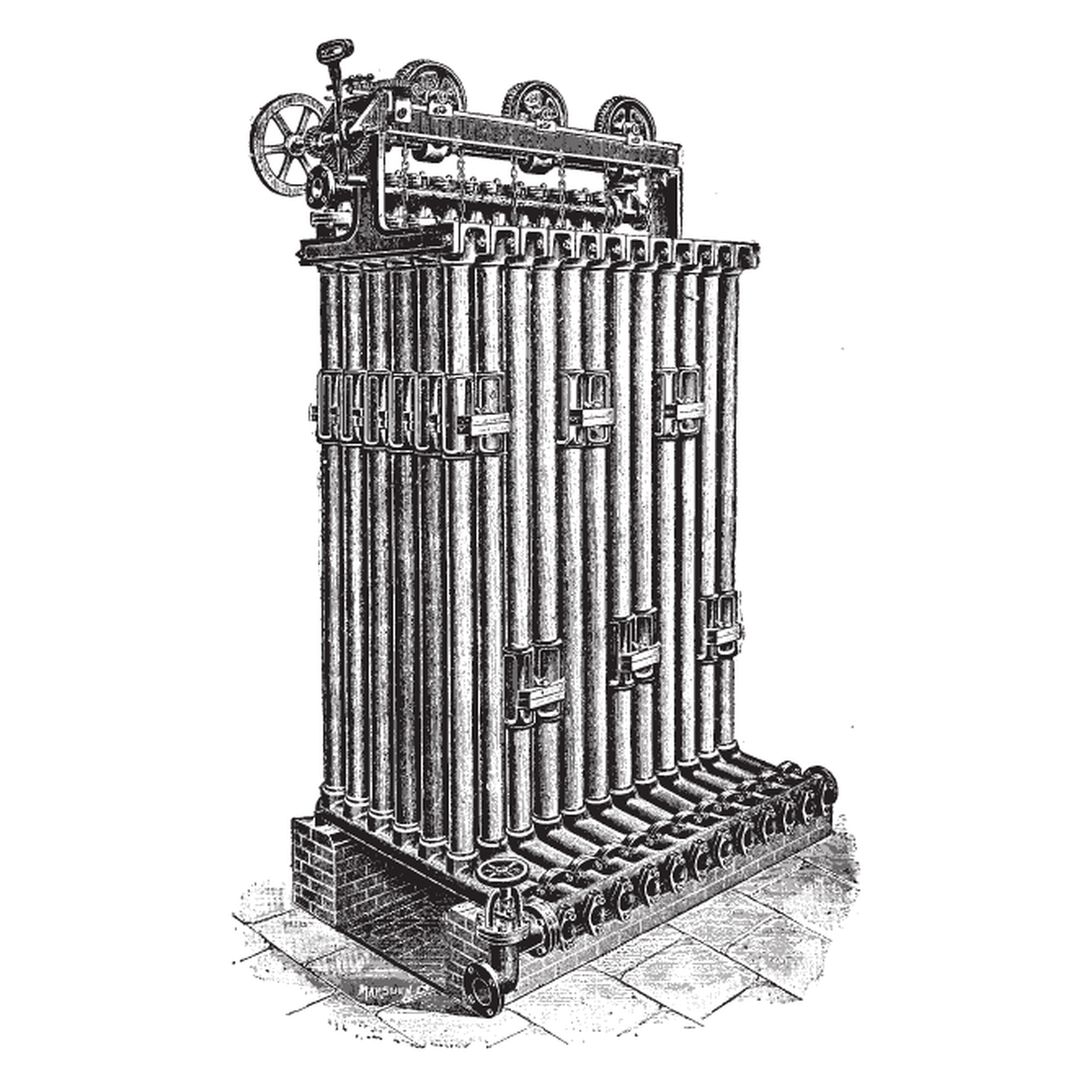


The Economiser: The Heat Still Going Up the Chimney
Even a good boiler sends its flue gas up the chimney hot. Edward Green's economiser of 1845 put a bank of cast-iron tubes in the flue and ran the cold feed water through them on its way to the boiler, so the gas that was leaving anyway warmed the water that was arriving anyway. His tubes carried mechanical scrapers that travelled up and down them to keep the soot off, because a sooted tube is an insulated tube.
The same idea is in every modern condensing boiler, which cools its flue gas until the water vapour in it condenses and gives up its latent heat too.
This rung works out how much heat the stack carries away, measures a real flue, and finds the dew point below which an economiser starts to run wet.
Miðlungs
About 3 hours
Leiðbeiningar
1
1
Stack loss and the dew point
Stack loss and the dew point
Hleð Jupyter-vinnubók…
2
2
Measure a real flue
Measure a real flue
Find a flue you are allowed to measure: a wood stove's stove pipe, a workshop heater, the test port of a gas boiler (ask whoever services it). Strap the thermocouple tip against the flue pipe with a hose clip a metre above the appliance, and log it every minute from a cold start to steady running. Measure the room air too.
The pipe surface reads lower than the gas inside, so this is a floor under the true stack temperature. Put it into the notebook's table: even the floor usually shows several per cent of the fuel leaving as heat.
Never block, puncture or restrict a working flue. Flue gas contains carbon monoxide.
Nauðsynleg verkfæri:
 Hitanemapar með aflestri
 Eldhúshitamælir
 Skeiðklukka
 Skiptilykill
 Vinnuhanskar úr leðri
 Slönguklemmusafn
3
3
The feed water gets the heat, not the room
The feed water gets the heat, not the room
An economiser is a counterflow heat exchanger (rung 5 of this batch explains why counterflow): the coldest water meets the coolest gas at the chimney end, and the warmest water meets the hottest gas at the boiler end. That is how it cools the gas as far as it does.
It sits between the feed pump and the boiler, so it runs at boiler pressure; a check valve and a safety valve protect it. Green's tubes were cast iron, with scraper gear travelling up and down them to deal with the soot.
4
4
The flue runs hotter than it should: find out why
The flue runs hotter than it should: find out why
A rising stack temperature is fuel going up the chimney. The usual causes, in order.
Flow
Loading...
5
5
History and context
History and context
**Edward Green of Wakefield, 1845** — the fuel economiser, cast-iron vertical tubes in the flue with mechanical scrapers. It spread through the mills of northern England and the name stuck to the whole class of flue-gas feed-water heaters. No patent number is asserted here.
Its descendants are the economiser bank in every power-station boiler, the air preheater (rung 7 of this batch), and the condensing domestic boiler.
**Honest limits.** An economiser adds resistance to the flue, so a natural-draught chimney may need a fan. Cooled below the dew point it condenses, and with sulphur fuels the condensate is acid. And a sooted or scaled economiser saves nothing.
Nauðsynleg verkfæri
6- Staðgengill
- Staðgengill
- Staðgengill
- Staðgengill
- Staðgengill
- Staðgengill
Tengd Blueprint
Þessi blueprint deila þekkingu — tækni, efni eða meginreglur


CC0 opinbert ríki
Þessi teikning er gefin út undir CC0. Þér er frjálst að afrita, breyta, dreifa og nota þetta verk í hvaða tilgangi sem er, án þess að biðja um leyfi.
Studdu smiðinn með því að kaupa vörur í gegnum teikningu hans þar sem hann fær þóknun smiða sem seljendur ákvarða, eða búðu til nýja endurskoðun á þessari teikningu og tengdu hana sem tengingu í þinni eigin teikningu til að deila tekjum.