LIST
FEGURÐ OG VELLÍÐAN
HANDVERK
MENNING OG SAGA
SKEMMTUN
UMHVERFI
MATUR OG DRYKKUR
ÖFUGVERKFRÆÐI
VÍSINDI
ÍÞRÓTTIR
TÆKNI
KLÆÐANLEG TÆKNI
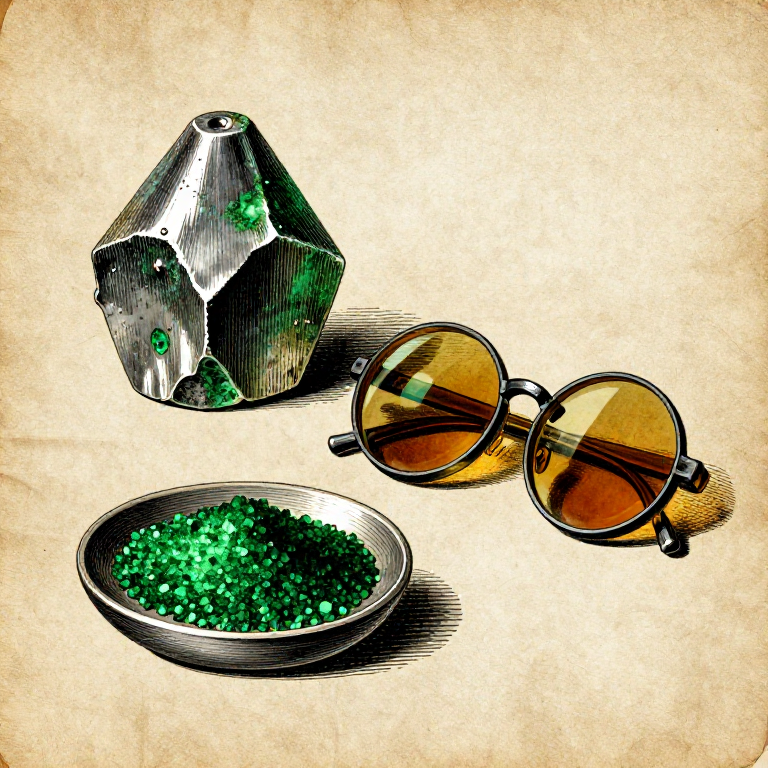

Understanding Praseodymium from Monazite — The Green Twin That Colors Glass
Miðlungs
Leiðbeiningar
1
1
Understand the Didymium Separation
Understand the Didymium Separation
Carl Auer von Welsbach separated praseodymium from neodymium in 1885 after 40 years of failed attempts by other chemists. What Mosander had called 'didymium' (twin element) in 1841 was actually two elements so similar that ordinary chemical methods could not distinguish them. Von Welsbach used repeated fractional crystallization of double ammonium nitrate salts — over 100 recrystallizations — to obtain green praseodymium and pink neodymium salts.
2
2
Identify Praseodymium in Rare Earth Ores
Identify Praseodymium in Rare Earth Ores
Praseodymium comprises 4-5% of light rare earth concentrates from bastnasite and monazite — always accompanying cerium, lanthanum, and neodymium. Its name comes from Greek 'prasios' (green) and 'didymos' (twin) because Pr³⁺ salts are distinctly green, while Nd³⁺ salts are pink-violet. In solvent extraction cascades, praseodymium separates between lanthanum and neodymium. Annual production is approximately 7,000 tonnes of praseodymium oxide.
Efni fyrir þetta skref:
 Mónasítsýni
Nauðsynleg verkfæri:
 Handstækkunargler 10xHandstækkunargler 10x
 Rispuplata (óglerjað postulín)
 Mohs-hörkunálar
3
3
Examine Praseodymium Metal Properties
Examine Praseodymium Metal Properties
Praseodymium is a soft, silvery metal that develops a distinctive green oxide coating in air — the only lanthanide whose oxide is green rather than white. Melting point is 931°C, density 6.77 g/cm³. Praseodymium has a double-hexagonal close-packed crystal structure (DHCP), unusual among metals. It is paramagnetic and becomes antiferromagnetic below 20 K. The metal is obtained by molten salt electrolysis of PrCl₃ or reduction of PrF₃ with calcium.
4
4
Explore Didymium Glass for Welding
Explore Didymium Glass for Welding
Didymium glass containing praseodymium and neodymium oxides selectively absorbs the intense yellow sodium D-line emission at 589 nm while transmitting other wavelengths. This makes it essential for glassblowing and lampworking goggles — without it, the bright sodium flare from molten glass blinds the worker to the glass shape. Didymium filters are also used in photography to enhance autumn foliage colors by removing the yellow-green wavelengths that dull reds and oranges.
Nauðsynleg verkfæri:
 Lokuð öryggisgleraugu
5
5
Understand Praseodymium in Permanent Magnets
Understand Praseodymium in Permanent Magnets
Praseodymium substitutes for neodymium in NdFeB permanent magnets at up to 25% without significant performance loss, creating (Nd,Pr)₂Fe₁₄B magnets. This is commercially important because praseodymium is cheaper and more abundant than neodymium, and the mixed didymium fraction avoids expensive separation. Most Chinese magnet producers use a mixed Nd-Pr oxide (typically 75:25) called 'didymium metal' as feedstock.
6
6
Discover Praseodymium Yellow Pigment
Discover Praseodymium Yellow Pigment
Praseodymium-doped zirconium silicate (Pr-ZrSiO₄) is a bright yellow ceramic pigment stable to 1,300°C — used in tiles, tableware, and architectural ceramics where organic dyes would decompose. This is one of the few yellow pigments that survives kiln firing. Praseodymium also creates green colors in glass and enamel, and a unique amber color when combined with cerium in automotive glass.
7
7
Explore Aircraft Engine Alloy Applications
Explore Aircraft Engine Alloy Applications
Praseodymium is added to magnesium alloys (with neodymium) to improve high-temperature creep resistance — essential for jet engine gearboxes and missile components. The MEL (magnesium-rare earth-lithium) alloy family uses praseodymium-rich mischmetal. Praseodymium also strengthens aluminum alloys for aerospace applications. These alloys maintain strength at temperatures where conventional magnesium alloys soften and deform.
8
8
Survey Fiber Optic Amplifier Uses
Survey Fiber Optic Amplifier Uses
Praseodymium-doped fluoride glass fibers amplify optical signals at 1,300 nm — the wavelength used in older fiber optic networks. While erbium-doped amplifiers dominate the 1,550 nm band, praseodymium amplifiers served the 1,300 nm window that remains in legacy telecommunications infrastructure. Praseodymium-doped crystals also find use in solid-state lasers operating in the visible spectrum, producing orange, red, and deep-red laser output.
9
9
Understand the Praseodymium-Neodymium Balance
Understand the Praseodymium-Neodymium Balance
Rare earth economics are governed by the 'balance problem' — mining for one element inevitably produces all others in fixed ratios. Bastnasite yields a Ce:La:Nd:Pr ratio of roughly 50:25:18:5. The explosive demand for neodymium magnets creates surpluses of cerium, lanthanum, and praseodymium. Using praseodymium alongside neodymium in magnets is not just cheaper — it helps solve the balance problem by creating demand for an otherwise surplus element.
Nauðsynleg verkfæri:
 Nákvæmnisvog
10
10
Document Findings and Market Context
Document Findings and Market Context
Record praseodymium's key data: atomic number 59, density 6.77 g/cm³, melting point 931°C, silvery metal with green oxide. Praseodymium oxide is priced at $50-80 per kilogram — intermediate between cheap cerium/lanthanum and expensive neodymium/dysprosium. Its ability to substitute for neodymium in magnets makes praseodymium increasingly strategic. China dominates production, but new rare earth projects in Australia, Canada, and the US are diversifying supply.
11
11
Ore grade: how much monazite per kilogram
Ore grade: how much monazite per kilogram
Hleð Jupyter-vinnubók…
Efni
1- 1 stykkiStaðgengill
Nauðsynleg verkfæri
5- Staðgengill
- Staðgengill
- Staðgengill
- Staðgengill
- Staðgengill
Efni úr tengdum teikningum

Hættulegt
10% eignun
Extracting Neodymium-Rich Rare Earth Oxide from Monazite — The Magnet Metal That Reshaped Technology
eftir Peter
Námuvinnsla
38
0
0
0
11
0
10% eignun
Understanding Cerium from Bastnasite — The Self-Cleaning Rare Earth
eftir Peter
Námuvinnsla
10
0
0
0
9
0
10% eignun
Understanding Lanthanum from Monazite — The Hidden Element That Bends Light
eftir Peter
Námuvinnsla
21
0
0
0
8
0
Hættulegt
10% eignun
Understanding Yttrium from Xenotime — The Rare Earth That Lights Red Screens
eftir Peter
Námuvinnsla
43
0
0
0
12
0
10% eignun
Extracting Iron from Hematite — Bloomery Smelting from Ore to Bloom
eftir Peter
Málmsmíði
162
0
0
0
12
0
Tengd Blueprint
Þessi blueprint deila þekkingu — tækni, efni eða meginreglur
Hættulegt
Extracting Cobalt from Cobaltite — The Goblin Metal That Colors Glass Blue
eftir Peter
Málmsmíði
77
0
0
0
4
0
Extracting Manganese from Pyrolusite — The Cave Painter's Black That Cleans Glass
eftir Peter
Málmsmíði
64
0
0
0
4
0
Hættulegt
Understanding Titanium Extraction from Ilmenite — The Impossible Metal to Smelt
eftir Peter
Námuvinnsla
62
0
0
0
3
0
CC0 opinbert ríki
Þessi teikning er gefin út undir CC0. Þér er frjálst að afrita, breyta, dreifa og nota þetta verk í hvaða tilgangi sem er, án þess að biðja um leyfi.
Studdu smiðinn með því að kaupa vörur í gegnum teikningu hans þar sem hann fær þóknun smiða sem seljendur ákvarða, eða búðu til nýja endurskoðun á þessari teikningu og tengdu hana sem tengingu í þinni eigin teikningu til að deila tekjum.