
Understanding Tellurium from Calaverite — The Rarest Stable Metalloid from Gold Ore
Tellurium (Te, element 52) is one of the rarest stable elements in the Earth's crust — rarer than platinum and gold. It was discovered in 1783 by Franz-Joseph Müller von Reichenstein, a mining inspector in Transylvania, who encountered it in gold ores from the Zlatna mines (now in Romania). The gold ore contained a puzzling metallic substance that was not antimony, bismuth, or any known metal. Müller struggled to identify it for three years before sending samples to Martin Heinrich Klaproth, who confirmed it as a new element in 1798 and named it tellurium from Latin tellus ('earth').
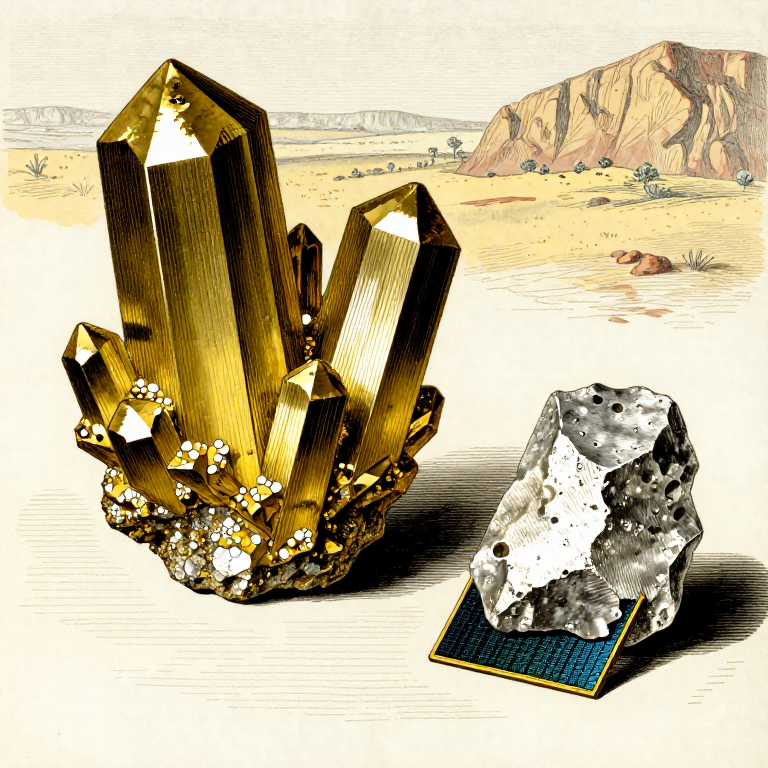
The mineral calaverite (AuTe₂, gold ditelluride) is a gold-tellurium compound containing 43.6% gold and 56.4% tellurium by mass. It is one of the few minerals where gold occurs chemically bonded to another element rather than as native metal. Calaverite was responsible for the famous Kalgoorlie gold rush mistake in Western Australia (1890s), where tonnes of calaverite-bearing ore were used as road fill because it didn't look like gold — the gold was chemically locked in telluride form and invisible.
Tellurium is a metalloid — it sits on the boundary between metals and nonmetals, with properties of both. It is brittle, silvery-white with a metallic luster, and a poor electrical conductor (it is a semiconductor). Today, tellurium's most important application is in cadmium telluride (CdTe) thin-film solar cells, which are the lowest-cost photovoltaic technology per watt.
HAZARD: Tellurium and its compounds are moderately toxic. The most distinctive hazard is 'tellurium breath' — even trace exposure causes the body to metabolize tellurium into dimethyl telluride, producing an intensely unpleasant garlic-like body odor that persists for weeks. Handle with gloves.
Leiðbeiningar
Understand tellurium chemistry and the metalloid nature
Understand tellurium chemistry and the metalloid nature
Tellurium (Te, element 52) is a metalloid in Group 16 (the chalcogens), below oxygen, sulfur, and selenium. It has a density of 6.24 g/cm³, a melting point of 449.5 °C, and Mohs hardness of 2–2.5. Tellurium is brittle, silvery-white with a metallic luster, and crystallizes in a trigonal structure of helical atomic chains — the same structure as selenium and grey sulfur.
As a metalloid, tellurium has intermediate properties: it conducts electricity, but poorly (it is a p-type semiconductor with a band gap of 0.35 eV). Its conductivity increases with temperature (semiconductor behavior) and with light exposure (photoconductivity). This semiconducting nature makes tellurium and its compounds important in photovoltaic applications, thermoelectric devices, and infrared detectors.
Tellurium is genuinely rare. Its crustal abundance is approximately 0.001 ppm (1 part per billion) — making it rarer than gold (0.004 ppm) and platinum (0.005 ppm) by some estimates. Despite this rarity, tellurium is not extremely expensive because it is produced as a byproduct of copper refining — the tellurium accumulates in the anode slime of copper electrolysis and is recovered during processing. Nearly all commercial tellurium comes from this source.
Identify calaverite and other tellurium minerals
Identify calaverite and other tellurium minerals
Calaverite (AuTe₂) is a brass-yellow to silver-white metallic mineral that can look remarkably like pyrite ('fool's gold') or native gold. Key identification features: Mohs hardness 2.5–3 (softer than pyrite at 6–6.5, but similar to gold at 2.5–3), specific gravity 9.31 (heavier than pyrite at 5.0 but lighter than gold at 19.3), and a yellowish-grey streak. Calaverite forms monoclinic crystals, often striated or bladed.
The critical distinction from native gold: calaverite is brittle (it fractures when struck), while native gold is malleable (it deforms). And calaverite is significantly lighter than gold per unit volume — the density difference (9.31 vs 19.32) is immediately noticeable by heft for any specimen large enough to hold.
Other tellurium minerals include sylvanite ((Au,Ag)₂Te₄, silver-white, also from Transylvania — named after the old Roman name for the region), hessite (Ag₂Te, a silver telluride), coloradoite (HgTe, mercury telluride), and native tellurium (rare). Telluride gold deposits occur in volcanic hydrothermal systems — major deposits include Cripple Creek (Colorado, USA), Kalgoorlie (Western Australia), Emperor Mine (Fiji), and the original Transylvanian deposits of Zlatna and Săcărâmb (Romania).
Efni fyrir þetta skref:
 Kalaverítsýni
Nauðsynleg verkfæri:
 Jarðfræðihamar
 Handstækkunargler 10x
 Rispuplata (óglerjað postulín)Handstækkunargler 10xRispuplata (óglerjað postulín)
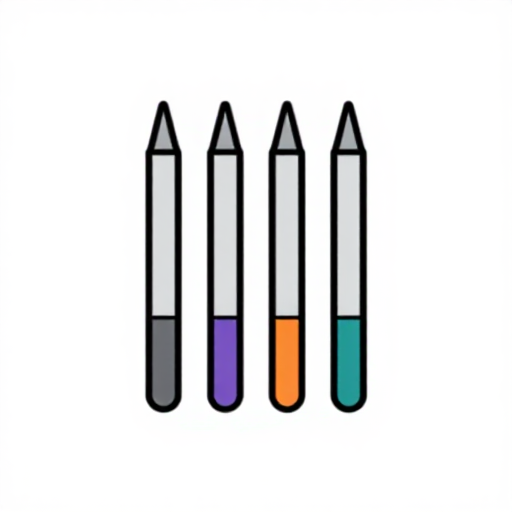 Mohs-hörkunálar
Understand tellurium extraction from copper refining
Understand tellurium extraction from copper refining
Tellurium is almost never mined directly. Instead, it is a byproduct of electrolytic copper refining. When impure copper anodes are dissolved in sulfuric acid electrolyte during copper electrorefining, the tellurium (along with selenium, silver, gold, and platinum-group metals) does not dissolve. Instead, it falls to the bottom of the electrolytic cell as 'anode slime' — a dark, muddy sediment that is one of the most valuable waste products in all of metallurgy.
The anode slime is processed through a series of roasting, smelting, and chemical separation steps. Tellurium is typically recovered by: (1) roasting the slime with sodium carbonate to form sodium tellurate (Na₂TeO₃), (2) leaching with water, (3) neutralizing to precipitate tellurium dioxide (TeO₂), and (4) reducing TeO₂ to metallic tellurium with sulfur dioxide gas: TeO₂ + 2SO₂ → Te + 2SO₃.
This production pathway means tellurium supply is inelastic — it depends on copper production, not tellurium demand. If copper demand falls, tellurium supply falls regardless of how much the solar cell industry needs. This supply constraint is a significant concern for the cadmium telluride solar industry, which consumes approximately 40% of world tellurium production.
Understand the Kalgoorlie gold rush mistake
Understand the Kalgoorlie gold rush mistake
The Kalgoorlie telluride story is one of the most expensive blunders in mining history. In the 1890s, prospectors at Kalgoorlie (Western Australia) found abundant gold ore — the Golden Mile, one of the richest gold deposits ever discovered. But much of the gold was locked in telluride minerals (calaverite and sylvanite) rather than occurring as free native gold.
Telluride gold ore looks nothing like what prospectors expected. Calaverite and sylvanite are pale, metallic, and often microscopic — they don't show the warm yellow color of native gold. Many miners discarded telluride ore as worthless rock. In the most famous incident, telluride-bearing ore was used as road fill and building rubble in the town of Kalgoorlie. When metallurgists eventually demonstrated that the 'worthless' rock contained 30–50 grams of gold per tonne (spectacularly rich by any standard), the roads and building foundations were torn up and reprocessed.
The metallurgical challenge was that telluride gold cannot be recovered by simple panning or amalgamation (the standard gold recovery methods of the era). The gold is chemically bonded to tellurium and must be liberated by roasting (which burns off the tellurium as TeO₂) or by cyanide leaching (which dissolves gold from the telluride). The development of cyanidation for telluride ores transformed Kalgoorlie from a marginal prospect into one of the world's great gold fields.
Understand tellurium in solar energy technology
Understand tellurium in solar energy technology
Cadmium telluride (CdTe) thin-film photovoltaic cells are the lowest-cost solar technology per watt in utility-scale installations. CdTe has a nearly ideal band gap (1.44 eV) for single-junction solar energy conversion — it absorbs the solar spectrum more efficiently than crystalline silicon (band gap 1.12 eV) and can be deposited as a thin film (2–5 micrometers thick) rather than requiring thick crystal wafers.
First Solar, the dominant CdTe manufacturer, has achieved module efficiencies exceeding 19% and manufactures panels at a lower cost per watt than most crystalline silicon competitors. CdTe panels now generate electricity at several of the world's largest solar installations, including the Topaz Solar Farm (California, 550 MW) and the Desert Sunlight Solar Farm (California, 550 MW).
The environmental concern with CdTe is cadmium toxicity — cadmium is a known carcinogen. However, CdTe itself is a very stable compound with low bioavailability, and lifecycle analyses show that CdTe solar panels actually prevent more cadmium release than they contain (because they displace coal-fired power generation, which releases cadmium as a combustion byproduct). First Solar operates a comprehensive panel recycling program that recovers over 90% of the cadmium and tellurium for reuse.
Document findings and understand tellurium's future
Document findings and understand tellurium's future
Document your observations of any telluride mineral specimens: color, luster, hardness, density, and streak. If calaverite is available, test its brittleness (it fractures when struck, unlike gold which deforms) and its density (9.31 — much lighter than gold's 19.32 but heavier than pyrite's 5.0). Handle all tellurium minerals with gloves — the 'tellurium breath' phenomenon (garlic-like body odor from dimethyl telluride metabolite) can result from even minor exposure through skin contact.
Tellurium's story connects Transylvanian gold mining (Müller von Reichenstein, 1783) through one of history's most expensive mining mistakes (Kalgoorlie, 1890s) to cutting-edge solar energy technology. It is one of the rarest elements we routinely use, produced almost entirely as a byproduct of another industry, and its supply is a critical bottleneck for one of the most promising renewable energy technologies.
The element also illustrates an important principle: an element's value is not determined by its crustal abundance. Tellurium is rarer than gold but costs approximately $50–100/kg (versus gold at $60,000+/kg) because it has fewer high-value applications and is available as a byproduct. Rarity and value are determined by demand and supply economics, not by geology alone.
Nauðsynleg verkfæri:
Handstækkunargler 10x Sýnaglas
 Nítrílhanskar
Ore grade: how much calaverite per kilogram
Ore grade: how much calaverite per kilogram
Efni
1- 1 stykkiStaðgengill
Nauðsynleg verkfæri
7- Staðgengill
- Staðgengill
- Staðgengill
- Staðgengill
- Staðgengill
- Staðgengill
- Staðgengill
CC0 opinbert ríki
Þessi teikning er gefin út undir CC0. Þér er frjálst að afrita, breyta, dreifa og nota þetta verk í hvaða tilgangi sem er, án þess að biðja um leyfi.
Studdu smiðinn með því að kaupa vörur í gegnum teikningu hans þar sem hann fær þóknun smiða sem seljendur ákvarða, eða búðu til nýja endurskoðun á þessari teikningu og tengdu hana sem tengingu í þinni eigin teikningu til að deila tekjum.