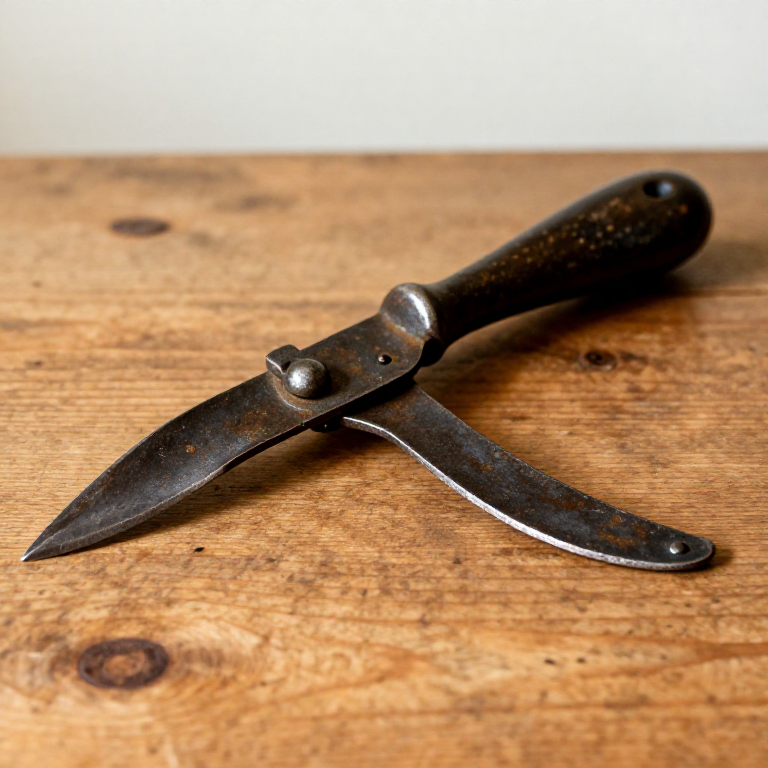


Warner Can Opener
The tin can was patented in 1810. The can opener arrived in 1858. For forty-eight years the instruction on a tin was, in effect, to attack it with a chisel and a hammer — and early cans were heavy wrought iron, sometimes thicker than the food was deep.
Ezra Warner's opener is a lever with two blades. A curved bayonet punctures the lid, a guard stops it plunging into the contents, and a sickle-shaped second blade is then sawed around the rim. It is crude, it leaves an edge that will cut you, and it was a genuine advance because it turned an unpredictable act of violence into a controlled cut.
US Patent 19,063, "Instrument for Opening Cans", granted 5 January 1858. This blueprint forges one — and the four-decade gap it closes is the more interesting object of study.
Leiðbeiningar
A cut tin lid is as sharp as a blade
A cut tin lid is as sharp as a blade
Every opened can in this build leaves a jagged edge. Handle lids with pliers, never fingers, and dispose of them folded inside the empty can.
Read US 19,063 and identify the two blades
Read US 19,063 and identify the two blades
Warner's tool has a piercing bayonet and a cutting sickle, plus a guard. Three features, one lever — find each in the drawing before forging.
Measure the seam on a real can
Measure the seam on a real can
Look closely at where the lid meets the body. The tool has to work INSIDE that rolled seam, and its geometry is dictated by the can, not the other way round.
Nauðsynleg verkfæri:
 Reglustika
Cut a blank from tool steel
Cut a blank from tool steel
Take a bar of high-carbon steel long enough to give a handle and both blades from one piece. One-piece construction has no joints to fail under leverage.
Efni fyrir þetta skref:
 Flatt verkfærastál1 stykki
Forge the bayonet point
Forge the bayonet point
Draw one end to a stout curved point. It must punch through sheet steel without folding, so keep it thick behind the tip.
Nauðsynleg verkfæri:
 Járnsmiðshamar
Forge the guard that limits penetration
Forge the guard that limits penetration
Upset a shoulder behind the point. Without it the blade plunges to the bottom of the can — into the food, and towards your other hand.
Forge the sickle blade
Forge the sickle blade
Shape the second blade as a shallow curve. The curve keeps a single point in contact so force concentrates where you are cutting.
Draw out a handle long enough for leverage
Draw out a handle long enough for leverage
Make the handle several times the blade length. All the cutting force comes from this ratio — a short handle simply will not open a can.
Normalise, then harden and temper
Normalise, then harden and temper
Normalise to relieve forging stress, harden the blades, then temper to a straw colour. Fully hard steel chips on tin; too soft and the edge rolls.
Grind the cutting edge on the inside curve
Grind the cutting edge on the inside curve
Put the bevel on the concave side so the blade pulls itself into the cut as you lever, rather than skating across the lid.
Nauðsynleg verkfæri:
 Sandpappír
Punch the first hole just inside the rim
Punch the first hole just inside the rim
Set the point close to the seam and press down. Too far in and you have a hole in the middle of the lid you cannot work from.
Rock the sickle along the rim in short strokes
Rock the sickle along the rim in short strokes
Lever down, advance a few millimetres, lever again. It is a series of small cuts, not one continuous slice — and that is genuinely tiring.
Leave a hinge and fold the lid back
Leave a hinge and fold the lid back
Stop short of a full circle and bend the lid up on the uncut section. A fully detached lid is a loose disc with a razor edge.
Compare against a modern rotary opener
Compare against a modern rotary opener
Open a second can with a wheel-type opener and time both. The rotary cutter replaces sawing with rolling — which is why Warner's design lasted only a decade in shops.
Compendium — forty-eight years of no opener at all
Compendium — forty-eight years of no opener at all
The patent. US 19,063, "Instrument for Opening Cans", granted 5 January 1858 to Ezra J. Warner of Waterbury, Connecticut. It is generally recognised as the first US can opener patent. It came into use quickly with the Union Army during the American Civil War, where canned rations mattered and a dedicated tool beat a bayonet.
Why the gap was so long. Peter Durand patented tin-plated iron canning in Britain in 1810, and the earliest cans were made of heavy wrought iron plate — some weighed more than their contents. They were opened with a hammer and chisel, and tins were labelled accordingly. Two things had to change before a hand tool was possible: canning had to move to thinner rolled steel plate, and cans had to become a household rather than a military or expedition item. The opener did not lag through lack of ingenuity; the object it opens had to become openable first. That is a useful pattern — a tool often cannot exist until its target changes.
What Warner's design does and does not solve. The bayonet-and-sickle is a controlled puncture followed by a sawing cut, with a guard to stop over-penetration. It works on any can size and needs no fitting. What it leaves is a ragged edge, a tiring stroke, and a real risk of slipping — which is why grocers often opened cans for customers rather than selling the tool. William Lyman's 1870 patent introduced the rotating cutting wheel that pivots about the can's centre, replacing sawing with rolling, and the familiar twin-wheel opener followed around 1925.
The design lineage is still visible. The military P-38, a folding one-piece opener issued in enormous numbers from 1942, is essentially Warner's principle miniaturised — a hooked blade that punctures and then walks around the rim in short levered bites. The pull-tab can, patented by Ermal Fraze in 1963, finally removed the tool altogether by building the opening into the lid, which is the usual endpoint: the best tool for a job is often no tool.
Efni
1- 1 stykkiStaðgengill
Nauðsynleg verkfæri
3- Staðgengill
- Staðgengill
- Staðgengill
Þessi teikning býr til
Tengd Blueprint
Þessi blueprint deila þekkingu — tækni, efni eða meginreglur
CC0 opinbert ríki
Þessi teikning er gefin út undir CC0. Þér er frjálst að afrita, breyta, dreifa og nota þetta verk í hvaða tilgangi sem er, án þess að biðja um leyfi.
Studdu smiðinn með því að kaupa vörur í gegnum teikningu hans þar sem hann fær þóknun smiða sem seljendur ákvarða, eða búðu til nýja endurskoðun á þessari teikningu og tengdu hana sem tengingu í þinni eigin teikningu til að deila tekjum.