

Wheatstone Bridge
Leiðbeiningar
Build the diamond
Build the diamond
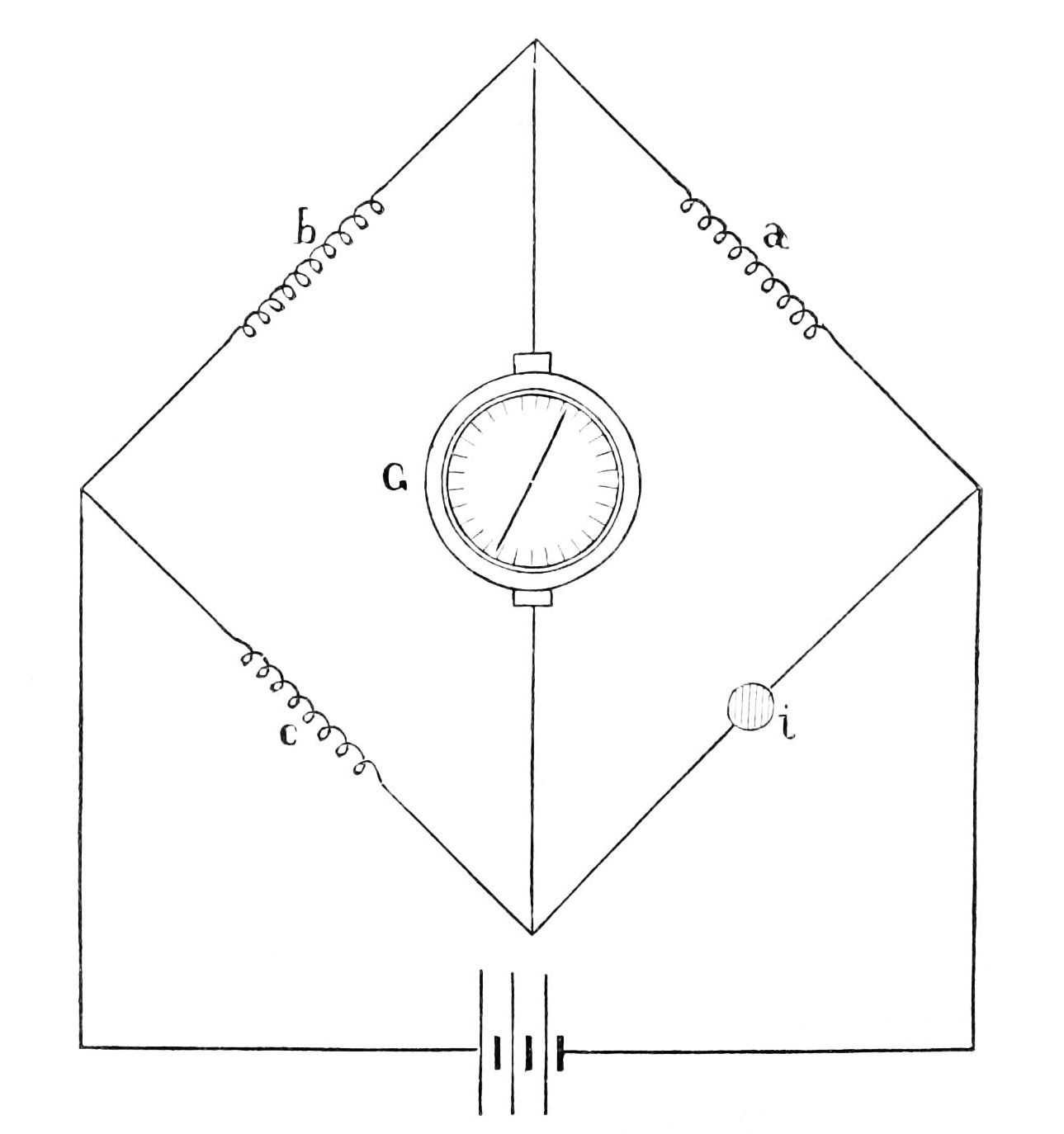
Four arms meet at four corners. Label them so the maths stays straight.
- Corners A and C are opposite: the supply connects across these.
- Corners B and D are the other pair: the detector goes across these.
- Arms A–B and B–C are the known ratio arms, R1 and R2.
- Arm A–D is the variable arm R3; arm D–C holds the unknown, Rx.
Efni fyrir þetta skref:
 Viðnámasett 1/4 W1 sett
 Koparvír1 length
Fit the detector across the middle
Fit the detector across the middle
Connect the galvanometer between B and D. This is the instrument that has to be sensitive, not accurate — it only ever has to tell you when the reading is zero.
That distinction is the whole trick. A galvanometer whose scale is wrong by twenty per cent still finds the null perfectly, and the null is where the answer lives.Efni fyrir þetta skref:
 Hliðrænn straummælir1 stykki
Balance the bridge
Balance the bridge
Apply the supply across A and C, then adjust R3 until the detector reads exactly zero.
- Start coarse, then refine.
- Tap the supply on briefly rather than leaving it connected while you hunt — self-heating changes the very resistances you are measuring.
At balance: Rx = R3 × (R2 / R1)
At the null, no current flows through the detector, which means B and D sit at exactly the same potential. Nothing about the supply voltage appears in the answer — that is why a tired battery does not spoil the measurement.Prove it is immune to the supply
Prove it is immune to the supply
The claim above is testable in a minute, so test it.
- Balance the bridge and note R3.
- Swap the supply for one of noticeably different voltage.
- Re-balance. The null should land at the same R3.
Nauðsynleg verkfæri:
 Digital Multimeter - Basic
History and context
History and context
Samuel Hunter Christie published this circuit in 1833 as a way of comparing wires. Charles Wheatstone found it, saw what it was for, developed it into a practical instrument in 1843 — and said plainly in his paper that the arrangement was Christie's. The misattribution in the name was not Wheatstone's doing.
Its first heavy use was the telegraph, where finding the distance to a fault on a buried or submarine line meant measuring resistance accurately in the field, with whatever battery was to hand. The Wheatstone bridge and its variants — the Kelvin double bridge for very low resistances, the Wheatstone-derived AC bridges for capacitance and inductance — carried precision measurement for a century.
It has not retired. Every strain gauge, load cell and pressure sensor works by unbalancing a bridge slightly and reading the difference, which is why a supermarket scale and a 19th-century telegraph fault-finder share a circuit diagram.
Efni
3- 1 settStaðgengill
- 1 lengthStaðgengill
- 1 stykkiStaðgengill
Nauðsynleg verkfæri
1- Digital Multimeter - Basic10% þóknun$14.38
Þessi teikning býr til
Tengd Blueprint
Þessi blueprint deila þekkingu — tækni, efni eða meginreglur
CC0 opinbert ríki
Þessi teikning er gefin út undir CC0. Þér er frjálst að afrita, breyta, dreifa og nota þetta verk í hvaða tilgangi sem er, án þess að biðja um leyfi.
Studdu smiðinn með því að kaupa vörur í gegnum teikningu hans þar sem hann fær þóknun smiða sem seljendur ákvarða, eða búðu til nýja endurskoðun á þessari teikningu og tengdu hana sem tengingu í þinni eigin teikningu til að deila tekjum.