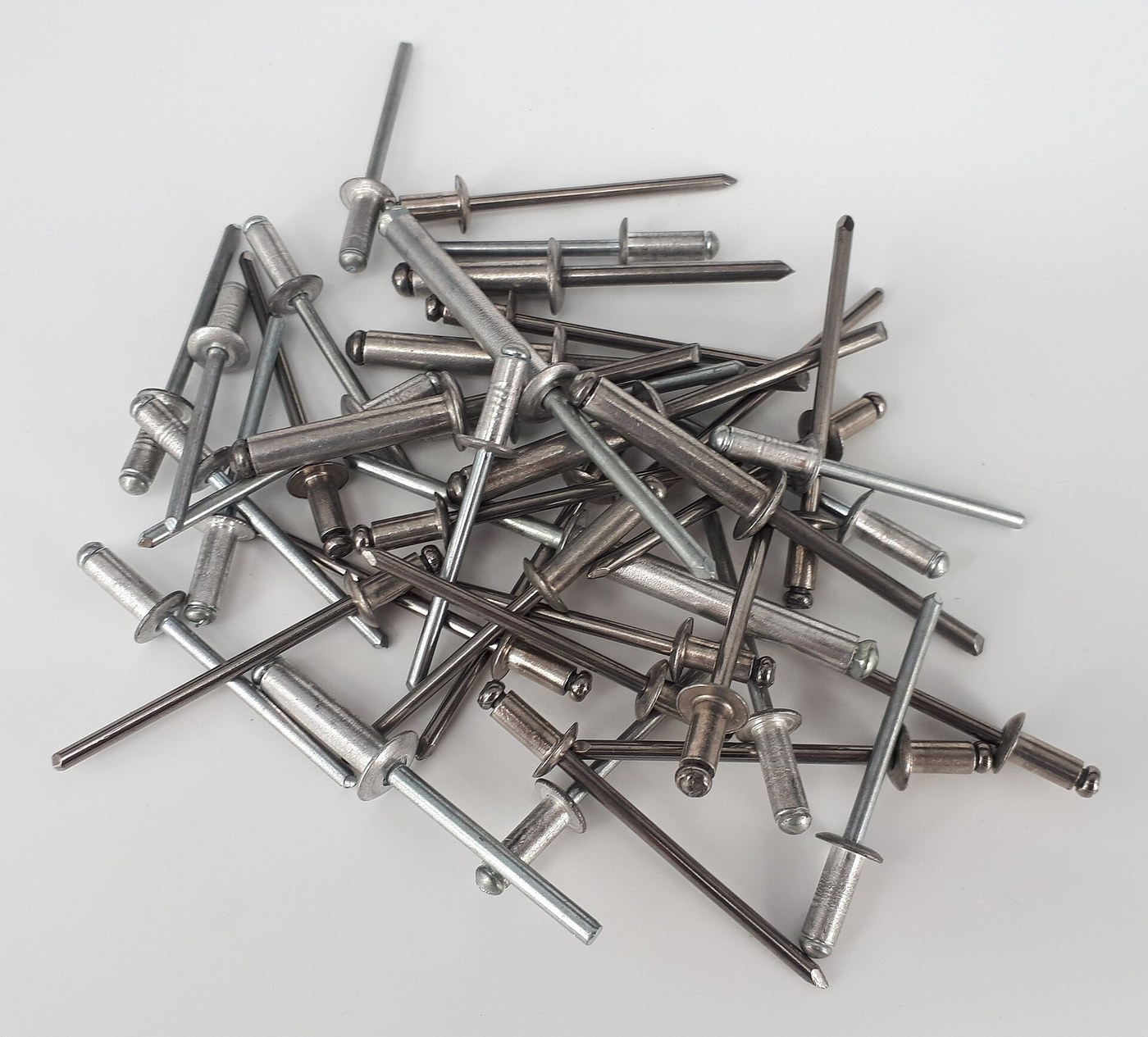


Blind Rivet
Almost every way of joining metal assumes you can reach both sides of the joint. A rivet needs a hammer on one face and a bucking bar on the other; a spot weld needs an electrode on each side. But an aircraft wing is a closed box. Once the skin goes on, the inside is gone.
The blind rivet solves it with a trick of geometry. The rivet is a hollow tube threaded onto a steel mandrel with a bulb at the far end. Pull the mandrel and the bulb is dragged back into the tube, swelling it against the blind face until the joint is clamped — then the mandrel snaps at a designed weak point and the stub is discarded. One hand, one side, about two seconds.
Hamilton Neil Wylie, a British engineer and Royal Navy reservist, was granted a British patent in 1916-1917 for “an improved means of closing tubular rivets”. No patent number for that grant could be verified from any source consulted, and none is invented here. The mechanism is thoroughly documented, and it is authored on that basis: function is the payload, attribution is metadata.
What follows measures the joint the mandrel makes — grip range, hole clearance, and the two different ways it fails.
Leiðbeiningar
Write down the constraint
Write down the constraint
Record the problem: how do you set a rivet when you can only reach one side? Sketch a closed wing box to see why it matters.
Measure a rivet before setting it
Measure a rivet before setting it
Measure the rivet body diameter and the length of the unset tube with the caliper. Record both. Note the mandrel protruding from the head.
Nauðsynleg verkfæri:
 Skífmælir
 Poppnaglabyssusett
Work out the correct hole size
Work out the correct hole size
The hole should be a close clearance on the body — typically 0.1 mm over. Write down the drill size your measured rivet needs.
Efni fyrir þetta skref:
 Rúðustrikaður pappír1 plata
Nauðsynleg verkfæri:
SkífmælirDrill matched holes in two aluminium coupons
Drill matched holes in two aluminium coupons
Clamp two aluminium sheet coupons together and drill through both at once, so the holes cannot misalign.
Efni fyrir þetta skref:
 Álplata2 stykki
Nauðsynleg verkfæri:
 C-þvinga
 Tær öryggisgleraugu
Set a rivet and listen for the snap
Set a rivet and listen for the snap
Insert the rivet, squeeze the gun until the mandrel breaks with a distinct snap. That snap is the designed break point doing its job.
Efni fyrir þetta skref:
Álplata2 stykkiNauðsynleg verkfæri:
PoppnaglabyssusettTær öryggisglerauguMeasure the set rivet and find the missing length
Measure the set rivet and find the missing length
Measure the head height now. Compare with step 2: the tube has shortened, and that lost length has become the bulb on the blind side.
Efni fyrir þetta skref:
Rúðustrikaður pappír1 plataNauðsynleg verkfæri:
SkífmælirCut one open to see the bulb
Cut one open to see the bulb
Cut through a set rivet with a file or cut-off wheel and look at the section. The formed bulb on the far side is the entire mechanism.
Nauðsynleg verkfæri:
 Þjalasett
 StækkunarglerTær öryggisgleraugu
Test the grip range at the wrong thickness
Test the grip range at the wrong thickness
Set an identical rivet through a single sheet only. It is loose — too little material for its grip range, so the bulb forms in air.
Efni fyrir þetta skref:
Álplata1 stykkiNauðsynleg verkfæri:
PoppnaglabyssusettSet three specimens for pull testing
Set three specimens for pull testing
Make three identical two-sheet joints, one rivet each. Label them with the marker.
Efni fyrir þetta skref:
Álplata6 stykkiNauðsynleg verkfæri:
Poppnaglabyssusett Merkipenni
Pull each joint apart and record the force
Pull each joint apart and record the force
Clamp each specimen and pull with the force meter until it fails. Record the peak force for all three and average them.
Nauðsynleg verkfæri:
 Kraftmælir (gormvog)
 Skrúfstykki
Identify which of the two failures happened
Identify which of the two failures happened
Blind rivets fail two ways: the rivet shears, or it pulls through the sheet, tearing a hole. Record which you got — thin sheet gives the second.
Efni fyrir þetta skref:
Rúðustrikaður pappír1 plataNauðsynleg verkfæri:
StækkunarglerCompare against a spot weld
Compare against a spot weld
Note the trade: a rivet leaves a hole and needs no power at all; a spot weld leaves no hole and needs both sides plus a machine.
Safety awareness — small parts at speed
Safety awareness — small parts at speed
The mandrel is fired, not dropped. When it snaps it can leave the gun with real force, and the stub is a hardened steel splinter. Safety glasses are worn for every setting operation, including the first one you think is too small to matter.
Drilling aluminium throws sharp swarf in fine curls that embed in skin, and the drilled coupons carry a burr on the back face that cuts like a blade. Deburr before handling, and never brush swarf away by hand.
Collect the spent mandrels. A dropped mandrel in an assembly is called foreign object debris, and in aviation it is treated as seriously as a bad weld — a loose steel pin inside a control surface can jam it. Modern guns catch them in a bottle for exactly this reason.
Nauðsynleg verkfæri:
Tær öryggisgleraugu Leðurhanskar
History & Context
History & Context
Hamilton Neil Wylie, British patent, 1916-1917, “an improved means of closing tubular rivets”. Sources give both 1916 and 1917, and none consulted supplies a patent number. That gap is reported rather than filled — a fabricated number would look more authoritative and be worth less than nothing.
Aircraft made it necessary. Wylie worked for Armstrong-Whitworth Aircraft in the 1920s, and Armstrong-Whitworth brought in the George Tucker Eyelet Company of Birmingham to develop the design further. Their joint refinement produced the version whose mandrel head pops off after setting — the sound that named the product. “POP” is a trade mark, now owned through Stanley Black & Decker; the generic term is blind rivet, and using the trade mark for the category is the same error as calling every vacuum flask a Thermos.
Carl Cherry, and the second wave. In 1936 Cherry, an MIT-trained engineer in California, was brought a production problem by his stepson, a riveter at Douglas Aircraft. His redesign was filed in 1937 and issued in 1939, and Cherry rivets became a standard of American aviation. The pattern is worth noticing: the concept is British and wartime, the industrialisation is American and inter-war, and the same shape repeats right across the history of joining metal.
Why it still wins. A blind rivet needs no electricity, no gas, no skill certification and no access to the far side, and it works on dissimilar materials that cannot be welded to each other at all — aluminium to steel, metal to plastic, metal to composite. In an age of adhesive bonding and laser welding, a hollow tube and a mandrel remain the cheapest way to clamp two sheets you can only touch from one side.
Nauðsynleg verkfæri
10- Staðgengill
- Staðgengill
- Staðgengill
- Staðgengill
- Staðgengill
- Staðgengill
- Staðgengill
- Staðgengill
- Staðgengill
- Staðgengill
Efni úr tengdum teikningum
Tengd Blueprint
Þessi blueprint deila þekkingu — tækni, efni eða meginreglur


CC0 opinbert ríki
Þessi teikning er gefin út undir CC0. Þér er frjálst að afrita, breyta, dreifa og nota þetta verk í hvaða tilgangi sem er, án þess að biðja um leyfi.
Studdu smiðinn með því að kaupa vörur í gegnum teikningu hans þar sem hann fær þóknun smiða sem seljendur ákvarða, eða búðu til nýja endurskoðun á þessari teikningu og tengdu hana sem tengingu í þinni eigin teikningu til að deila tekjum.