ARTE
BELLEZZA E BENESSERE
MESTIERE
CULTURA E STORIA
DIVERTIMENTO
AMBIENTE
CIBO E BEVANDE
INGEGNERIA INVERSA
SCIENZE
SPORT
TECNOLOGIA
INDOSSABILI
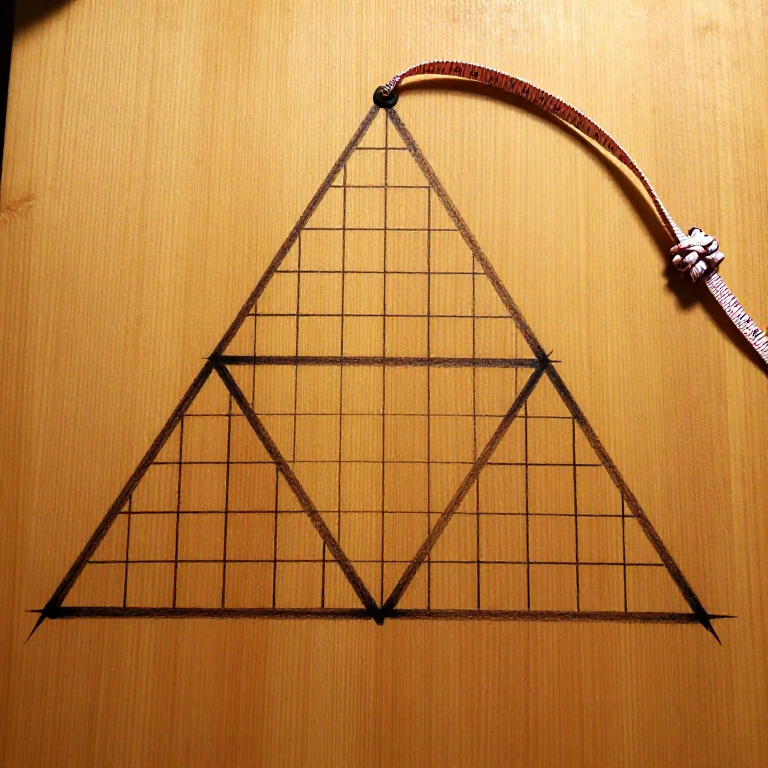


Proving the Pythagorean Theorem by Cutting Squares — a² + b² = c²
The most famous rule in geometry says that in any right-angled triangle, the square built on the longest side equals the two squares on the shorter sides added together: a² + b² = c². The school of Pythagoras proved it around 530 BC. This blueprint proves it the maker's way — with a knotted cord, three cut squares, and a dissection you can hold in your hands. Seeing the pieces of the two small squares fit exactly into the big one is a proof that needs no algebra, and it doubles as the ancient builder's test for a true square corner.
Principiante
2
Istruzioni
1
1
State the theorem
State the theorem
In a right-angled triangle, name the two short sides a and b and the longest side (the hypotenuse) c. The theorem says the square on c has exactly the same area as the squares on a and b together: a² + b² = c². You will prove this by area, not algebra.
2
2
Make a right angle with a cord
Make a right angle with a cord
Knot a loop of cord into twelve equal spaces. Peg it out as a triangle with sides of 3, 4 and 5 spaces; the corner between the 3 and 4 sides is a perfect right angle. This 3-4-5 trick is how builders have squared corners for thousands of years.
Strumenti necessari:
 Spago da cucina in cotone
3
3
Lay out a right triangle
Lay out a right triangle
Using that right angle, mark a right triangle with legs 3 and 4 units on a board. Its hypotenuse comes out to exactly 5 units — a whole-number right triangle to make the areas easy to count.
Materiali per questo passaggio:
 Tavola di legno duro1 pezzo
Strumenti necessari:
 Filo tracciatore
4
4
Cut the three squares
Cut the three squares
Cut a square on each side of the triangle: 3×3, 4×4 and 5×5. Rule each into unit squares — 9, 16 and 25 of them. These three squares are the whole proof, made physical.
Strumenti necessari:
 Sega a mano
 Coltello
5
5
Count the areas
Count the areas
Count: the small squares hold 9 and 16 unit squares, together 25 — exactly the number in the big square on the hypotenuse. 9 + 16 = 25 is a² + b² = c² in plain counting.
6
6
Prove it by dissection
Prove it by dissection
Now cut the two smaller squares into pieces and lay them inside the largest square. They tile it exactly — no gaps, no overlaps. Because the pieces fit for reasons of shape, not luck, this works for every right triangle, not only 3-4-5.
Strumenti necessari:
Coltello7
7
Test other triangles
Test other triangles
Repeat with other right triangles: the square on the hypotenuse always equals the sum of the other two. Change the corner so it is no longer a right angle, and the fit fails — which is exactly why the same rule can TEST whether a corner is truly square.
8
8
See why it matters
See why it matters
This single relationship underlies distance, surveying, navigation and building ever since. Any time you find a straight-line distance from two measurements at right angles, you are using Pythagoras — a 2,500-year-old proof you just held in your hands.
Materiali
2- 1 pezzoSegnaposto
- 1 pezzoSegnaposto
Strumenti richiesti
4- Segnaposto
- Segnaposto
- Segnaposto
- Segnaposto
Blueprint correlati
Questi blueprint condividono conoscenze — tecniche, materiali o principi
CC0 Pubblico dominio
Questo progetto è rilasciato sotto CC0. Sei libero di copiare, modificare, distribuire e utilizzare quest'opera per qualsiasi scopo, senza chiedere permesso.
Supporta il Maker acquistando prodotti tramite il suo progetto dove guadagna una Commissione Maker stabilita dai venditori, oppure crea una nuova iterazione di questo progetto e includilo come collegamento nel tuo progetto per condividere i ricavi.