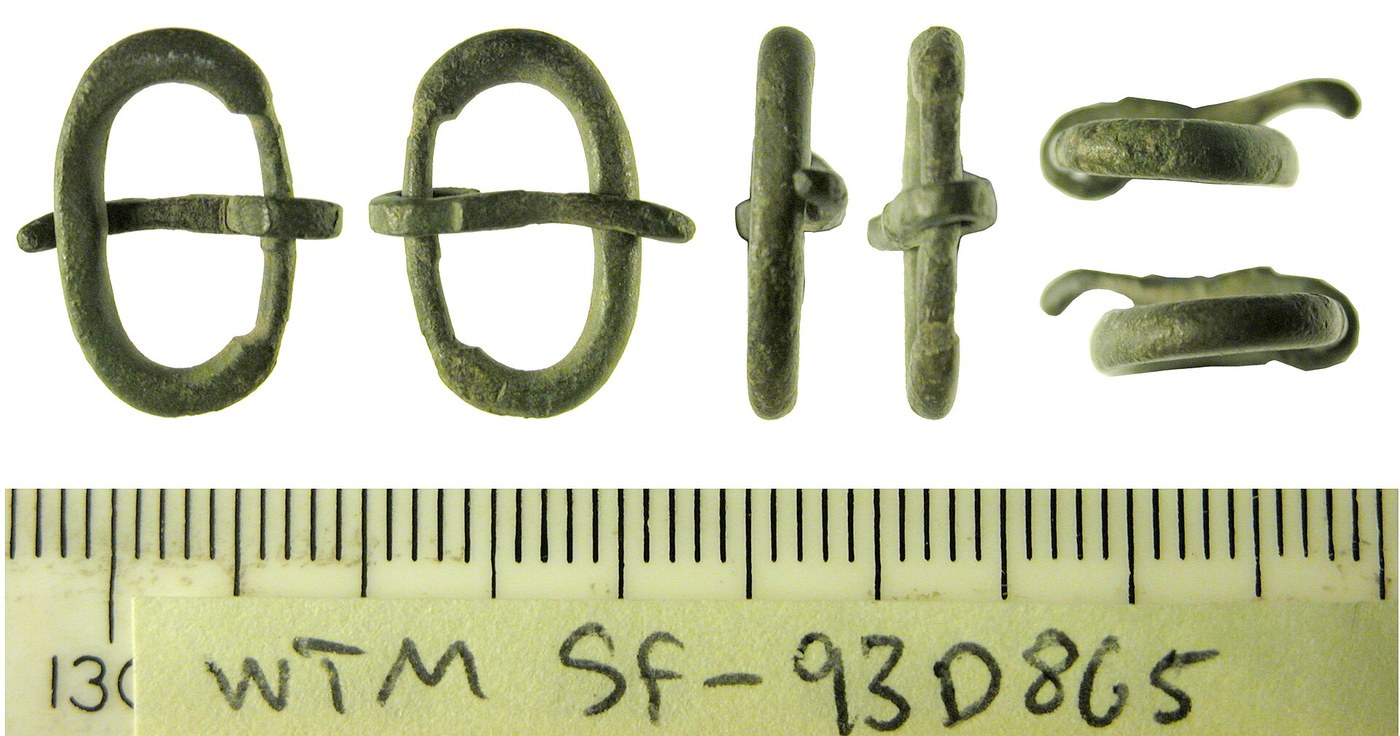


Anglo-Saxon Belt Buckle
A belt buckle is three parts that have to work together: a loop the strap passes through, a tongue that drops into a hole to hold the tension, and a plate that fastens the whole thing to the leather. Get the proportions wrong and the tongue slips, the loop bends, or the plate tears out of the strap.
Anglo-Saxon buckles survive in enormous numbers — they are among the commonest grave finds of the period, in copper alloy, iron, silver and occasionally gold. This blueprint builds the standard workaday form in cast or forged copper alloy, which is what most people actually wore.
It is emphatically not the Sutton Hoo great gold buckle. That object is a hollow box with a hinged back and a system of internal sliding rods, made from over 400 grams of gold. It is one of the finest pieces of metalwork to survive from early medieval Europe and it is not a beginner's project — but it is worth knowing about, so it is in the last step.
Istruzioni
Measure the strap
Measure the strap
Measure the belt width. Every dimension follows from it: the loop's internal width must be 2 mm wider than the strap so it runs freely without flopping.
Materiali per questo passaggio:
 Cuoio conciato al vegetale1 pezzo
Bend the loop from rod
Bend the loop from rod
Anneal 120 mm of 4 mm brass rod to dull red, air-cool, then bend it into a D-shape over a former. The straight bar of the D is the axis the tongue will pivot on.
Materiali per questo passaggio:
 Barra di ottone1 pezzo
Strumenti necessari:
 Cannello a propano
 Mattoni refrattari
 Serie di pinze da orafo
File a seat for the tongue
File a seat for the tongue
File a shallow flat about 6 mm wide at the centre of the straight bar. The tongue sits in this seat and stops it sliding sideways along the bar in wear.
Strumenti necessari:
 Set di lime ad ago
Close the loop joint
Close the loop joint
Bring the two ends of the D together and solder with hard silver solder. This joint carries the full pull of the belt — a gap here is where the buckle fails.
Materiali per questo passaggio:
 Lega per brasatura all'argento1 set
 Pasta disossidante per saldatura (a base di colofonia)1 pezzo
Strumenti necessari:
Cannello a propanoCut and shape the tongue
Cut and shape the tongue
Cut a tapered tongue from 2 mm sheet, long enough to reach 3 mm past the far side of the loop. Too short and it lifts out under load; too long and it catches on the strap.
Materiali per questo passaggio:
 Lamiera di ottone1 foglio
Strumenti necessari:
 Sega da orafo
Roll the tongue's pivot eye
Roll the tongue's pivot eye
Anneal the wide end and roll it around the loop bar into a closed eye. Roll it on the bar — a separately-formed eye almost never fits.
Strumenti necessari:
Serie di pinze da orafoCannello a propanoCheck the tongue swings free
Check the tongue swings free
The tongue must fall under its own weight and rest against the far side of the loop. A stiff tongue will not seat itself when the wearer fastens the belt one-handed.
Cut the plate
Cut the plate
Cut a plate from 1.5 mm sheet, twice the strap width long. It folds in half around the strap end, so half wraps the front and half the back.
Materiali per questo passaggio:
Lamiera di ottone1 foglioStrumenti necessari:
Sega da orafoCut the tongue slot
Cut the tongue slot
Pierce a slot across the fold line, wide enough for the tongue to pass through and hinge. Without it the plate cannot fold around the loop bar.
Strumenti necessari:
Sega da orafoSet di lime ad agoChase a simple interlace
Chase a simple interlace
Chase a two-strand interlace into the plate with a small punch. Anglo-Saxon ornament is overwhelmingly interlace and stylised animal forms — keep it geometric and repeating.
Strumenti necessari:
 Bulino da incisione
Fold the plate around the bar
Fold the plate around the bar
Bend the plate over the loop bar so it hinges freely, with the tongue passing through the slot. Check the whole assembly articulates before the leather goes anywhere near it.
Strumenti necessari:
Serie di pinze da orafoRivet to the strap
Rivet to the strap
Slide the strap end between the folded halves and set three rivets in a triangle, not a line. A line of rivets tears the leather along the grain; a triangle spreads the load.
Materiali per questo passaggio:
 Rivetti di rame3 pezzi
Punch the strap holes and test
Punch the strap holes and test
Punch holes at 25 mm spacing and fasten. Pull hard: the tongue should bite, the loop should not spring open, and the plate should not rock on the rivets.
History & Context
History & Context
Why buckles are everywhere in the archaeology. Belt fittings are among the most common finds from early medieval graves, because everyone wore a belt and metal survives when textile and leather do not. That abundance makes them a dating tool: buckle shapes changed with fashion, so a typology of buckles gives archaeologists a way to date a burial from a single small object. The plain copper-alloy buckle in this blueprint is the type most people actually owned.
The Sutton Hoo great gold buckle. Found in the 1939 ship burial and dated to the early 7th century, it is made from over 400 grams of gold and covered in zoomorphic interlace — thirteen intertwining creatures picked out with punched circles and inlaid with niello, a black metal alloy. It is not solid: it is a hollow box, made in parts joined by a hinge under the loop, and it opens at the back. Three plain hemispherical bosses connect to sliding catches on a hinged back-plate, operated through a system of internal rods fitting into slotted fixings. Nobody has satisfactorily explained what the cavity was for.
Three parts, one job. Loop, tongue and plate is a solution so good it has not changed. The buckle on a modern belt is the same three components in the same relationship. What changes across fifteen centuries is decoration and material, not mechanism — a sign the geometry was solved early.
Interlace is not decoration alone. Anglo-Saxon and Insular interlace is highly rule-bound: strands pass over and under in strict alternation, and a strand that breaks the alternation reads instantly as wrong even to an untrained eye. Chasing a convincing interlace is an exercise in following that rule without a template, which is why period examples that get it right are a marker of a skilled workshop.
Copper alloy, not "bronze". Archaeological reports usually say "copper alloy" rather than bronze or brass, because without analysis you cannot tell which alloy a given object is, and early medieval metalworkers used a wide and inconsistent range. It is a small habit of precision worth copying: name what you know, not what you assume.
Materiali
6- 1 pezzoSegnaposto
- 1 pezzoSegnaposto
- Segnaposto
- Segnaposto
- 1 foglioSegnaposto
- 3 pezziSegnaposto
Questo progetto realizza

CC0 Pubblico dominio
Questo progetto è rilasciato sotto CC0. Sei libero di copiare, modificare, distribuire e utilizzare quest'opera per qualsiasi scopo, senza chiedere permesso.
Supporta il Maker acquistando prodotti tramite il suo progetto dove guadagna una Commissione Maker stabilita dai venditori, oppure crea una nuova iterazione di questo progetto e includilo come collegamento nel tuo progetto per condividere i ricavi.