
Burning Quicklime from Limestone — The Element That Built Civilization
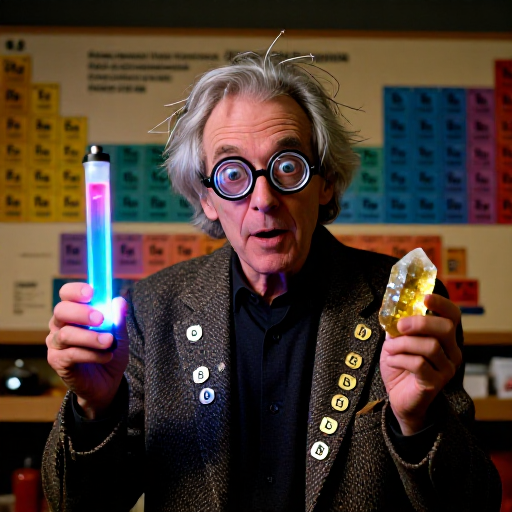
Calcium (Ca, element 20) is the fifth most abundant element in Earth's crust and the most abundant metal in the human body — your bones and teeth are calcium phosphate (Ca₃(PO₄)₂). Its name comes from Latin 'calx' (lime), because calcium was first isolated from lime by Humphry Davy in 1808 using electrolysis — the same technique he had used on potassium just months earlier. The pure metal is silvery-white, soft enough to cut with a knife, and reacts readily with water and air.
But humans never needed pure calcium metal. What they needed was lime — calcium oxide (CaO) — and they discovered how to make it at least 12,000 years ago. The earliest known lime plaster floors date to the Pre-Pottery Neolithic period in the Jordan Valley (~10,000 BCE). When you heat limestone (CaCO₃) above 900 °C, it decomposes into quicklime (CaO) and carbon dioxide (CO₂). Add water to quicklime, and it violently exothemizes into slaked lime (Ca(OH)₂), which sets hard when exposed to air by absorbing CO₂ — turning back into CaCO₃. This reversible cycle — limestone → quicklime → slaked lime → limestone — is the foundation of mortar, plaster, concrete, and cement.
This blueprint teaches the core lime-burning reaction that connects ancient construction to modern chemistry. Every Roman road, Gothic cathedral, and modern skyscraper depends on this single chemical transformation. Calcium also links to agriculture (soil pH), steelmaking (limestone flux removes impurities), water treatment (lime softening), and food (nixtamalization of corn with lime). No other element's chemistry has shaped more human structures.
Istruzioni
Understand calcium's properties and place in the periodic table
Understand calcium's properties and place in the periodic table
Calcium (Ca, element 20) sits in Group 2 (alkaline earth metals), Period 4. It has an atomic weight of 40.078 and electron configuration [Ar] 4s². With two valence electrons, calcium forms the stable Ca²⁺ ion in virtually all its compounds. The pure metal has a density of 1.55 g/cm³ (lighter than aluminum), melts at 842 °C, and is silvery-white when freshly cut but quickly tarnishes grey in air as it reacts with oxygen and moisture.
Calcium is never found as a free metal in nature — it is too reactive. Instead, it occurs as calcium carbonate (CaCO₃) in limestone, marble, chalk, and seashells; as calcium sulfate (CaSO₄) in gypsum; as calcium fluoride (CaF₂) in fluorite; and as calcium phosphate (Ca₃(PO₄)₂) in apatite and bones. Limestone alone makes up approximately 10% of all sedimentary rock on Earth. The calcium cycle drives both geology (karst caves, stalactites, coral reefs) and biology (bones, teeth, eggshells, mollusk shells).
Identify and collect limestone from natural outcrops
Identify and collect limestone from natural outcrops
Locate a limestone outcrop — these are common in most continental regions. Good-quality limestone for lime burning is dense, grey to blue-grey, and rings when struck with a hammer. Chalk (soft, white limestone) and shell beds also work but produce weaker lime. Avoid dolomite (CaMg(CO₃)₂) which contains magnesium and produces different lime chemistry — it is often yellowed or has a sugary texture.
The acid test confirms calcium carbonate: drop a few drops of vinegar (5% acetic acid) on the rock surface. Limestone fizzes vigorously as the acid reacts: CaCO₃ + 2CH₃COOH → Ca(CH₃COO)₂ + H₂O + CO₂↑. If no fizzing occurs, the rock is not limestone.
Materiali per questo passaggio:
 Carbonato di calcio - calcare frantumato
 Aceto bianco per pulizia
Strumenti necessari:
 Martello da geologo
Break limestone into fist-sized pieces
Break limestone into fist-sized pieces
Break the collected limestone into roughly fist-sized chunks (8–12 cm across). Pieces too large will not calcine fully in the center; pieces too small will clog airflow in the kiln. Use a geological hammer or a heavy club hammer on a flat rock surface. Wear safety goggles — limestone chips fly with force when struck.
You need approximately 50–80 kg of broken limestone for a small field kiln that will produce 25–40 kg of quicklime. The exact yield depends on the purity of the limestone and the completeness of calcination.
Materiali per questo passaggio:
Carbonato di calcio - calcare frantumatoStrumenti necessari:
Martello da geologo Occhiali antispruzzo chimico
Build a field lime kiln from earth and stone
Build a field lime kiln from earth and stone
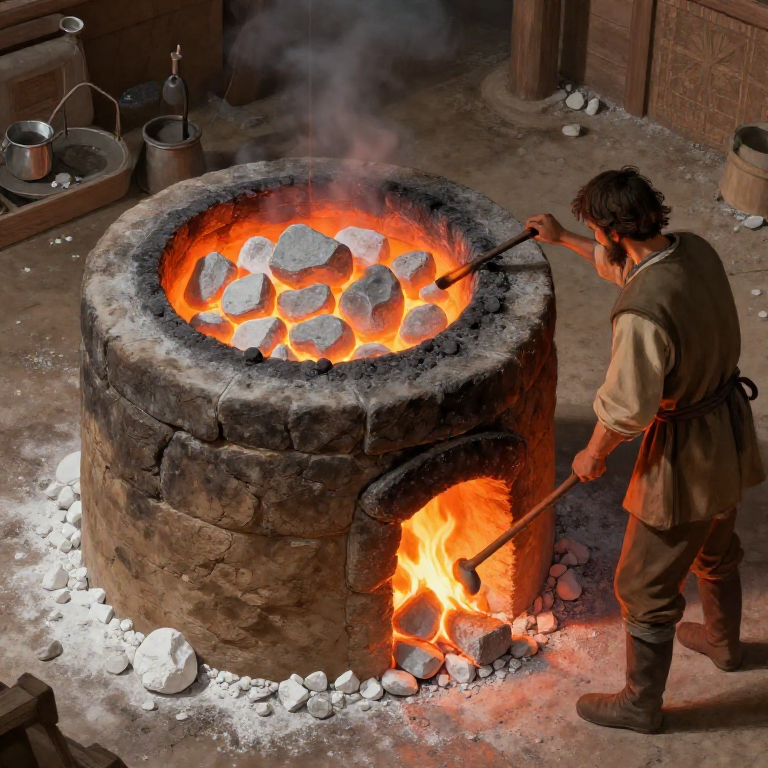
Dig a shallow pit about 1 meter in diameter and 30 cm deep in well-drained ground. Build up walls around it using clay-rich soil or stacked stones to form a cylindrical structure about 1 meter tall. Leave a fire-mouth opening at the base (about 30 cm wide) on the downwind side — this is where you feed firewood. The kiln does not need to be elaborate; medieval field kilns (clamp kilns) were simple earth-and-stone structures rebuilt for each burning.
The principle is simple: the limestone must reach at least 900 °C (ideally 1000–1100 °C) throughout for the thermal decomposition reaction CaCO₃ → CaO + CO₂ to proceed to completion. The kiln concentrates heat around the stone.
Strumenti necessari:
 Pala da scavo
 Pala piatta
Layer firewood and limestone in the kiln
Layer firewood and limestone in the kiln
Build a lattice of dry hardwood at the bottom of the kiln, creating an open structure that allows air to circulate upward. Place the largest limestone pieces on this first wood layer. Add alternating layers of firewood and limestone, with the smaller limestone pieces toward the top. The wood-to-stone ratio should be roughly 1:1 by volume — lime burning consumes enormous amounts of fuel, which is why it historically caused significant deforestation near lime-producing regions.
Materiali per questo passaggio:
Carbonato di calcio - calcare frantumato Legna da ardere di latifoglia
Strumenti necessari:
 Guanti in cuoio a manichetta lunga
Light the kiln and maintain fire for 24-48 hours
Light the kiln and maintain fire for 24-48 hours
Light the firewood through the fire-mouth at the base. The fire must be maintained continuously for 24–48 hours, depending on the size of the kiln and the limestone pieces. Feed additional firewood through the fire-mouth as the original fuel burns down. The kiln should glow dull red to orange at its hottest — this corresponds to the 900–1100 °C range needed for complete calcination.
You will see carbon dioxide venting from the top of the kiln as a slight shimmer in the air — this is 44% of the limestone's weight leaving as gas. The remaining 56% is quicklime. Do not leave the kiln unattended — if the fire dies and restarts unevenly, some stones will be under-burned (still limestone in the core) and useless.
Materiali per questo passaggio:
Legna da ardere di latifogliaStrumenti necessari:
 AttizzatoioGuanti in cuoio a manichetta lunga
Let the kiln cool completely
Let the kiln cool completely
After the final firing, let the kiln cool for at least 24–48 hours. Do not rush this — quicklime at kiln temperature will cause severe burns instantly. The outside of the kiln may feel cool while the interior remains at hundreds of degrees. Only approach the limestone when you can hold your hand near the kiln wall without discomfort.
SAFETY: Quicklime (CaO) is a severe irritant. It reacts exothermically with moisture — including the moisture in your skin, eyes, and lungs. From this point forward, wear goggles, dust mask, and leather gloves when handling quicklime. Keep water nearby but never pour water directly onto a large mass of quicklime — the violent exothermic reaction can cause spattering and steam burns.
Strumenti necessari:
Occhiali antispruzzo chimico Mascherina antipolvereGuanti in cuoio a manichetta lunga
Extract quicklime from the kiln
Extract quicklime from the kiln
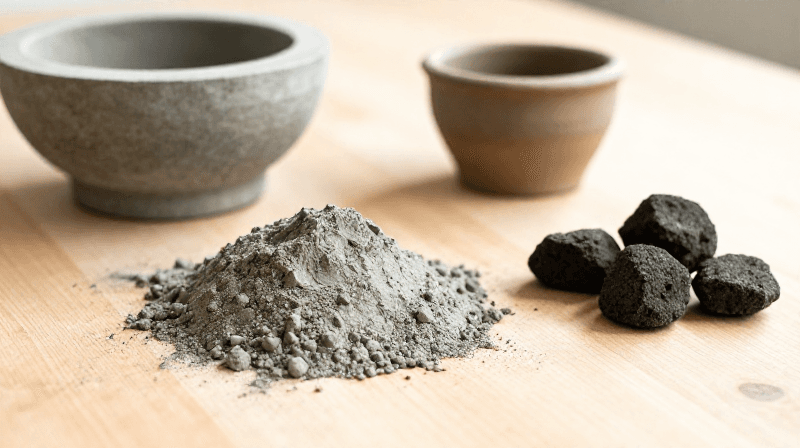
Carefully remove the calcined stones from the cooled kiln. Well-burned quicklime is lighter than the original limestone (it lost 44% of its weight as CO₂), white to pale grey, and crumbles more easily. Tap each piece — properly calcined quicklime sounds hollow and light compared to the dense ring of unburned limestone. Separate the well-burned pieces from any under-burned cores (which still sound dense and heavy).
Place the quicklime in a dry metal bucket immediately. Quicklime begins absorbing moisture and CO₂ from the air the moment it leaves the kiln — a process called air-slaking that gradually converts it back to useless calcium carbonate. Fresh quicklime must be used within days or stored in airtight containers.
Strumenti necessari:
 Secchio metallico
 Tenaglia da forgiaOcchiali antispruzzo chimicoMascherina antipolvere
Confirm quicklime with the water test
Confirm quicklime with the water test
To verify successful calcination, take a small piece (walnut-sized) and place it in a metal container outdoors. Wearing goggles and gloves, slowly drip a small amount of water onto it. Genuine quicklime reacts immediately and violently: CaO + H₂O → Ca(OH)₂ + 65.2 kJ/mol. The piece will hiss, crack, steam, and heat up dramatically — temperatures can exceed 300 °C during slaking. The quicklime swells and crumbles into a white powder (slaked lime). If the rock simply gets wet with no heat or reaction, it was not properly calcined and is still limestone.
Materiali per questo passaggio:
 Acqua pulita (per risciacquare)
Strumenti necessari:
Occhiali antispruzzo chimicoGuanti in cuoio a manichetta lungaSlake quicklime to produce hydrated lime
Slake quicklime to produce hydrated lime
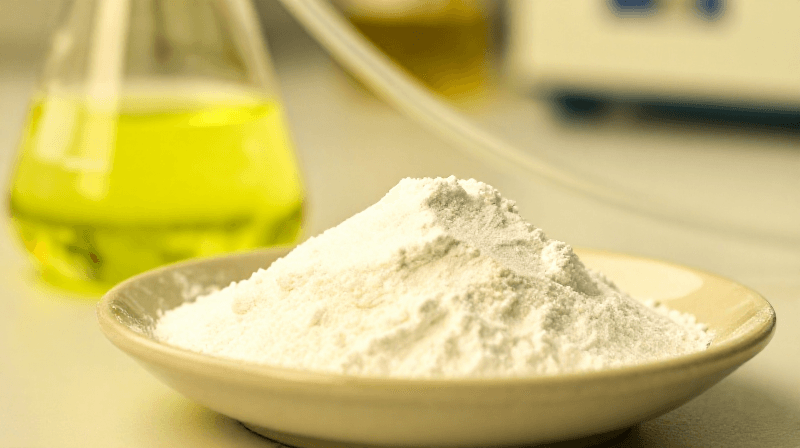
To produce slaked lime (calcium hydroxide, Ca(OH)₂) for mortar or plaster, place quicklime chunks in a large metal container outdoors. Add water gradually — never dump water all at once onto a large mass of quicklime. The reaction is extremely exothermic: the mixture will steam, boil, and reach temperatures above 150 °C. Add water slowly until all the quicklime has broken down into a thick white paste. This paste is slaked lime, also called lime putty.
The ratio is approximately 1 part quicklime to 2-3 parts water by volume. Stir with a long iron rod or wooden hoe — keep your face away from the steam. Allow the slaked lime to cool completely before handling.
Materiali per questo passaggio:
Acqua pulita (per risciacquare)Strumenti necessari:
Secchio metallico Tenaglie a manico lungoOcchiali antispruzzo chimicoGuanti in cuoio a manichetta lunga
Test slaked lime's alkalinity with the acid-base reaction
Test slaked lime's alkalinity with the acid-base reaction
Dissolve a small amount of slaked lime in water to make limewater (a clear, saturated solution of Ca(OH)₂). This solution is strongly alkaline — pH 12.4 at saturation. If you have litmus paper or red cabbage juice indicator, it turns blue/green, confirming high pH. More dramatically, blow gently through a straw into the limewater: your exhaled CO₂ reacts with dissolved calcium hydroxide to form insoluble calcium carbonate: Ca(OH)₂ + CO₂ → CaCO₃↓ + H₂O. The clear liquid turns milky white as tiny particles of CaCO₃ precipitate — this is the classic limewater test for carbon dioxide, and it demonstrates the calcium cycle completing its loop back to calcium carbonate.
Materiali per questo passaggio:
 Calce spenta (idrossido di calcio)Acqua pulita (per risciacquare)
Store quicklime or slaked lime properly
Store quicklime or slaked lime properly
Store unused quicklime in sealed, airtight containers — preferably metal with tight-fitting lids. Quicklime absorbs both moisture and CO₂ from air, gradually reverting to calcium carbonate and losing its reactivity. Properly sealed quicklime can last months; exposed quicklime becomes useless within weeks.
Slaked lime (lime putty) improves with age when stored under a thin layer of water in a sealed container. Medieval and Roman builders stored lime putty for months or even years before use — aged lime putty makes superior mortar and plaster because the Ca(OH)₂ crystals grow finer and more uniform over time, producing a smoother, more workable material.
Materiali per questo passaggio:
Calce spenta (idrossido di calcio)Strumenti necessari:
 Contenitore di HDPE
Understand calcium's connections to civilization
Understand calcium's connections to civilization
Calcium compounds connect to nearly every branch of human technology. Construction: lime mortar binds Roman roads, medieval cathedrals, and the Great Wall of China. Portland cement (invented 1824) is calcined limestone mixed with clay. Agriculture: spreading lime on acidic soil raises pH, making nutrients available to plants — a practice documented since Roman times. Steelmaking: limestone added to blast furnaces acts as a flux, combining with silica impurities to form calcium silicate slag that floats off the molten iron. Water treatment: lime softening removes dissolved calcium and magnesium that cause hard water. Food: nixtamalization — soaking corn in lime water — was invented by Mesoamerican civilizations ~3500 years ago, making niacin bioavailable and preventing pellagra. Biology: calcium ions (Ca²⁺) trigger muscle contraction, nerve signaling, and blood clotting — no calcium, no movement, no thought, no healing.
The lime cycle (CaCO₃ → CaO → Ca(OH)₂ → CaCO₃) is arguably the single most important chemical transformation in human history. Every civilization that built in stone mastered it independently. Calcium is not just an element — it is the element that turns shelter from temporary to permanent.
Materiali
6- Segnaposto
- 1 pezzoSegnaposto
- Segnaposto
- Segnaposto
- Segnaposto
- 1 pezzoSegnaposto
Strumenti richiesti
11- Segnaposto
- Segnaposto
- Segnaposto
- Segnaposto
- Segnaposto
- Segnaposto
- Segnaposto
- Segnaposto
- Segnaposto
- Segnaposto
- Segnaposto
Materiali dei progetti collegati

CC0 Pubblico dominio
Questo progetto è rilasciato sotto CC0. Sei libero di copiare, modificare, distribuire e utilizzare quest'opera per qualsiasi scopo, senza chiedere permesso.
Supporta il Maker acquistando prodotti tramite il suo progetto dove guadagna una Commissione Maker stabilita dai venditori, oppure crea una nuova iterazione di questo progetto e includilo come collegamento nel tuo progetto per condividere i ricavi.