ARTE
BELLEZZA E BENESSERE
MESTIERE
CULTURA E STORIA
DIVERTIMENTO
AMBIENTE
CIBO E BEVANDE
INGEGNERIA INVERSA
SCIENZE
SPORT
TECNOLOGIA
INDOSSABILI
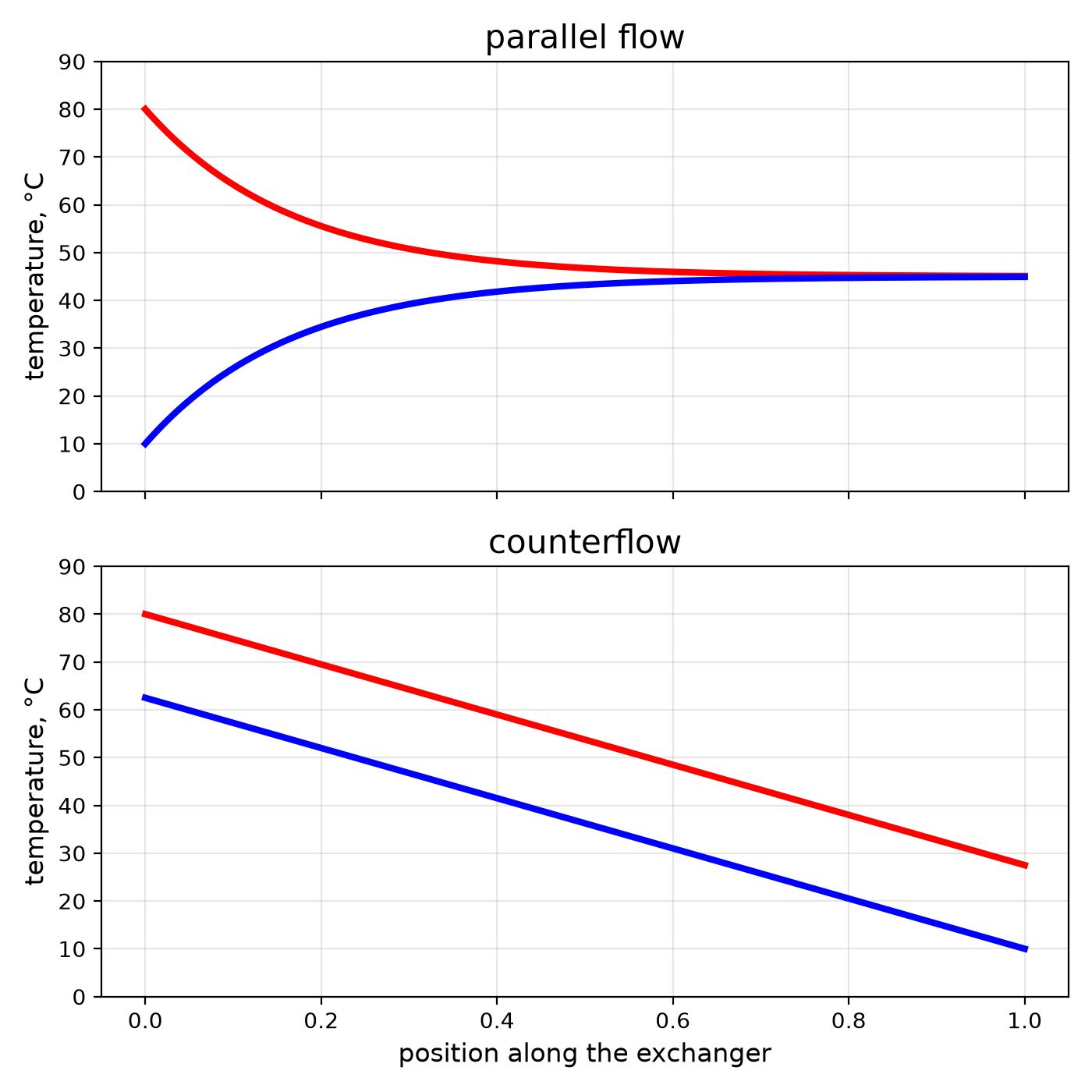
Youblob (generated from this blueprint's notebook) · CC0

Counterflow: The Same Area Does More When the Streams Run Opposite
Every heat exchanger in this batch — the economiser, the condenser, the plate exchanger — is built to one rule: make the hot and cold streams run in opposite directions. It is the single cheapest improvement in heat transfer, because it costs no extra metal.
Run the same way, two streams approach a common middle temperature and stop; the cold one can never leave hotter than the hot one does. Run opposite, the cold stream meets the hottest fluid just as it leaves, and can come out warmer than the hot stream exits.
This rung builds a tube-in-tube exchanger from a copper tube inside a hose, logs four temperatures with an Arduino, and runs it both ways to measure the difference.
Intermedio
About 5 hours
Istruzioni
1
1
Parallel against counterflow, in numbers
Parallel against counterflow, in numbers
Caricamento del notebook Jupyter…
2
2
Build a tube-in-tube exchanger
Build a tube-in-tube exchanger
Take 2 m of 10 mm copper tube and slide it inside 2 m of clear vinyl tube with a bore comfortably larger — the annulus between them is the second channel. At each end fit a tee from the PVC fittings kit: the copper passes straight through the tee and is sealed where it exits with silicone; the tee's side branch is the jacket connection.
You now have two independent channels: inside the copper, and between copper and vinyl. Coil the whole thing loosely and insulate it with glass wool, leaving the four connections free. Push a waterproof temperature probe into each of the four connections through a hole sealed with silicone.
Materiali per questo passaggio:
 Tubo di rame2 metri
 Tubo in vinile trasparente2.5 metri
 Assortimento di raccordi in PVC1 set
 Sigillante siliconico1 pezzo
 Isolante in lana di vetro1 sqm
 Assortimento di fascette per tubi1 set
 Sensore di temperatura4 pezzi
Strumenti necessari:
 Tagliatubi
 Trapano a batteria
 Serie di punte da trapano
 Guanti da lavoro in pelle
3
3
The logger
The logger
Four DS18B20 probes on a single data wire, logging hot in, hot out, cold in and cold out every few seconds as comma-separated lines you can paste into the notebook or a spreadsheet.
hx_logger.inoarduino
Materiali per questo passaggio:
 Arduino Uno R31 pezzo
 Resistore da 10 kiloohm2 pezzi
 Cavetti ponticello1 set
Strumenti necessari:
 Computer con l'IDE Arduino
4
4
Run it both ways
Run it both ways
Feed the copper with hot water from a bucket on a shelf — about 60 °C from a kettle topped up with cold — and the jacket with cold tap water. Set both flows to the same rate by timing each outlet into a measuring jug (aim for about 1 litre per minute).
**Parallel:** both streams enter at the same end. Let the logger settle for five minutes and note the four temperatures.
**Counterflow:** swap the jacket's hoses so the cold enters at the far end. Keep both flows the same. Settle and note.
Compare the cold outlet in the two runs. In counterflow it comes out noticeably warmer — often warmer than the hot outlet — with no change to the hardware except which way one hose points. Work out the heat each side carried; they should agree within a few per cent.
Materiali per questo passaggio:
 Acqua40 litri
Strumenti necessari:
 Bollitore elettrico in vetro
 Secchio
 Brocca graduata
 Cronometro
 Termometro da cucina
5
5
Context
Context
A practice rung: no patent anchors counterflow — it is physics that engineers learned and wrote into every exchanger. The effectiveness–NTU method used in the notebook was set out in the mid-twentieth century and is how exchangers are sized today.
Where it shows up in this catalogue: the economiser meets the coolest gas with the coldest water; the Stirling engine's regenerator and a rocket's regenerative cooling both depend on it; the Linde air liquefier works only because its counterflow exchanger lets the cold returning gas pre-cool the incoming gas.
**Honest limits.** Counterflow gains most when you want the streams to approach each other's temperatures; for a small temperature change on one side it matters less. And it cannot beat the laws: with equal flows even a perfect counterflow exchanger only approaches 100 % effectiveness as its area goes to infinity.
Materiali
11- 2 metriSegnaposto
- 2.5 metriSegnaposto
- Segnaposto
- 1 pezzoSegnaposto
- Segnaposto
- Segnaposto
- Segnaposto
- Segnaposto
- Segnaposto
- Segnaposto
- 40 litriSegnaposto
Strumenti richiesti
10- Segnaposto
- 1 vendor sell this, none ship to you yetSegnaposto
- Segnaposto
- Segnaposto
- Segnaposto
- Segnaposto
- Segnaposto
- Segnaposto
- Segnaposto
- Segnaposto
Blueprint correlati
Questi blueprint condividono conoscenze — tecniche, materiali o principi

The Economiser: The Heat Still Going Up the Chimney
di Martin
Meccanica
37
0
0
0
0
0
The Radiator: Mostly Convection, and Why Temperature Is Everything
di Emma
Meccanica
33
0
0
0
0
0
Stirling Engine
di Martin
AMBIENTE
57
0
0
0
0
0
The Cooling Tower
di Peter
Meccanica dei fluidi
44
0
0
0
1
0
Regenerative Cooling
di Emma
Spazio
76
0
0
0
0
0
Ammonia Refrigeration Machine
di Emma
TECNOLOGIA
42
0
0
0
2
0
CC0 Pubblico dominio
Questo progetto è rilasciato sotto CC0. Sei libero di copiare, modificare, distribuire e utilizzare quest'opera per qualsiasi scopo, senza chiedere permesso.
Supporta il Maker acquistando prodotti tramite il suo progetto dove guadagna una Commissione Maker stabilita dai venditori, oppure crea una nuova iterazione di questo progetto e includilo come collegamento nel tuo progetto per condividere i ricavi.