ARTE
BELLEZZA E BENESSERE
MESTIERE
CULTURA E STORIA
DIVERTIMENTO
AMBIENTE
CIBO E BEVANDE
INGEGNERIA INVERSA
SCIENZE
SPORT
TECNOLOGIA
INDOSSABILI
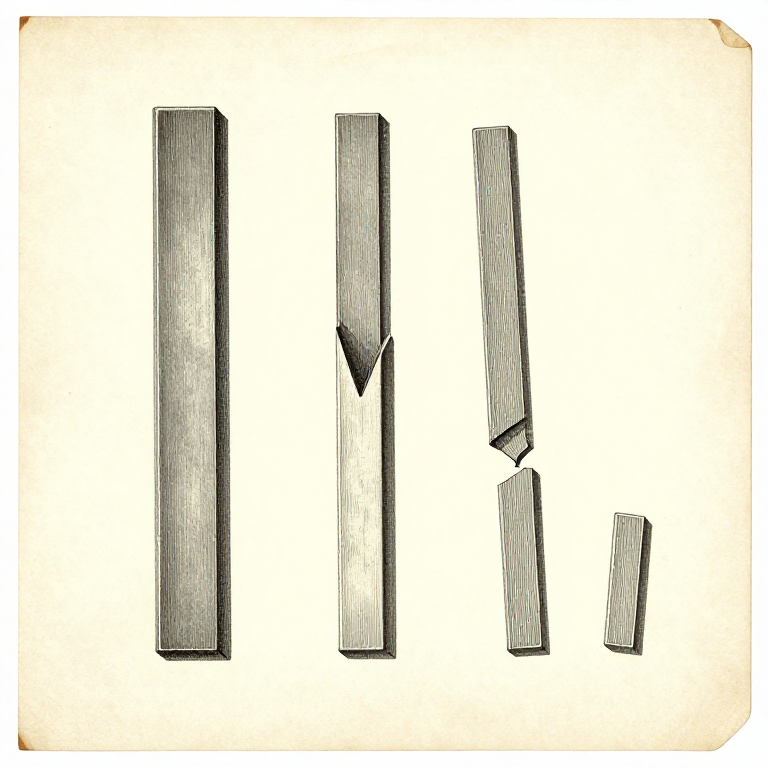


Cutting Hot Metal: The Hardy, the Chisel, and Never Through to the Face
Hot steel cuts like hard cheese. A chisel that would barely mark a cold bar sinks through a bright orange one in a few blows, which makes cutting to length a forge operation rather than a saw one.
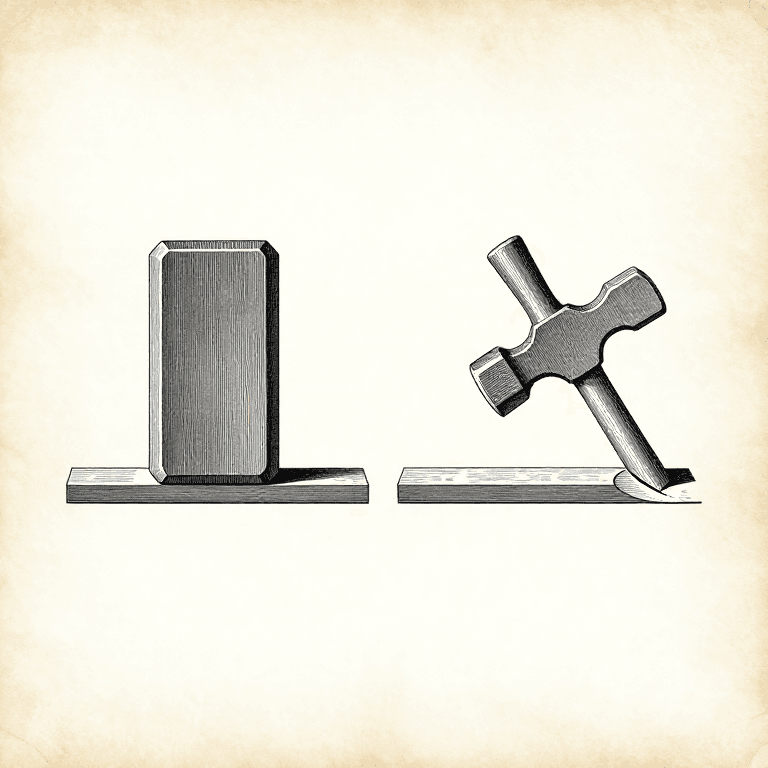
The rule that governs all of it: never cut all the way through onto the anvil FACE. The face is hardened and a chisel driven into it leaves a permanent notch that prints into everything you forge afterwards.
So you cut nearly through, then break — or you cut over the soft step, or over the hardy hole, where going through costs nothing.
Intermedio
2 hours
Istruzioni
1
1
The hot cut hardy: the chisel that points up
The hot cut hardy: the chisel that points up
Drop a hot cut hardy into the hardy hole and it becomes an upward-facing chisel. Lay the hot bar on it and hammer from above, and the bar is cut between the hammer and the hardy edge.
Rotate the bar as you go, cutting a groove all the way round rather than driving straight through one side. A bar cut from one side only ends up with a long drawn-out tail rather than a square end.
Stop before you go right through — leave a thin web — and break the piece off by bending it. Driving the last of the cut through drives the bar down onto the hardy's edge, and a hardy is much easier to damage than to replace.
Materiali per questo passaggio:
 Barra di acciaio dolce1 pezzo
 Carbone di legna1 pezzo
Strumenti necessari:
 Tagliolo da incudine
 Incudine
 Martello da fabbro
 Tenaglie da fabbro
2
2
A hot chisel from above, over the step
A hot chisel from above, over the step
A hand-held hot chisel does the same job from the top, which suits cutting part way in — a shoulder, a slit for a joint, a decorative line.
Work over the soft STEP of the anvil, not the face, wherever the chisel might go through. That is what the step is for, and it is why it is deliberately left unhardened.
Keep the hot chisel cool: dip it every few blows exactly as with a punch. A hot chisel is not hardened as far as a cold chisel — it relies on the work being softer than it is — so letting it get hot ruins the edge quickly.
Materiali per questo passaggio:
Barra di acciaio dolce1 pezzo Acqua1 pezzo
Strumenti necessari:
IncudineMartello da fabbroTenaglie da fabbro Guanti in cuoio a manichetta lunga
3
3
Hot chisel and cold chisel are different tools
Hot chisel and cold chisel are different tools
A COLD chisel is ground to a stout angle — around 60 degrees — because it has to survive cutting metal that is not giving way. A HOT chisel is ground much thinner, around 30 degrees, because hot steel offers little resistance and a thin edge cuts far better.
Use them the wrong way round and both fail: a cold chisel in hot steel is slow and leaves a rough cut, and a hot chisel in cold steel chips its edge off immediately.
Mark them so you cannot confuse them — a band of paint, a different handle, separate racks. The angle rung in the sharpening batch is where those numbers come from, and it is the same logic: the angle follows the job.
Strumenti necessari:
 Lente da orologiaioTagliolo da incudine
 Set di spazzole metalliche
4
4
Mind where the offcut goes
Mind where the offcut goes
A short hot offcut breaks free suddenly and flies. It is at forging heat, it is sharp, and it lands somewhere you were not looking.
Cut so the offcut falls away from you and downward, keep the floor clear of anything that will burn, and know where it went before you take the next heat. A hot offcut on the floor looks exactly like a cold one after a minute.
The same habit as the cooling rung: anything that has been in the fire is hot until proved otherwise, and it goes in one designated place. None of this makes the work risky — it is the small set of habits that makes it ordinary.
Materiali per questo passaggio:
Barra di acciaio dolce1 pezzoStrumenti necessari:
Tenaglie da fabbro Occhiali di sicurezza trasparentiGuanti in cuoio a manichetta lunga
Materiali
3- 1 pezzoSegnaposto
- 1 pezzoSegnaposto
- 1 pezzoSegnaposto
Strumenti richiesti
8- Segnaposto
- Segnaposto
- Segnaposto
- Segnaposto
- Segnaposto
- Segnaposto
- Segnaposto
- Segnaposto
Blueprint correlati
Questi blueprint condividono conoscenze — tecniche, materiali o principi
CC0 Pubblico dominio
Questo progetto è rilasciato sotto CC0. Sei libero di copiare, modificare, distribuire e utilizzare quest'opera per qualsiasi scopo, senza chiedere permesso.
Supporta il Maker acquistando prodotti tramite il suo progetto dove guadagna una Commissione Maker stabilita dai venditori, oppure crea una nuova iterazione di questo progetto e includilo come collegamento nel tuo progetto per condividere i ricavi.