ARTE
BELLEZZA E BENESSERE
MESTIERE
CULTURA E STORIA
DIVERTIMENTO
AMBIENTE
CIBO E BEVANDE
INGEGNERIA INVERSA
SCIENZE
SPORT
TECNOLOGIA
INDOSSABILI


Double-Swing Churn: Swing the Platform, the Toothed Pieces Work Both Dashers
Working a dash churn means lifting the dasher, again and again.
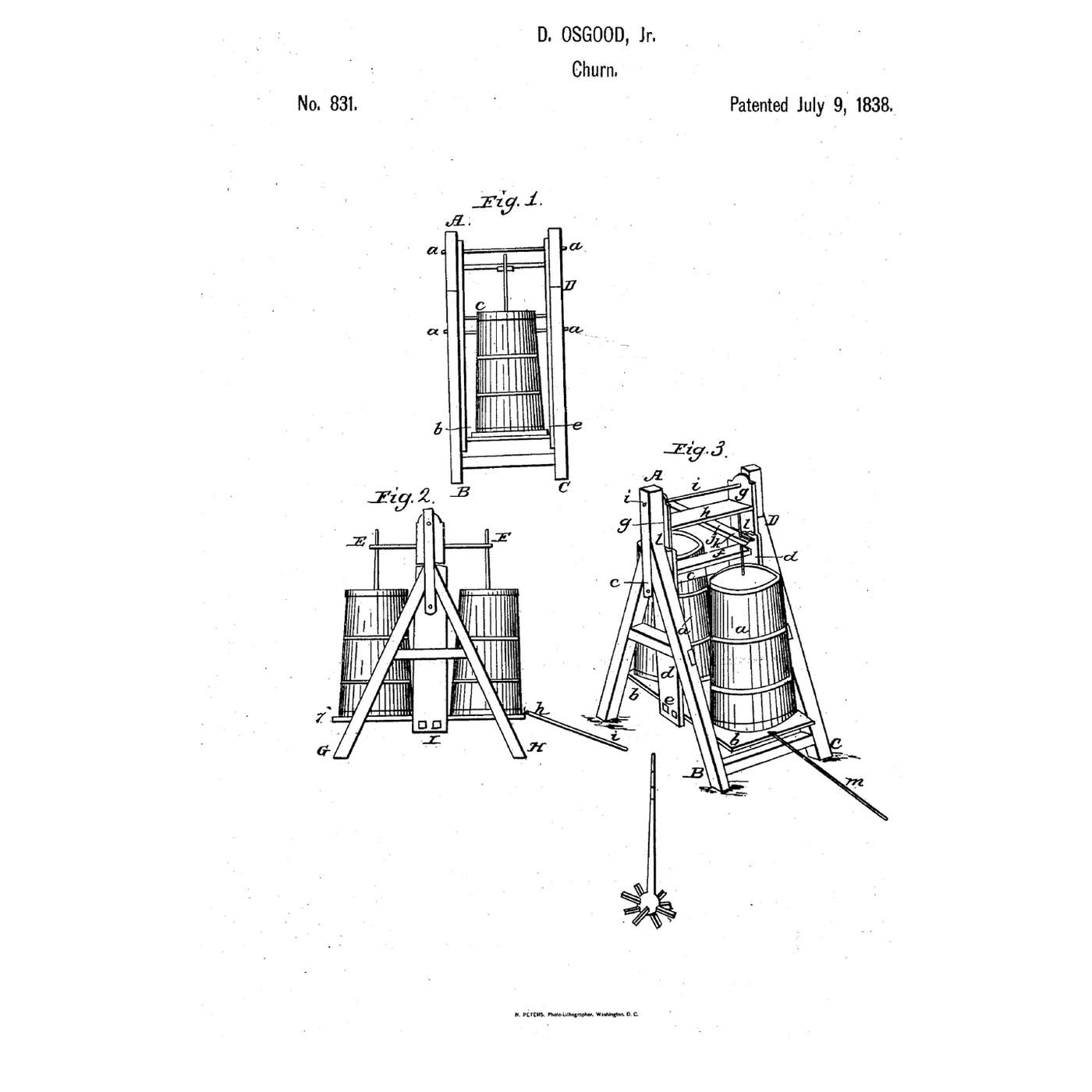
Daniel Osgood, Jr., of Bluehill, Maine, received US 831, dated 9 July 1838, for what he called "Osgood's Double-Swing Churn": two common churns on a platform swinging in a frame. The side pieces rising from the platform are cut into teeth that mesh with the teeth of two pieces hung above, so as the platform swings backward and forward a lever is alternately raised and depressed, "giving the downward and upward motion to the dashers." The power required, he wrote, "is nearly in proportion to the power required to draw a pendulum in its lateral motion compared with that of raising its weight."
This rung compares the swing of his platform and ours, then prints the toothed sectors, builds a tabletop frame for two jars, and makes butter.
Intermedio
About 6 hours, plus printing
Istruzioni
1
1
Swing period and dasher stroke
Swing period and dasher stroke
Caricamento del notebook Jupyter…
2
2
One load balancing another on a lever
One load balancing another on a lever
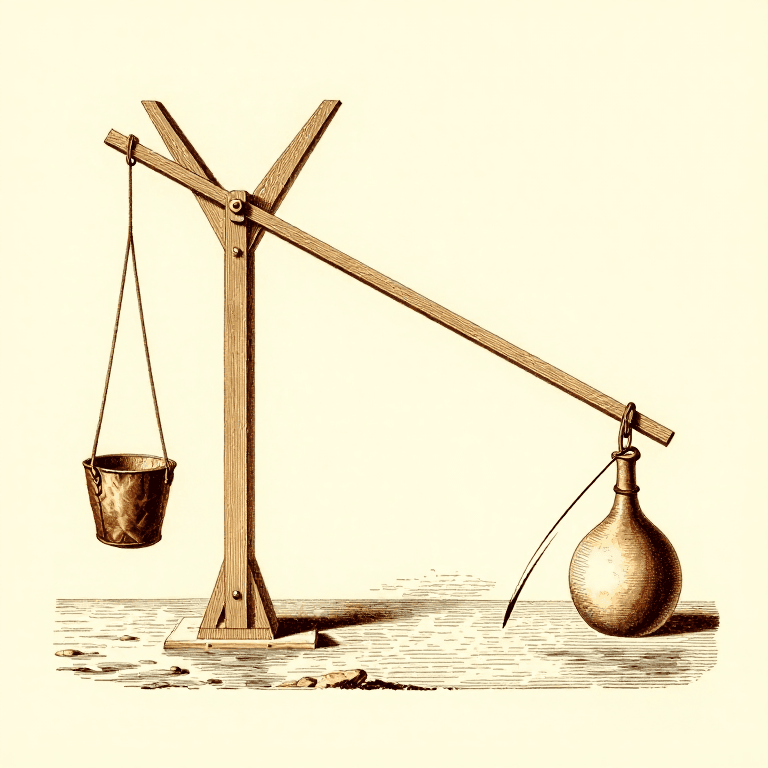
The embedded blueprint lifts water with a counterweighted beam. Osgood's beam balances one churn's dasher against the other's, and he says to balance a single churn with a weight.
3
3
Read US 831
Read US 831
"This saving of labor is acquired by placing two common churns, Figure 3 (a a) on a swinging platform (b). This platform is made to swing by being suspended in the frame A, B, C, D, by a rod passing through the frame and two pieces (d d) rising from the sides of the platform (b)... The ends of the side pieces (d, d,) and the corresponding upper, pieces (g, g,) are cut into teeth or cogs (l l,) and mesh into each other."
4
4
Print four toothed sectors
Print four toothed sectors
Print four identical sectors (/uploads/blueprints/double-swing-churn-sector.stl), flat. Each has a 6.6 mm pivot hole at the centre of its teeth and two screw holes in its tail. Print in PETG at 0.2 mm layers, 30 % infill, 4 walls; wash before first use.
Materiali per questo passaggio:
 Filamento PETG1 pezzo
Strumenti necessari:
 Stampante 3D a filamento (FDM)
5
5
Build the frame and platform
Build the frame and platform
Make two A-frames of pine about 420 mm tall, joined at the top by a cross bar. Drill both for two 6 mm steel rods 60 mm apart, one above the other: the lower rod carries the platform and the upper carries the beam. Cut a plywood platform 280 × 130 mm. Screw an upright pine strip to each side of the platform, reaching up to the lower rod, and screw a sector to the top of each strip, teeth up and pivot on the rod.
Materiali per questo passaggio:
 Tavola di pino1 pezzo
 Pannello di compensato1 pezzo
 Tondo di acciaio dolce1 pezzo
 Vite da legno #8 x 1"1 pezzo
 Colla da legno1 pezzo
Strumenti necessari:
 Sega a mano
 Seghetto per metalli
 Trapano a batteria
 Serie di punte da trapano
 Morsetti
 Metro a nastro
6
6
Hang the beam and dashers
Hang the beam and dashers
Screw the other two sectors to two short pine pieces hung on the upper rod, teeth down, meshing with the lower ones. Join the hung pieces with a cross bar and fix a beam across it at right angles, 200 mm long. Hang a dowel dasher with a plywood disc from each end on a loose screw, through a hole in each jar's lid. Fit a long handle to the platform.
Materiali per questo passaggio:
Tavola di pino1 pezzo Tasselli di legno duro1 pezzoPannello di compensato1 pezzo
 Barattolo di vetro2 pezziVite da legno #8 x 1"1 pezzo
Strumenti necessari:
Sega a manoTrapano a batteriaSerie di punte da trapano Set di cacciaviti
7
7
The patent drawing
The patent drawing
US 831 drawing sheet, public domain (expired patent).
8
8
Swing and make butter
Swing and make butter
Let the heavy cream stand until it reaches about 15 °C, checked with the thermometer. Pour half into each jar, no more than a third full, and fit the lids. Swing the platform steadily by the handle; the dashers rise and fall in turn. Time until the butter comes. Pour off the buttermilk, add cold water, churn a little and pour off again until it runs clear; work in a pinch of salt and weigh the butter.
Materiali per questo passaggio:
 Panna da montare500 ml
 Sale marino grosso1 pezzo
 Acqua1 pezzo
Strumenti necessari:
 Termometro a sonda permanente
 Cronometro
 Bilancia digitale da cucina
 Grande ciotola da impasto in acciaio inossidabile
9
9
Teeth that slip, a swing that dies
Teeth that slip, a swing that dies
Double-swing churn troubleshooting.
Flow
Loading...
10
10
History and honest limits
History and honest limits
**Daniel Osgood, Jr.** of Bluehill, Hancock County, Maine, received US 831, dated 9 July 1838. He gave the dimensions for common use: a frame 3 ft 1 in high, churns 1 ft 7 in high, 14 inches across at the bottom and 12 at the top, a platform 2 ft 6 in by 1 ft, and the pendulum 1 ft 4 in from its rod to the platform. "When but one churn is necessary, the other may be dispensed with by substituting any other weight in its stead to balance the one that is used." He claimed "the manner in which the dashers are worked by the pendulous motion of the churn."
**Honest limits.** Jars on a tabletop frame stand in for his two churns, and printed sectors for his wooden teeth. FDM prints hold food in their layer lines, so wash well and replace when worn. Your times and weights are the result.
Materiali
11- 1 pezzoSegnaposto
- 1 pezzoSegnaposto
- 1 pezzoSegnaposto
- 1 pezzoSegnaposto
- 2 pezziSegnaposto
- 1 pezzoSegnaposto
- 1 pezzoSegnaposto
- 2 pezziSegnaposto
- 500 mlSegnaposto
- 1 pezzoSegnaposto
- 1 pezzoSegnaposto
Strumenti richiesti
12- Segnaposto
- Segnaposto
- Segnaposto
- 1 vendor sell this, none ship to you yetSegnaposto
- Segnaposto
- Segnaposto
- 1 vendor sell this, none ship to you yetSegnaposto
- Segnaposto
- Segnaposto
- Segnaposto
- Segnaposto
Questo progetto realizza
Blueprint correlati
Questi blueprint condividono conoscenze — tecniche, materiali o principi




CC0 Pubblico dominio
Questo progetto è rilasciato sotto CC0. Sei libero di copiare, modificare, distribuire e utilizzare quest'opera per qualsiasi scopo, senza chiedere permesso.
Supporta il Maker acquistando prodotti tramite il suo progetto dove guadagna una Commissione Maker stabilita dai venditori, oppure crea una nuova iterazione di questo progetto e includilo come collegamento nel tuo progetto per condividere i ricavi.