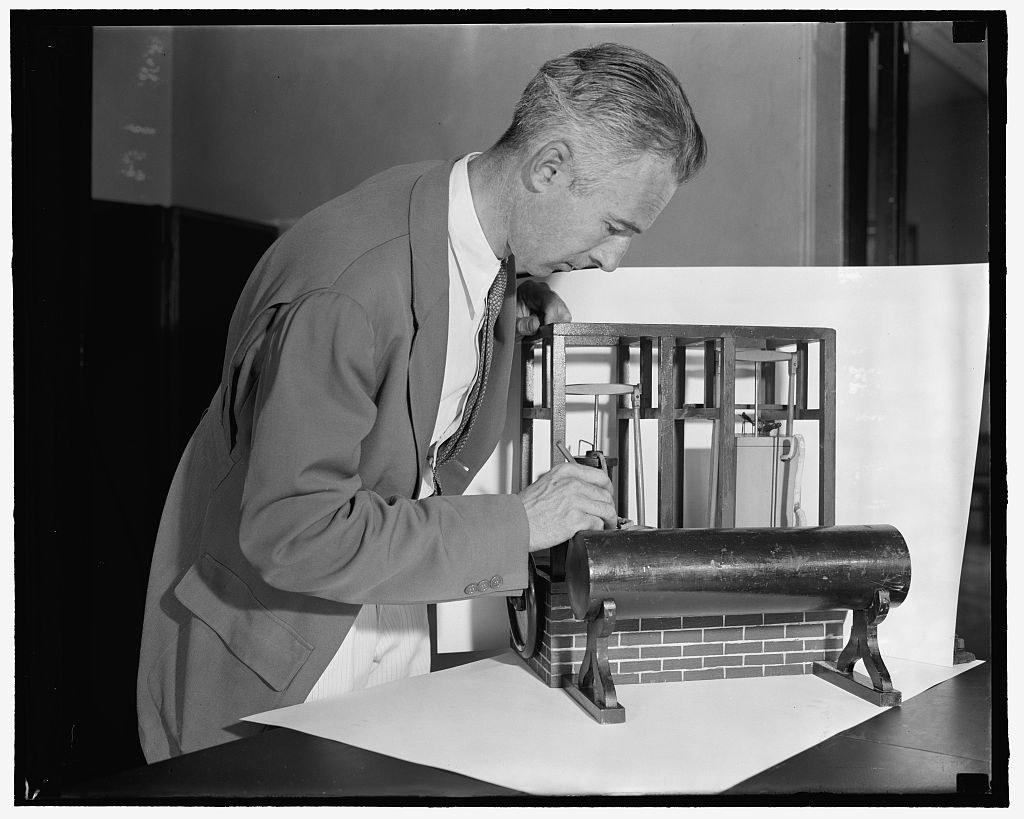


Gorrie Ice Machine
Until 1851 ice was harvested, not made. It was cut from frozen northern lakes in winter, packed in sawdust, and shipped south in insulated holds — an industry built entirely on the assumption that cold is something you find and move.
John Gorrie made cold instead of moving it. Compress air into a reservoir, let the heat of compression escape, then let that air expand again through an engine. Expanding gas does work on its surroundings, and the energy has to come from somewhere — so the gas cools sharply. Run a brine loop through that cold and you can freeze water in a warm room.
Gorrie was a physician in Apalachicola, Florida, trying to cool the rooms of malaria and yellow-fever patients. US Patent 8,080, "Improved process for the artificial production of ice", granted 6 May 1851 — the first US patent for mechanical refrigeration.
Istruzioni
Compressed air stores real energy
Compressed air stores real energy
Keep test pressures modest, use rated fittings, and never stand in line with a plugged end. Everything here works at bench scale — do not scale it up.
Read US 8,080 and note the two stages
Read US 8,080 and note the two stages
Gorrie compresses air, lets the heat of compression escape, then expands it again. Both stages are essential — expansion alone gives you nothing.
Feel a bicycle pump warm as you use it
Feel a bicycle pump warm as you use it
Pump hard and touch the barrel. Compressing air heats it. That is the first half of the cycle, and you can feel it with your hand.
Now feel a canister cool as it discharges
Now feel a canister cool as it discharges
Let compressed air out of a container and touch it. It goes cold. Expansion cools — and the whole machine is arranging these two effects in the right order.
Build a compressor with a receiver
Build a compressor with a receiver
Fit a piston pump feeding a rigid reservoir. This is where the air is squeezed and where it will sit while it sheds its heat.
Materiali per questo passaggio:
 Serbatoio di accumulo di energia ad aria compressa da 10 l e 300 bar1 pezzo
Water-cool the receiver and WAIT
Water-cool the receiver and WAIT
Sit the reservoir in cold water until it returns to room temperature. This step is the entire trick — you are discarding the heat of compression to the surroundings.
Strumenti necessari:
 Termometro da ambiente
Understand why waiting matters
Understand why waiting matters
If you expand air immediately it just returns to where it started. Removing heat while compressed means expansion takes it BELOW ambient — the cooling is bought with the heat you threw away.
Expand the air through a device that does work
Expand the air through a device that does work
Let it drive a small piston or turbine rather than simply venting. Air that does work cools far more than air that merely escapes.
Materiali per questo passaggio:
 Cilindro pneumatico1 pezzo
Measure the expansion temperature
Measure the expansion temperature
Put a thermometer in the exhaust. It should read well below room temperature — this is the cold you have manufactured.
Run a brine loop through the cold exhaust
Run a brine loop through the cold exhaust
Circulate salt water through a coil in the cold stream. Brine stays liquid below zero, so it can carry cold to where you want it.
Materiali per questo passaggio:
 Salamoia satura2 litri
 Tubo di rame3 metri
Immerse a vessel of fresh water in the brine
Immerse a vessel of fresh water in the brine
Suspend a small container of clean water in the chilled brine. Gorrie made ice in a bath exactly like this rather than freezing the working fluid itself.
Insulate everything you are not trying to cool
Insulate everything you are not trying to cool
Lag the brine loop and the vessel. Heat leaking in from the room is the largest loss in any small refrigeration rig, by a wide margin.
Cycle it repeatedly and watch ice form
Cycle it repeatedly and watch ice form
Compress, cool, expand, repeat. Ice appears at the edges of the vessel first, where contact with the brine is best.
Account for where the heat went
Account for where the heat went
Trace it: water → brine → expanding air → compressor work → the cooling water at step 6. Nothing was destroyed; heat was moved uphill, and the compressor paid for the lift.
Compendium — cold as a manufactured good
Compendium — cold as a manufactured good
The patent. US 8,080, "Improved process for the artificial production of ice", granted 6 May 1851 to John Gorrie of New Orleans, Louisiana — though he practised in Apalachicola, Florida. It is the first United States patent for mechanical refrigeration. Gorrie was a physician who believed, incorrectly, that malaria and yellow fever were caused by hot damp air; he built cooling machines to chill sickrooms, and the ice was a by-product of that goal. The medical theory was wrong and the machine was right.
The thermodynamics. Compressing a gas does work on it and raises its temperature. If that heat is then removed to the surroundings while the gas is still compressed, the gas has lost energy it cannot recover. Allowing it to expand — particularly against a piston, so it does work on the way out — drops it well below its starting temperature. This is the air-cycle or reverse-Brayton refrigeration cycle. The essential insight is that a refrigerator does not destroy heat; it moves heat from a cold place to a warm one, and the compressor work is the price of moving it uphill.
Why against a piston and not just a valve. Venting compressed gas through a restriction cools it too — the Joule-Thomson effect — but expanding it against a load extracts far more energy and gives a much larger temperature drop. Gorrie's patent specifies expansion through an engine for exactly this reason, and the same distinction separates a turboexpander from a throttle valve in modern plant.
He was destroyed commercially. The natural-ice industry was large, entrenched and hostile; the New York Globe reportedly mocked "a crank down in Apalachicola, Florida, that thinks he can make ice by his machine as good as God Almighty". Gorrie's financial backer died, he failed to raise more capital, and he died in 1855 having sold no machines. Air-cycle refrigeration was later superseded for most uses by vapour-compression systems, which are far more efficient because they exploit latent heat of vaporisation rather than the sensible heat of a gas — but it survives today in aircraft air-conditioning packs, where the compressed air is free from the engines and there is no refrigerant to carry. Florida placed a statue of Gorrie in the United States Capitol.
Materiali
4- Segnaposto
- 1 pezzoSegnaposto
- 2 litriSegnaposto
- 3 metriSegnaposto
Strumenti richiesti
1- Segnaposto
Blueprint correlati
Questi blueprint condividono conoscenze — tecniche, materiali o principi

CC0 Pubblico dominio
Questo progetto è rilasciato sotto CC0. Sei libero di copiare, modificare, distribuire e utilizzare quest'opera per qualsiasi scopo, senza chiedere permesso.
Supporta il Maker acquistando prodotti tramite il suo progetto dove guadagna una Commissione Maker stabilita dai venditori, oppure crea una nuova iterazione di questo progetto e includilo come collegamento nel tuo progetto per condividere i ricavi.