
Greek Theatre Mask
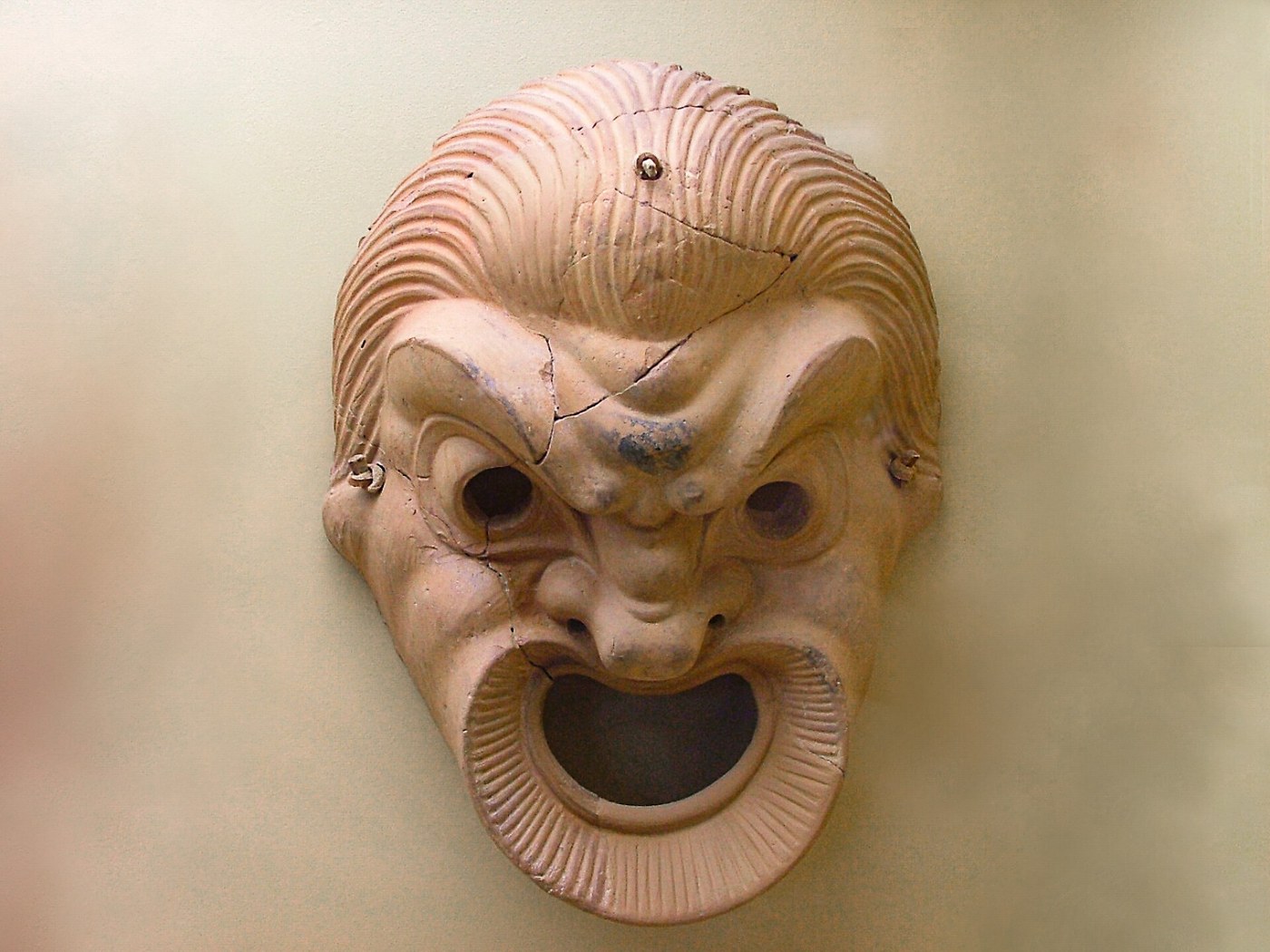
A Greek theatre held thousands of people, outdoors, in daylight, with the back rows a long way from the action. The actors wore masks — and the mask solved several problems at once. It made a face readable at distance, it let three actors play a dozen roles, and it let men play women and gods.
This blueprint builds one over a modelled clay form, in layers of linen and glue. That is a light, rigid, comfortable shell, and it is the technique most reconstructions use.
An honesty warning before you start: almost no Greek theatre masks survive. They were made of perishable materials — linen, cork, wood — and what we have instead are depictions: vase paintings, reliefs, and small terracotta souvenir models. Everything below is a reconstruction from that evidence, and the last step explains exactly which parts are solid and which are inference.
Istruzioni
Measure the wearer's face
Measure the wearer's face
Measure from chin to hairline and ear to ear. The mask must clear the face by 15 mm all round — it is worn over the head, not pressed against the skin.
Model the form in clay
Model the form in clay
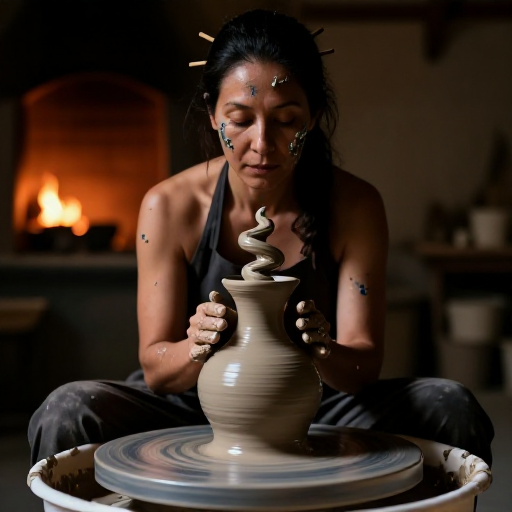
Build a solid clay form of the face, oversized to those measurements. This is a mould to work over and gets destroyed later — do not fire it.
Materiali per questo passaggio:
 Argilla da grès5 kg
Exaggerate every feature
Exaggerate every feature
Cut the brow deep, open the eyes wide, make the mouth large. Subtlety is invisible at 50 metres — the features must carry as shapes and shadows, not as detail.
Angle the features for the audience above
Angle the features for the audience above
Tilt the brow and cheekbones slightly upward. Greek audiences sat in a steep bowl looking down, so the mask reads from above, not from straight on.
Open the mouth wide
Open the mouth wide
Cut a large open mouth. The actor speaks through it, and any restriction muffles the voice — an unusable mask is one you cannot be heard through.
Cut the eye holes for real sight
Cut the eye holes for real sight
Make the eye openings large enough to see the floor as well as ahead. Actors moved on a raked stage among other performers; restricted sight is a genuine hazard.
Grease the clay form
Grease the clay form
Rub the clay with a thin film of grease or oil as a release layer. Without it the linen bonds to the clay and the shell tears coming off.
Materiali per questo passaggio:
 Cera d'api in pastiglie20 g
Lay the first linen layer
Lay the first linen layer
Tear linen into strips, soak in warm hide glue, and lay them over the form with overlaps. Tear rather than cut — torn edges blend invisibly, cut edges leave ridges.
Materiali per questo passaggio:
 Tessuto di lino1 metro
 Colla di pelle200 ml
Cross the grain on each layer
Cross the grain on each layer
Lay five to six layers, turning the strip direction roughly 45° each time. Crossed layers make the shell rigid in every direction — parallel layers stay floppy across the grain.
Dry slowly and lift off
Dry slowly and lift off
Dry fully — 24 hours at least — then ease the shell off the clay. Forcing it while damp distorts the face permanently.
Trim and smooth the shell
Trim and smooth the shell
Trim the edges, then skim the surface with a thin gesso of chalk and glue and sand it smooth. This gives a paintable face and stiffens the shell further.
Strumenti necessari:
 Carta abrasiva
Paint in flat strong colour
Paint in flat strong colour
Paint with earth pigments in flat areas, no blending. Ancient depictions show strong, simple colouring — and flat colour reads at distance where modelling does not.
Materiali per questo passaggio:
 Set di pigmenti minerali in polvere1 set
Fit the head strap and test outdoors
Fit the head strap and test outdoors
Fit a linen tape across the back so the mask sits without hands. Then walk 40 metres away and have someone wear it. Whatever does not read at that distance is not finished.
History & Context
History & Context
What survives, and what does not. This is the crucial caveat. Greek theatre masks were made from perishable materials and essentially none survive. Our evidence is indirect: painted scenes on pottery showing actors holding or wearing masks, sculptural reliefs, and small terracotta miniatures that appear to be votives or souvenirs rather than working masks. So the general appearance is well attested, while construction details are reconstructed. Anyone presenting a definitive "how the Greeks made masks" is going beyond the evidence.
Why masks at all. Several problems solved at once. Greek theatres were large and open-air, so a face needed to read at great distance — masks give bold, unchanging, legible features. A small cast, conventionally three speaking actors, had to cover many roles, and a mask change is instant where a costume change is not. And with an all-male cast, masks let actors play women and gods.
The voice question. It is often claimed the mask's mouth acted as a megaphone to amplify the actor. That is doubtful on acoustic grounds and is not supported by good evidence — a small horn of that shape does very little at those frequencies. What is clear is that the mouth had to be wide enough not to obstruct the voice. Greek theatres achieved their remarkable audibility through the geometry of the stone bowl, not through the masks.
A fixed face, a moving body. A mask cannot change expression, which sounds like a limitation and turns out to be a discipline. Meaning has to be carried by the body, the voice, and the angle at which the mask is held to the light. Tilt a well-made mask down and it reads as grief; lift it and it reads as defiance. The performer animates a fixed object, which is precisely the skill that also underlies wayang kulit and Noh.
The words we inherited. The Greek for mask, prosopon, also meant face and came to mean the character itself; the Latin persona followed the same path and gave English "person" and "personality". The idea that identity is something worn is buried in the vocabulary.
Materiali
5- 5 kgSegnaposto
- Segnaposto
- 1 metroSegnaposto
- 200 mlSegnaposto
- Segnaposto
Strumenti richiesti
1- Segnaposto
Questo progetto realizza
CC0 Pubblico dominio
Questo progetto è rilasciato sotto CC0. Sei libero di copiare, modificare, distribuire e utilizzare quest'opera per qualsiasi scopo, senza chiedere permesso.
Supporta il Maker acquistando prodotti tramite il suo progetto dove guadagna una Commissione Maker stabilita dai venditori, oppure crea una nuova iterazione di questo progetto e includilo come collegamento nel tuo progetto per condividere i ricavi.