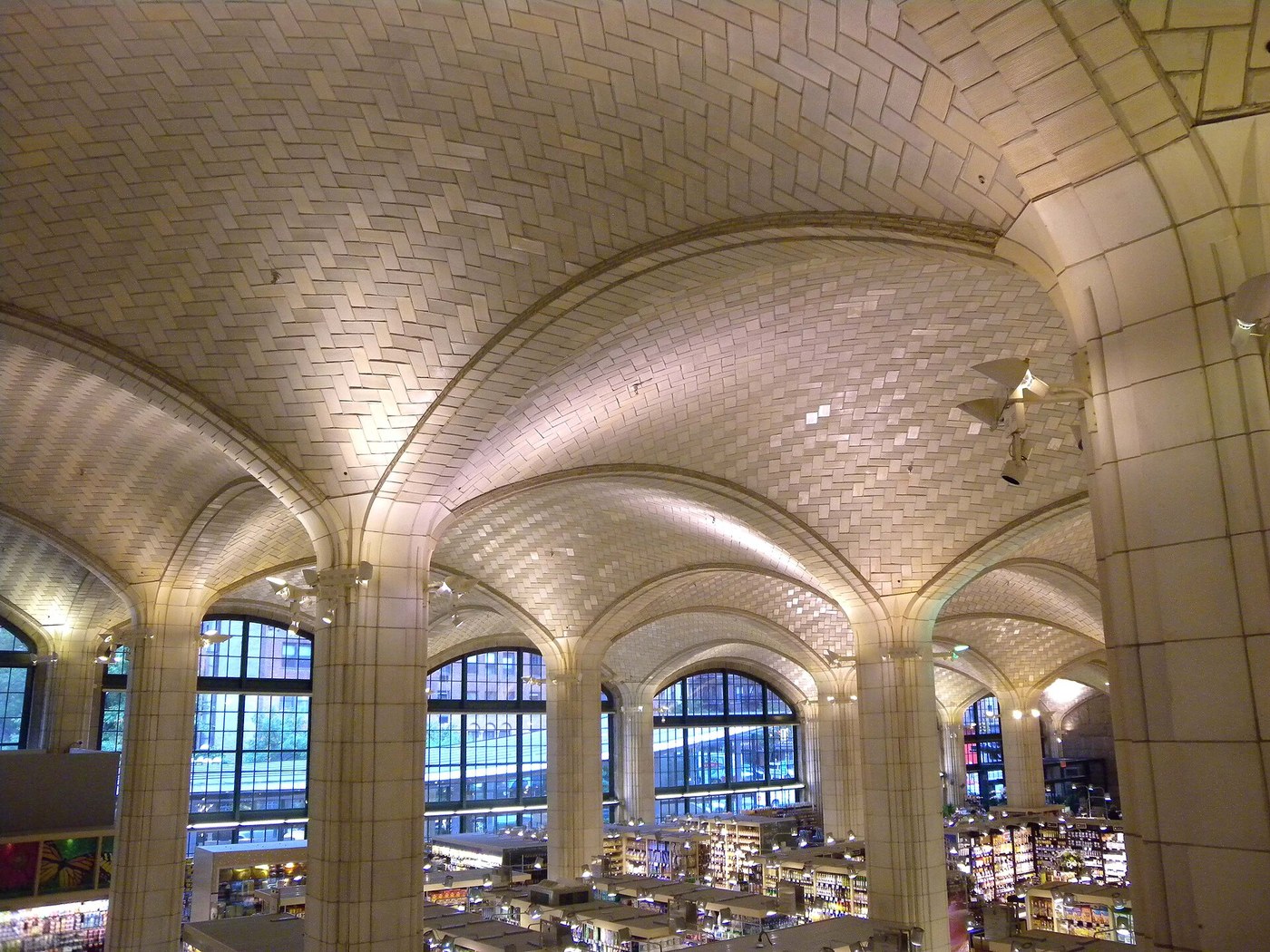

Bóveda Tabicada
Una bóveda de piedra es pesada y necesita una enorme cimbra de madera que la sostenga mientras se construye. Es cara, lenta y, sobre todo, la madera arde: en un incendio, el fuego se lleva primero los andamios y los pisos de vigas, y el edificio se derrumba.
La idea de Guastavino es hacer la bóveda con ladrillos-baldosa muy finos, en varias capas, pegados con yeso o cemento. Cada baldosa es delgada y ligera; se colocan de plano, en dos o tres capas que "traban" las juntas, de modo que el conjunto se comporta como una sola piedra continua — lo que él llamó "construcción cohesiva."
Y como el yeso agarra en segundos, la primera capa se sostiene sola casi sin cimbra: la bóveda se levanta a mano, en voladizo, sin el bosque de madera de una bóveda de piedra. El resultado es fino, ligero, resistente y — al no tener madera — incombustible.
Patente de EE. UU. 323.930, "Construcción de edificios a prueba de fuego", concedida el 11 de agosto de 1885 a Rafael Guastavino, arquitecto valenciano emigrado a Nueva York.
Istruzioni
Lee el término clave: construcción cohesiva
Lee el término clave: construcción cohesiva
Guastavino reclama unir varias capas de baldosa fina con cemento o yeso hasta formar "una sola estructura íntegra… como una gran piedra." Anota: lo que importa es la LAMINACIÓN.
Rompe una sola baldosa fina
Rompe una sola baldosa fina
Apoya una baldosa fina en los extremos y presiona el centro. Se parte enseguida — una capa sola es frágil. Anota la fuerza.
Materiali per questo passaggio:
 Tessera di mosaico1 confezione
Strumenti necessari:
 Dinamometro (bilancia a molla)
Prepara yeso de fraguado rápido
Prepara yeso de fraguado rápido
Mezcla yeso con poca agua. Fragua en segundos — esa rapidez es lo que permite construir casi sin cimbra.
Materiali per questo passaggio:
 Gesso da presa500 g
Pega dos baldosas planas trabando la junta
Pega dos baldosas planas trabando la junta
Une dos baldosas de plano con yeso, pero desplazando la segunda capa para que su junta no coincida con la de abajo. Trabar las juntas es la clave.
Añade una tercera capa, otra vez trabada
Añade una tercera capa, otra vez trabada
Pon una tercera capa desplazando de nuevo las juntas. Ahora ninguna junta atraviesa el espesor: es un panel continuo, no un montón de baldosas.
Rompe el panel laminado y compara
Rompe el panel laminado y compara
Apoya el panel de tres capas y cárgalo como en el paso 2. Aguanta muchísimo más que la baldosa suelta, con muy poco peso extra. Esa es la construcción cohesiva.
Levanta un arco fino sin cimbra
Levanta un arco fino sin cimbra
Empieza a colocar baldosas en curva desde un apoyo, en voladizo, dejando que el yeso rápido sujete cada una. El arco se sostiene solo mientras avanza, sin molde de madera.
Cierra el arco con la clave
Cierra el arco con la clave
Coloca la última baldosa en lo alto. En cuanto cierra, el arco trabaja a compresión y se vuelve firme. Retira la mano: se queda.
Refuerza con una segunda y tercera capa
Refuerza con una segunda y tercera capa
Sobre el arco fino, pega capas trabadas como en los pasos 4-5. La cáscara delgada se convierte en una bóveda cohesiva, fina pero rígida.
Carga la bóveda por arriba
Carga la bóveda por arriba
Pon peso sobre la clave. La bóveda lo lleva a los apoyos como compresión pura, igual que un arco de piedra, pero pesando una fracción. Mide cuánto aguanta.
Comprueba el empuje en los apoyos
Comprueba el empuje en los apoyos
Como todo arco, empuja hacia afuera en la base. Sujeta los apoyos y nota la fuerza. Sin tirante o estribo, la bóveda se abre — hay que atar el empuje.
Acerca una llama: no arde
Acerca una llama: no arde
Baldosa y cemento no arden. Compáralo con un piso de vigas de madera. Esta es la razón por la que se llama "a prueba de fuego": era el suelo que no se venía abajo en un incendio.
Historia y contexto — la bóveda catalana que conquistó América
Historia y contexto — la bóveda catalana que conquistó América
La patente. Patente de EE. UU. 323.930, "Construcción de edificios a prueba de fuego", concedida el 11 de agosto de 1885 a Rafael Guastavino, de Nueva York. La memoria describe con precisión el sistema: tabiques y bóvedas hechos de "dos o más espesores de ladrillo-baldosa unidos entre sí con cemento o yeso," con baldosas de unos tres cuartos de pulgada de grueso, trabando las juntas, hasta formar "una sola estructura íntegra, sin solución de continuidad, semejante a una gran piedra."
La técnica no la inventó él — la trajo. La bóveda tabicada (o bóveda catalana, o "timbrel vault") es una tradición mediterránea de siglos, muy viva en Valencia y Cataluña, donde Guastavino se formó: baldosas finas colocadas de plano, no de canto, pegadas con yeso rápido, que permiten levantar bóvedas ligerísimas casi sin cimbra. Lo que Guastavino hizo fue patentar, sistematizar y vender esa tradición como "construcción cohesiva" en un país — Estados Unidos — obsesionado en esos años con una cosa: el fuego. Tras los grandes incendios de Chicago (1871) y Boston (1872), las ciudades exigían edificios incombustibles, y un suelo o una bóveda de baldosa y cemento no arde donde un entramado de vigas de madera se consume (paso 12). Ese fue su argumento de venta, y funcionó.
Por qué es tan ingeniosa desde el punto de vista estructural. Dos ideas se juntan. Primera, la laminación: varias capas finas trabadas se comportan como una sola cáscara continua, mucho más resistente que la suma de baldosas sueltas (paso 6) — es el mismo principio que la madera contrachapada o el vidrio laminado. Segunda, la forma: al curvarla en arco o bóveda, la cáscara trabaja a compresión pura (pasos 8 y 10), que es justo donde la cerámica y el mortero son fuertes, de modo que una piel de apenas unos centímetros puede cubrir salas enormes. Y como el yeso agarra al instante, la bóveda se autosostiene mientras se construye, sin el bosque de cimbra que exige la piedra.
Dónde vive hoy. Rafael Guastavino y su hijo levantaron con este sistema algunas de las bóvedas más admiradas de Estados Unidos: la Grand Central Terminal y su "galería de los susurros," la Biblioteca Pública de Boston, el Registro de la Ellis Island, cúpulas de catedrales, estaciones de metro. Más de mil edificios llevan sus bóvedas. Es un caso hermoso de cómo una técnica artesanal del Mediterráneo, patentada y llevada al Nuevo Mundo, se convirtió en ingeniería de vanguardia — y de por qué a veces la construcción más avanzada consiste en colocar, a mano y con paciencia, baldosas muy finas.
Materiali
2- 1 confezioneSegnaposto
- 500 gSegnaposto
Strumenti richiesti
1- Segnaposto
Blueprint correlati
Questi blueprint condividono conoscenze — tecniche, materiali o principi


CC0 Pubblico dominio
Questo progetto è rilasciato sotto CC0. Sei libero di copiare, modificare, distribuire e utilizzare quest'opera per qualsiasi scopo, senza chiedere permesso.
Supporta il Maker acquistando prodotti tramite il suo progetto dove guadagna una Commissione Maker stabilita dai venditori, oppure crea una nuova iterazione di questo progetto e includilo come collegamento nel tuo progetto per condividere i ricavi.