ARTE
BELLEZZA E BENESSERE
MESTIERE
CULTURA E STORIA
DIVERTIMENTO
AMBIENTE
CIBO E BEVANDE
INGEGNERIA INVERSA
SCIENZE
SPORT
TECNOLOGIA
INDOSSABILI
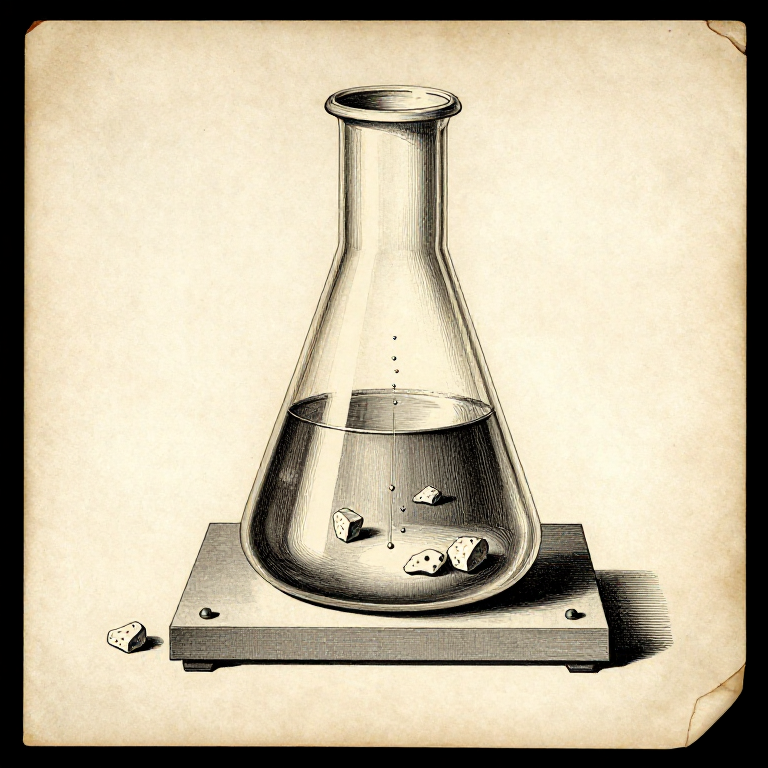


Heating and Stirring Without Bumping: Why the Flask Spat at You
A liquid heated in smooth glass can go ABOVE its boiling point without boiling, because a bubble needs somewhere to start and clean glass offers nowhere. When one finally does start, the whole superheated volume flashes into vapour at once.
That is bumping, and it throws the contents out of the vessel. It is most likely in exactly the situation where it matters most: clean new glassware, a quiet liquid, somebody watching closely from above.
The cure is to give bubbles somewhere to form, all the time, so that none of the liquid ever gets the chance to superheat. Boiling chips or a stirrer bar do that, and they are not optional extras.
Principiante
2 hours
Istruzioni
1
1
Boiling chips or a stirrer bar, added COLD
Boiling chips or a stirrer bar, added COLD
Add boiling chips or a magnetic stirrer bar before heating starts. Their porous surface or their motion keeps a stream of small bubbles going, and small bubbles continuously are what prevents one enormous one suddenly.
Never add boiling chips to a liquid that is already hot. A superheated liquid given a nucleation site all at once does exactly what the chips were meant to prevent, and does it while your hand is over the vessel.
Chips are single-use. Once cooled, their pores fill with liquid and they stop working, so a flask reheated after cooling needs fresh ones — added, again, while it is cold.
Materiali per questo passaggio:
 Acqua distillata1 litro
Strumenti necessari:
 Beuta di Erlenmeyer
 Piastra riscaldante con agitatore magnetico
 Piastra riscaldante
2
2
Heat the outside evenly, not one spot
Heat the outside evenly, not one spot
A hot plate heats the whole base; a flame heats a coin-sized patch to a temperature far above the liquid's boiling point. That hot spot is where superheating, decomposition and cracked glass all start.
A water or steam bath is better again for anything below 100 degrees: it cannot exceed the boiling point of its own water, so it physically cannot overheat the contents. Sand baths and oil baths do the same job at higher temperatures.
Use borosilicate, and never heat a vessel that is cracked, chipped or scratched. Thermal stress finds the flaw, and a flask that fails while hot empties its contents across the bench.
Materiali per questo passaggio:
 Acqua1 litro
Strumenti necessari:
Piastra riscaldante Becher in borosilicato
 Pinza da laboratorio (buretta/pallone)
 Occhiali antispruzzo chimico
3
3
Stir the liquid, do not just heat it
Stir the liquid, do not just heat it
Hot liquid rises and cold sinks, so an unstirred vessel develops a hot layer at the bottom and a cool one above. The thermometer reads one of those and the reaction experiences the other.
A magnetic stirrer bar turns the whole volume over and makes the temperature you measure the temperature that is actually happening. It also keeps a suspension suspended, which matters whenever a solid is dissolving or reacting.
Match the bar to the vessel. A bar too long for a round-bottom flask will not spin, and a bar that has lost its grip on the field spins wildly, chips the glass, and grinds the solid you were trying to dissolve.
Materiali per questo passaggio:
 Cloruro di sodio (sale)1 pezzoAcqua distillata1 litro
Strumenti necessari:
Piastra riscaldante con agitatore magnetico Bacchetta di vetro
 Becher di vetro
4
4
Never seal it, and never look straight down it
Never seal it, and never look straight down it
A heated closed vessel is a pressure vessel. Loosen every stopper, and use a watch glass resting loosely on a beaker rather than anything that seals — it keeps dust out and lets vapour go.
Never point the mouth of a heated tube or flask at yourself or anyone else, and never lean over one to look in. If a vessel does bump, what comes out goes straight up.
And keep the heating under control at the end: remove the heat before the last of the liquid goes, the same rule as evaporating. A dry vessel still on the plate reaches the plate's full temperature within a minute or two.
Strumenti necessari:
 Vetro da orologioOcchiali antispruzzo chimicoPinza da laboratorio (buretta/pallone)Piastra riscaldante
Materiali
3- 2 litriSegnaposto
- 1 litroSegnaposto
- 1 pezzoSegnaposto
Strumenti richiesti
9- Segnaposto
- Segnaposto
- Segnaposto
- Segnaposto
- Segnaposto
- Segnaposto
- Segnaposto
- Segnaposto
Blueprint correlati
Questi blueprint condividono conoscenze — tecniche, materiali o principi


CC0 Pubblico dominio
Questo progetto è rilasciato sotto CC0. Sei libero di copiare, modificare, distribuire e utilizzare quest'opera per qualsiasi scopo, senza chiedere permesso.
Supporta il Maker acquistando prodotti tramite il suo progetto dove guadagna una Commissione Maker stabilita dai venditori, oppure crea una nuova iterazione di questo progetto e includilo come collegamento nel tuo progetto per condividere i ricavi.