

Identifying and Collecting Malachite — Copper Carbonate Ore from the Earth
Istruzioni
Understand what malachite is
Understand what malachite is
Malachite is copper carbonate hydroxide with the chemical formula Cu₂CO₃(OH)₂. It contains approximately 57.5% copper by mass. It forms in the oxidation zone above copper ore deposits, where copper-bearing solutions react with carbonate minerals and limestone.
Learn the geological setting
Learn the geological setting
Malachite forms in the upper oxidized zone of copper deposits, typically within the first 20-50 meters below the surface. Look near limestone or dolomite bedrock where copper-rich groundwater has percolated. It often occurs alongside azurite (blue copper carbonate), chrysocolla (blue-green), and native copper.
Identify malachite by color
Identify malachite by color
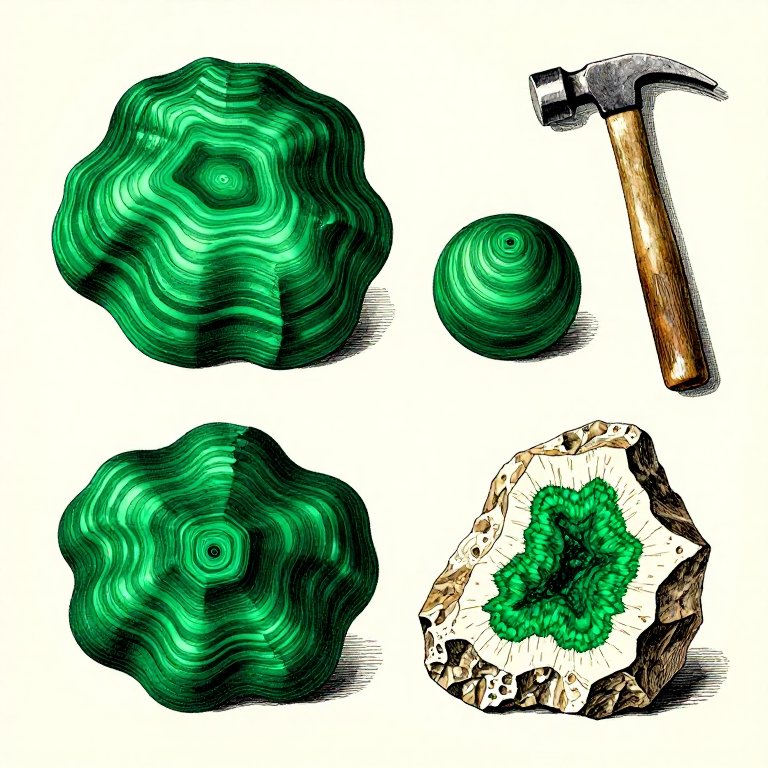
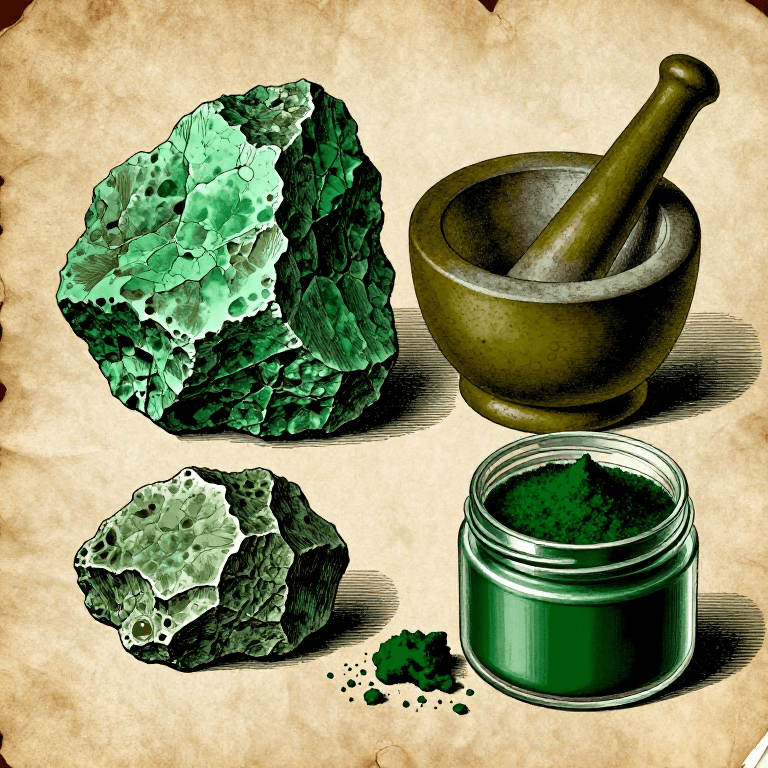
Malachite has a distinctive bright green to dark green color. It often displays characteristic banded patterns of alternating light and dark green when cut or broken. No other common mineral has this exact combination of green color with concentric banding. The color comes from the copper (Cu²⁺) content.
Test the hardness
Test the hardness
Malachite has a Mohs hardness of 3.5 to 4. It can be scratched by a steel knife (hardness 5.5) but NOT by a copper coin (hardness 3). If the green mineral is too hard to scratch with a knife, it is likely chrysocolla or a different mineral.
Strumenti necessari:
 Coltellino d'acciaio
 Moneta di rame
Perform the streak test
Perform the streak test
Drag the mineral across an unglazed white porcelain tile (streak plate). Malachite leaves a light green streak. This is different from chrysocolla (white to pale green streak) and helps confirm identification. The streak is always lighter than the mineral's surface color.
Strumenti necessari:
 Piastra da striscio in porcellana
Test with dilute hydrochloric acid
Test with dilute hydrochloric acid
Place one drop of dilute hydrochloric acid (10% HCl) on the mineral surface. Malachite fizzes vigorously because it is a carbonate — the acid reacts with CO₃ to release carbon dioxide gas. This carbonate fizz test distinguishes malachite from non-carbonate green minerals like chrysocolla or olivine.
Materiali per questo passaggio:
 Acido cloridrico10 milliliter
Strumenti necessari:
 Flacone contagocce di vetro (ambra)
 Occhiali a mascherina
Check the crystal habit
Check the crystal habit
Malachite rarely forms visible crystals. It typically occurs as botryoidal (grape-like) masses, stalactitic formations, or fibrous crusts. When it does form crystals, they are needle-like (acicular) prisms. Massive malachite shows the characteristic concentric banding when sliced.
Strumenti necessari:
 Lente d'ingrandimento 10x
Assess the deposit size
Assess the deposit size
Before extracting, evaluate how much malachite is present. Surface staining (thin green films on rock) indicates trace amounts. Solid nodules or crusts thicker than 5mm suggest a worthwhile collecting site. For copper smelting, you need at least 1-2 kg of solid malachite per attempt.
Prepare your safety equipment
Prepare your safety equipment
Wear safety goggles, leather gloves, and a dust mask before extracting malachite. Malachite dust contains copper, which is toxic if inhaled in significant quantities. Never eat, drink, or smoke while handling copper minerals. Wash hands thoroughly after handling.
Strumenti necessari:
Occhiali a mascherina Guanti da lavoro in pelle
 Mascherina antipolvere
Extract malachite from host rock
Extract malachite from host rock
Use a geological hammer and cold chisel to separate malachite from the surrounding rock. Strike the chisel at the boundary between malachite and host rock. Work gently — malachite is relatively soft and can shatter if struck too hard. Pry rather than smash.
Strumenti necessari:
 Martello da geologo
 Scalpello da taglio a freddo
Separate malachite from matrix rock
Separate malachite from matrix rock
Trim excess host rock from the malachite specimens using the chisel. For smelting purposes, it does not need to be perfectly clean — some attached limestone is acceptable as it acts as flux. For display specimens, carefully remove matrix to expose the green mineral.
Strumenti necessari:
Scalpello da taglio a freddoSort by quality and purpose
Sort by quality and purpose
Separate your collection into three piles: (1) solid malachite pieces for smelting — these yield the most copper, (2) banded or botryoidal specimens for display or pigment making, (3) mixed rock with trace malachite — low grade, keep only if large quantity available.
Weigh your collection
Weigh your collection
Weigh the sorted malachite. Pure malachite contains about 57.5% copper, but field specimens are rarely pure. Expect 20-40% copper content from typical collected material after accounting for matrix rock. You need roughly 2 kg of good malachite to produce 500-800 g of metallic copper.
Strumenti necessari:
 Bilancia digitale da cucina
Wash specimens
Wash specimens
Rinse malachite pieces under running water to remove loose dirt and rock dust. Use a stiff brush for stubborn deposits. For smelting stock, thorough cleaning is not critical. For display specimens, soak in clean water for 24 hours, then brush gently.
Materiali per questo passaggio:
 Acqua distillata5 litri
Strumenti necessari:
 Spazzola a setole dure
Dry the specimens
Dry the specimens
Lay washed malachite on newspaper or cloth in a well-ventilated area. Allow to air-dry completely — usually 24-48 hours. Malachite is stable in air and does not degrade, but storing wet specimens can promote mold growth on any organic material trapped in crevices.
Store safely
Store safely
Store dried malachite in labeled cloth bags or open containers. Do not seal in airtight plastic — trapped moisture can cause surface degradation. Keep away from acids and acidic environments. Label each bag with collection date and location. Malachite is stable at room temperature indefinitely.
Materiali per questo passaggio:
 Sacchetto di stoffa per la conservazione3 pezzi
Record your find
Record your find
Document the collection site: GPS coordinates, geological formation, associated minerals (azurite, chrysocolla, native copper), depth found, and estimated remaining deposit. This data is valuable for return trips and for understanding the local geology.
Strumenti necessari:
 Taccuino da campo
Clean up the collection site
Clean up the collection site
Replace any large rocks moved during extraction. Fill holes to prevent erosion and ankle injuries. Remove all litter, including acid dropper bottles. Leave the site as you found it — responsible collecting preserves sites for future visits and for other collectors.
Materiali
3- 10 milliliterSegnaposto
- 5 litriSegnaposto
- Segnaposto
Strumenti richiesti
13- Segnaposto
- Segnaposto
- Segnaposto
- Segnaposto
- Segnaposto
- Segnaposto
- Segnaposto
- Segnaposto
- Segnaposto
- Segnaposto
- Segnaposto
- Segnaposto
- Segnaposto
Materiali dei progetti collegati

Questo progetto realizza
Blueprint correlati
Questi blueprint condividono conoscenze — tecniche, materiali o principi
CC0 Pubblico dominio
Questo progetto è rilasciato sotto CC0. Sei libero di copiare, modificare, distribuire e utilizzare quest'opera per qualsiasi scopo, senza chiedere permesso.
Supporta il Maker acquistando prodotti tramite il suo progetto dove guadagna una Commissione Maker stabilita dai venditori, oppure crea una nuova iterazione di questo progetto e includilo come collegamento nel tuo progetto per condividere i ricavi.