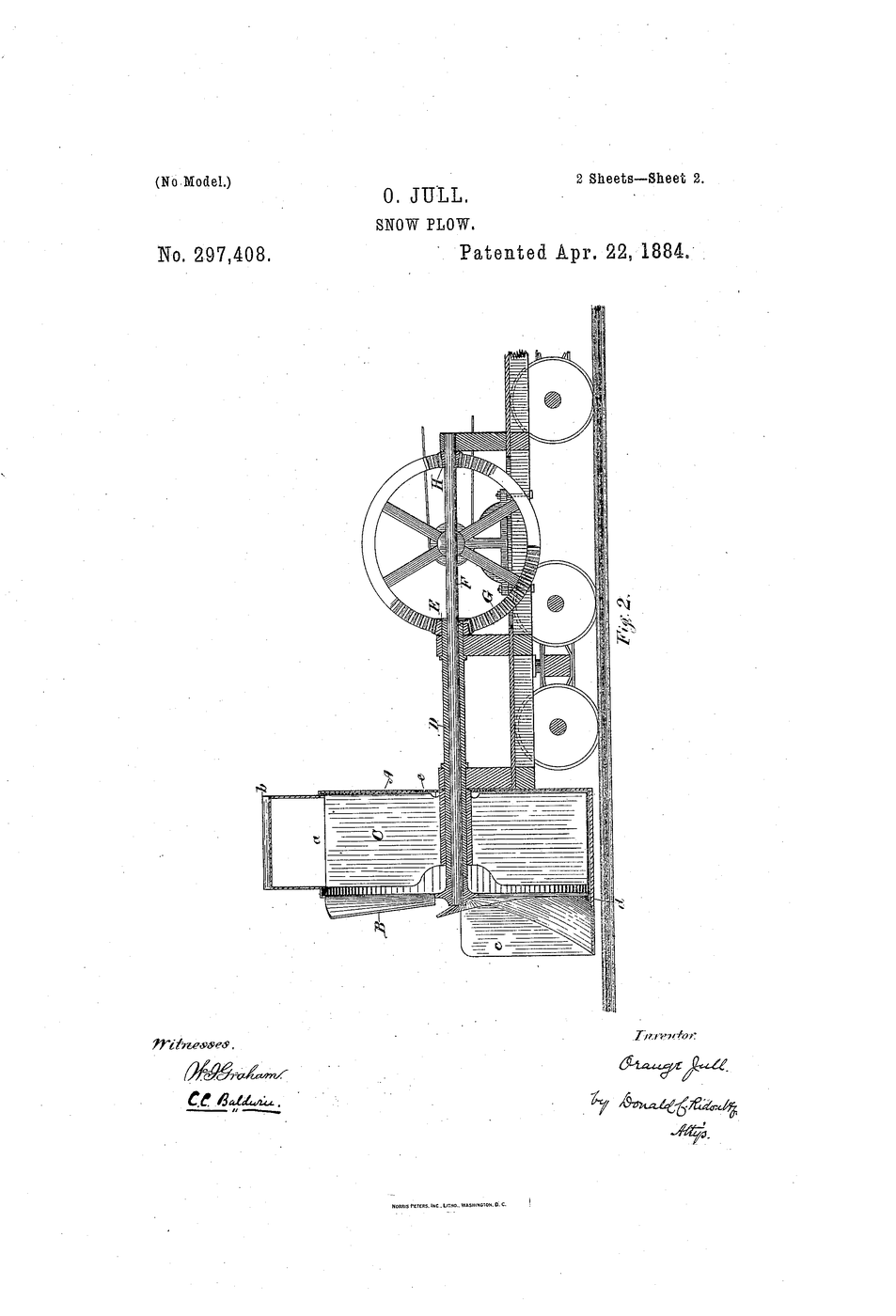


Rotary Snow Plough
A wedge plough clears snow by being rammed at it: the locomotive charges the drift and the wedge shoves it aside. It works in light snow and fails badly in deep or packed drifts, where the train simply buries itself and stops — sometimes with the crew shovelling for days.
Jull's plough attacks the snow with power instead of momentum. On one shaft it carries two things: cutting blades that slice the snow out of the bank, and fan blades that hurl the loosened snow clear of the track by centrifugal force. It is driven by its own engine, independent of whatever is pushing it, so the snow is cut and thrown at full power even when the machine is barely crawling forward.
Cut, then throw — two jobs, one axis. That division is the whole idea, and it is what lets a rotary eat a drift taller than itself.
US Patent 297,408, "Snow plow", granted 22 April 1884 to Orange Jull. The specification says it is "specially designed for use on railroads" but notes it could clear highway drifts or serve as an excavator.
Istruzioni
Read the claim: two blade sets, one centre
Read the claim: two blade sets, one centre
Jull claims cutting-blades that slice snow from the bank and fan-blades that throw it clear, operating on a common centre. Write both down as separate jobs.
Build the wedge plough first
Build the wedge plough first
Fold a card wedge about 100 mm wide and glue it to the front of a small card truck. This is the machine Jull was trying to beat.
Materiali per questo passaggio:
 Fogli di cartone ondulato1 foglio
Strumenti necessari:
 Pistola per colla a caldo
Make a drift of flour
Make a drift of flour
Heap plain flour across a tray to make a bank about 50 mm deep, and pat it down firmly. Loose flour is fresh snow; packed flour is the drift that stops trains.
Materiali per questo passaggio:
 Farina 00500 g
Strumenti necessari:
 Vassoio piatto
Ram the drift and measure how far you get
Ram the drift and measure how far you get
Run the wedge at the bank at a fixed speed. Measure how far it penetrates before it stalls and piles up. Record it.
Strumenti necessari:
 Metro a nastro
Cut the fan wheel
Cut the fan wheel
Cut a 90 mm card disc and glue on four rectangular vanes, standing square to the disc, evenly spaced. This wheel only throws.
Materiali per questo passaggio:
 Cartoncino1 foglio
Strumenti necessari:
 Goniometro / misuratore d'angoli
Cut the knife ring
Cut the knife ring
Cut a second 100 mm disc, cut four angled slots in its rim and bend the flaps forward into cutting edges. This ring only slices.
Materiali per questo passaggio:
Cartoncino1 foglioStrumenti necessari:
 Taglierino di precisione
Mount both on one shaft
Mount both on one shaft
Push a dowel through both discs, knife ring in front, fan behind, about 20 mm apart. Both turn together on a common centre, as claimed.
Materiali per questo passaggio:
 Tondino di legno (spina)1 pezzo
Strumenti necessari:
Pistola per colla a caldoBuild the housing with a side chute
Build the housing with a side chute
Wrap a card cylinder round the wheels, open at the front, with a chute cut in one side. Bearings: two holes in card end-plates for the shaft.
Materiali per questo passaggio:
Fogli di cartone ondulato1 foglioStrumenti necessari:
Taglierino di precisioneAdd a crank — its own power
Add a crank — its own power
Bend a wire crank onto the shaft. The plough now has power of its own, independent of how fast it is pushed forward. That is the difference from the wedge.
Materiali per questo passaggio:
 Filo di acciaio zincato1 metro
Eat the drift
Eat the drift
Crank steadily and advance the plough slowly into the packed bank. It cuts in and throws a stream of flour out of the chute. Measure the penetration and compare with step 4.
Strumenti necessari:
Metro a nastroMeasure the throw against speed
Measure the throw against speed
Crank slowly, then fast. Measure how far the flour lands each time. Throw distance climbs steeply with rim speed — centrifugal force, not shovelling.
Strumenti necessari:
Metro a nastroRemove the knife ring and try again
Remove the knife ring and try again
Run the fan alone into packed flour. It rubs and stalls — a fan cannot cut. Refit the ring: it bites again. The two jobs really are separate.
Aim the chute both ways
Aim the chute both ways
Cut a second chute on the other side and block one at a time. A real rotary must be able to throw downwind and away from the line, or it buries the track it just cleared.
Strumenti necessari:
Taglierino di precisioneHistory & Context — cutting, not charging
History & Context — cutting, not charging
The patent. US 297,408, "Snow plow", granted 22 April 1884 to Orange Jull. The specification describes cutting-blades that slice the snow from the bank and fan-blades that throw it clear by centrifugal force, working on a common centre, and notes the mechanism may be driven by an independent steam-engine. Jull is explicit that it is intended for railroads but could clear highways or work as an excavator.
Why the wedge had to go. A wedge plough converts the train's kinetic energy into snow displacement. That energy is fixed by the locomotive's speed and mass, so against a deep packed drift the train decelerates, the snow compacts ahead of it, and the plough stops — often stuck fast (step 4). A rotary brings its own engine, so the power going into the snow does not depend on forward speed at all. It can crawl forward at walking pace and still cut at full force (steps 9-10). This is a general engineering lesson worth keeping: when momentum is not enough, stop trying to go faster and drive the working element directly.
Why two blade sets. Packed snow must first be broken loose, then moved. A fan alone polishes and jams against a hard face (step 12); knives alone would loosen snow with nowhere to send it. Separating the functions and putting them on one shaft means one engine does both, and each set can be shaped for its own job — sharp angled edges for cutting, flat radial vanes for throwing. Throw distance rises sharply with rim speed (step 11), which is why rotaries can hurl snow far clear of the formation instead of piling it beside the rails to drift back.
Who built it. Jull, of Orangeville, Ontario, obtained patents in 1884 and assigned the rights to John and Edward Leslie, who developed and manufactured the machine — the first was built in 1885, and the Leslies formed a company to produce them. The rotary was decisive on mountain lines: crossings like Donner Pass in the Sierra Nevada became workable in winter in a way they had not been before. Jull himself went on to a different design, a screw-type "Jull centrifugal excavator", which was not the one that lasted.
An earlier idea that was never built. The rotary concept had been proposed years before by a Toronto dentist, J. W. Elliot, who patented a revolving snow shovel in 1869 but never constructed one. It is a familiar pattern in this programme: the person who first has the idea and the person who makes it work are often not the same, and the patent record shows both. Jull's contribution was a design that could actually be built and driven.
Where it sits. Rotary ploughs still clear mountain railways and airport runways, now diesel or electric rather than steam, and the domestic snow blower in a suburban garage is the same machine shrunk — an auger to cut, an impeller to throw, and a chute you aim downwind.
Materiali
5- 1 foglioSegnaposto
- 500 gSegnaposto
- 1 foglioSegnaposto
- 1 pezzoSegnaposto
- 1 metroSegnaposto
Strumenti richiesti
6- Segnaposto
- Segnaposto
- 1 vendor sell this, none ship to you yetSegnaposto
- Segnaposto
- Segnaposto
- Segnaposto
Blueprint correlati
Questi blueprint condividono conoscenze — tecniche, materiali o principi

CC0 Pubblico dominio
Questo progetto è rilasciato sotto CC0. Sei libero di copiare, modificare, distribuire e utilizzare quest'opera per qualsiasi scopo, senza chiedere permesso.
Supporta il Maker acquistando prodotti tramite il suo progetto dove guadagna una Commissione Maker stabilita dai venditori, oppure crea una nuova iterazione di questo progetto e includilo come collegamento nel tuo progetto per condividere i ricavi.