Collaborazione
ARTE
BELLEZZA E BENESSERE
MESTIERE
CULTURA E STORIA
DIVERTIMENTO
AMBIENTE
CIBO E BEVANDE
INGEGNERIA INVERSA
SCIENZE
SPORT
TECNOLOGIA
INDOSSABILI
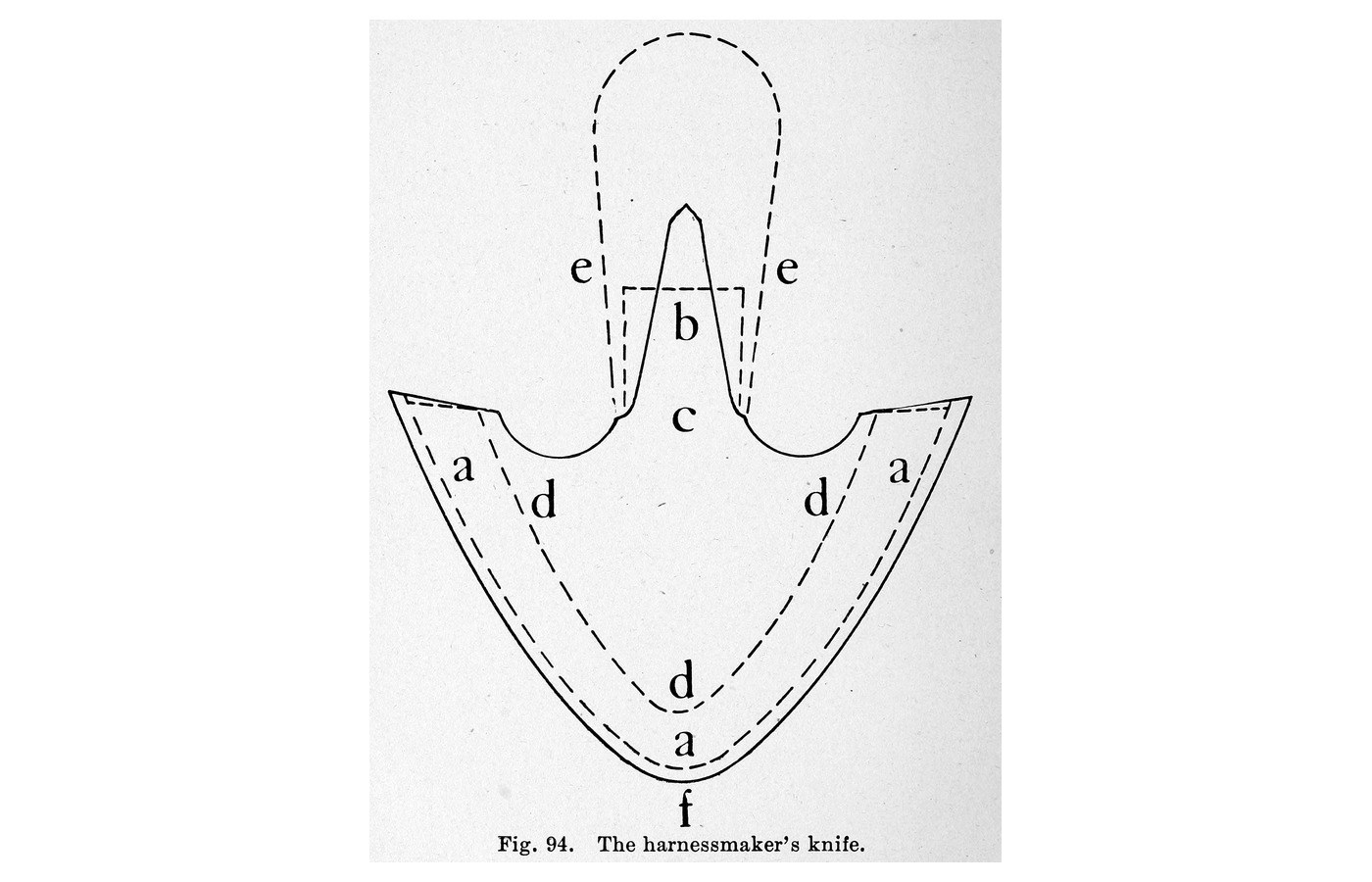


Leather Knife: the Harnessmaker's Knife, Forged from Cutlery Steel (Holford, 1907)
The harnessmaker's knife, the broad curved blade saddlers push through leather. Frederick Holford's 20th Century Toolsmith (1907) says it "will try the skill of the expert to its full extent". He cuts it from sheet cutlery steel of 0.75 % carbon, 3/32 inch thick, 4 to 6 inches wide; draws the cutting edge out at a deep cherry red; packs the steel with light blows at a dim red; anneals it in lime or ashes; hardens it from a low cherry red in the bath; and draws the temper to dark blue, the temper he gives for all leather-cutting tools.
He gives no handle wood and no outline sizes beyond the width; those are unknown here.
Source: F. J. Holford, The 20th Century Toolsmith and Steelworker (1907), pp. 163-166 and p. 21 (the hardening bath). Picture: his Fig. 94.
Avanzato
A day
Istruzioni
1
1
Read Holford
Read Holford
"To make one, use sheet cutlery steel of 75 points carbon and 3-32 of an inch thick, but the size of the steel to be used will depend on the size of the knife to be made."
2
2
Mark and cut the blank
Mark and cut the blank
Draw the outline of the knife on the steel, 4 to 6 inches wide or smaller, to suit whoever will use it. Cut it out 3/16 inch smaller than the finished knife along the edge (line a in Fig. 94), because the cutting edge is still to be drawn out. If the steel is too short for the shank, cut it as at b and draw the shank out to shape. Other outline sizes are not given (unknown).
Materiali per questo passaggio:
 Lamiera di acciaio da coltelleria1 foglio
Strumenti necessari:
 Punta da tracciare
 Scalpello da taglio a freddo
 Dimensioni sconosciute
3
3
Draw out the edge
Draw out the edge
Take a deep cherry red heat and start hammering at the point f, hammering equally from both sides until the whole cutting edge is drawn out. It may take two or three heats.
Strumenti necessari:
 Forgia
 Incudine
 Martello da fabbro
 Tenaglie da fabbro
4
4
Pack the steel and anneal
Pack the steel and anneal
Bring the knife to a very dim red and hammer evenly on both flat sides of the whole edge. Heat again to a very low heat and hammer again, this time a little back from the edge (line d), to take the strain out of the steel. Then heat the whole knife except the shank to an even blood red and pack it in lime or ashes until perfectly cold. File the edges smooth.
Strumenti necessari:
 Cenere di legno duro
 Lima per metalli
5
5
Harden
Harden
Heat the knife to a low cherry red one inch back from the edge in the blaze of the fire, moving it in a circle so the whole edge heats evenly and never in streaks. Plunge the whole knife upright into the hardening bath: clean water free from grease, best made a brine with as much salt as it will dissolve, kept large and cold (Holford, p. 21). An evenly forged and heated knife comes out straight.
Strumenti necessari:
ForgiaTenaglie da fabbro Salamoia satura
 Guanti resistenti al calore
6
6
Temper and straighten
Temper and straighten
Polish one side as far back as it is hardened. Draw the temper very slowly over the fire, moving the knife in a circle, until the polished side shows a dark blue. Before cooling, take out any crook by straightening on the anvil with the hammer, then cool off. If it crooked so much that it cannot be straightened now, heat it again, straighten and anneal, and start the hardening again.
Strumenti necessari:
 Tela smeriglioForgiaIncudineMartello da fabbro
7
7
Grind and handle
Grind and handle
Grind the edge; what crook is left can be taken out in grinding. Feather the shank with a very sharp cold chisel so it stays firm, and drive it into a wooden handle (the dotted outline e). The handle wood is not given (unknown).
Materiali per questo passaggio:
 Listello di legno duro per manici1 handle
Strumenti necessari:
 Mola ad acquaScalpello da taglio a freddo
8
8
History and honest limits
History and honest limits
Holford wrote for blacksmiths and toolmakers who forged their own tools; he says a well-made knife "will hold a very keen edge on the hardest of leather". The same dark-blue temper, he says, applies to all leather-cutting tools.
The handle wood and the outline sizes beyond the width are not given; a hardwood handle stands for the handle, and a cold chisel is our tool for cutting out the blank.
Materiali
2- Segnaposto
- Segnaposto
Strumenti richiesti
13- Segnaposto
- Segnaposto
- Segnaposto
- Segnaposto
- Segnaposto
- Segnaposto
- Segnaposto
- Segnaposto
- Segnaposto
- Segnaposto
- Segnaposto
- Segnaposto
- Segnaposto
Questo progetto realizza
CC0 Pubblico dominio
Questo progetto è rilasciato sotto CC0. Sei libero di copiare, modificare, distribuire e utilizzare quest'opera per qualsiasi scopo, senza chiedere permesso.
Supporta il Maker acquistando prodotti tramite il suo progetto dove guadagna una Commissione Maker stabilita dai venditori, oppure crea una nuova iterazione di questo progetto e includilo come collegamento nel tuo progetto per condividere i ricavi.