Collaborazione
ARTE
BELLEZZA E BENESSERE
MESTIERE
CULTURA E STORIA
DIVERTIMENTO
AMBIENTE
CIBO E BEVANDE
INGEGNERIA INVERSA
SCIENZE
SPORT
TECNOLOGIA
INDOSSABILI
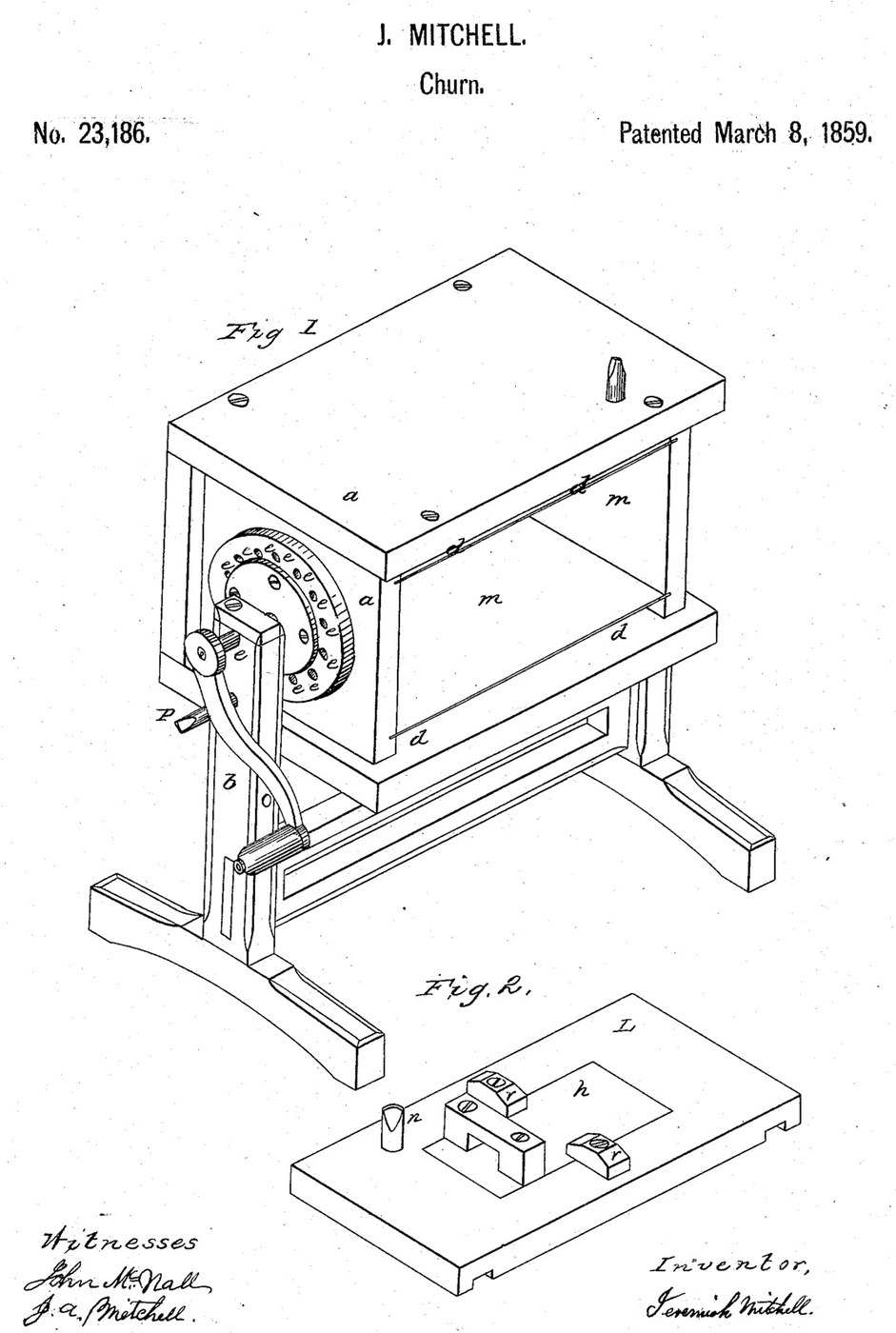


Water-Jacket Revolving Box Churn: A Box With No Dasher Turns on Stub Axles Inside Warm or Cold Water
Jeremiah Mitchell of Gasport, New York, received US 23,186, dated 8 March 1859, for a churn with no paddles or dashers: a square-cornered box turned end over end on stub axles that do not pass through it. Its lining is surrounded by a water space, filled warm or cold and checked with a thermometer. The cream goes in through a door held by buttons, the buttermilk comes out of a tap, and a pin through one standard into a ring of holes holds the box still.
This rung builds it with two nested food containers in a plywood box on timber standards.
Intermedio
About 8 hours
Istruzioni
1
1
Water space and weight
Water space and weight
Caricamento del notebook Jupyter…
2
2
Warming or cooling the cream, before it
Warming or cooling the cream, before it
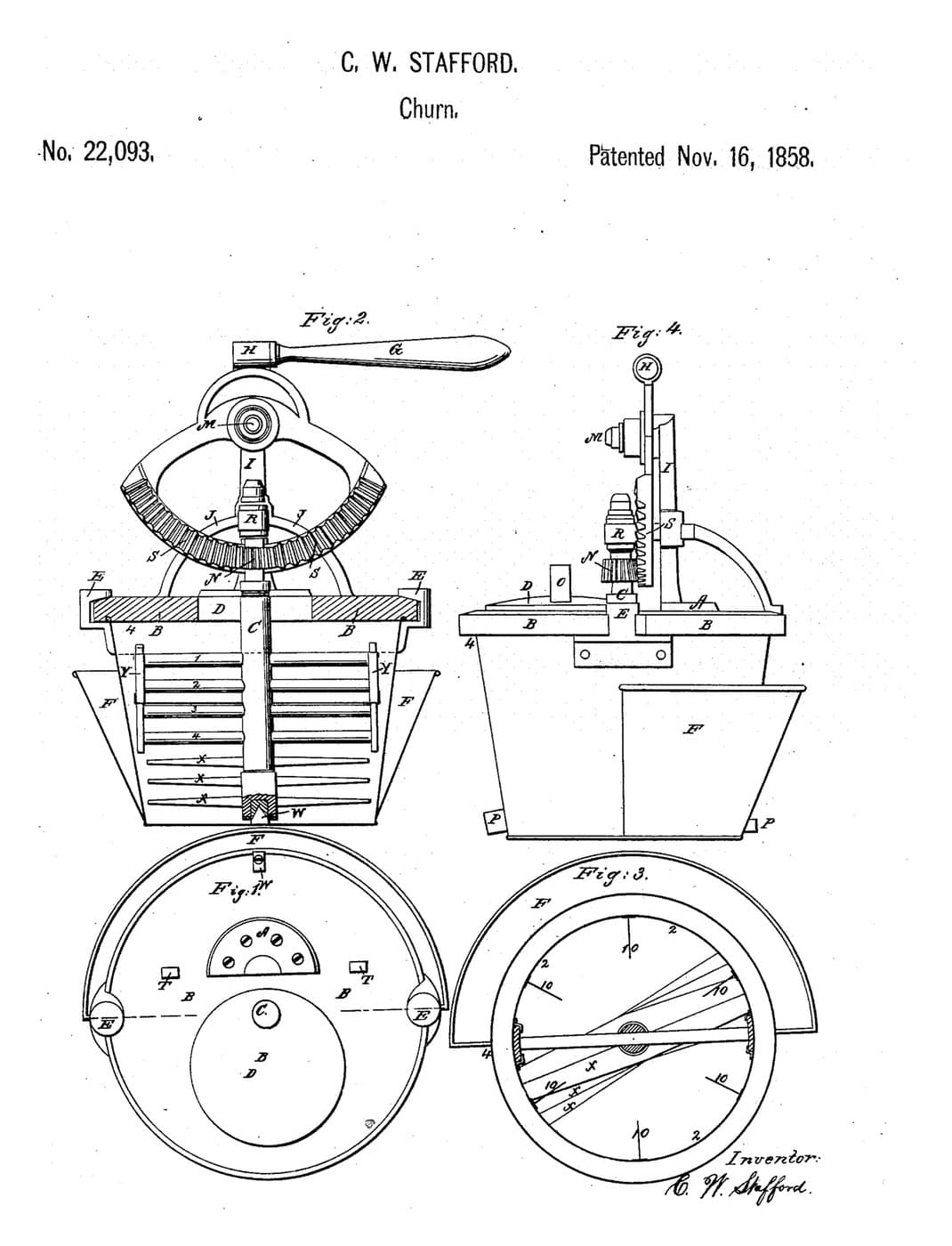
Stafford stood his churn in warm or cold water. Mitchell builds the water round the lining and drops the dasher.
3
3
Read US 23,186
Read US 23,186
"The nature of my invention consists in the employment of a revolving box, partially surrounded by a warm or cold water jacket, into which the cream is introduced, and butter made expeditiously without the use of the paddles or dashers as in ordinary churns."
4
4
Print the spacer
Print the spacer
A block that holds the lining off the jacket's floor. Print four. PETG, 0.2 mm layers, 100 % infill; wash before fitting.
5
5
Lining and water space
Lining and water space
Use two food-grade containers with rims: a lining 300 x 200 x 220 mm outside, with its snap-on lid, and a jacket 380 x 280 x 260 mm outside. Stand the lining on the four spacers in the jacket so their rims are level and the gap is 37 mm all round. Drill a 19 mm hole in the jacket's end low down for the brass spigot and a 7 mm hole in the other end for the thermometer probe, and drill the lining's lid for the PVC spigot n.
Materiali per questo passaggio:
 Contenitore di conservazione per uso alimentare2 pezzi
 Filamento PETG1 pezzo
Strumenti necessari:
 Stampante 3D a filamento (FDM)
 Trapano a batteria
 Serie di punte da trapano
 Set di punte a lancia
 Metro a nastro
6
6
Box a and face L
Box a and face L
From 18 mm plywood make box a round the jacket: a back 416 x 316 mm, two sides 380 x 260 mm and two ends 316 x 260 mm. Cut face L 416 x 316 mm from 12 mm plywood with a 310 x 210 mm opening for the lining's rim. Bed L on silicone on both rims and screw it to the box, so the water space is sealed and only the lining opens. Screw two hardwood turn buttons r on L to hold the lid (door h) down. Fit the brass spigot through the box end into the water space and the PVC spigot through the lid, each sealed with silicone, and push the thermometer probe through its hole in silicone.
Materiali per questo passaggio:
 Pannello di compensato2 pezzi
 Colla da legno1 pezzo
 Viti da legno40 pezzi
 Sigillante siliconico1 pezzo
 Tavola di legno duro1 pezzo
 Rubinetto di ottone1 pezzo
 Rubinetto in PVC1 pezzo
Strumenti necessari:
 Sega a mano
 Seghetto alternativo
 Kit di seghe a tazzaTrapano a batteriaSerie di punte da trapano
 Morsetti
 Set di cacciavitiMetro a nastro
7
7
Axles, standards and crank
Axles, standards and crank
Screw a hardwood hub 100 x 100 x 30 mm to the middle of each end, bore it 30 mm and cross-bolt a 30 mm steel stub axle in it; the axles do not pass through the box. Drill twelve 10.5 mm holes e in a circle 80 mm out from the axle on one end. Stand two 70 mm posts 500 mm to the axle line on 600 mm feet, 540 mm apart, joined by a low rail, and bolt a flange bearing on each post's outer face. Drill the post on the holes' side for pin p, a 10 mm dowel. Fix a hardwood crank arm 270 mm long on the other axle and glue in a 28 mm dowel handle.
Materiali per questo passaggio:
Tavola di legno duro1 pezzo Albero d'acciaio da 30 mm1 pezzo
 Serie di bulloni esagonali M103 pezzi
 Legno tenero 70x70 mm4 pezzi
 Vite da legno n. 10 x 3"16 pezzi
 Supporto flangiato2 pezzi
 Tasselli di legno duro1 pezzoColla da legno1 pezzo
Strumenti necessari:
Sega a manoTrapano a batteriaSerie di punte da trapanoSet di punte a lancia Chiave regolabile a rullinoMetro a nastro
8
8
The build in 3D
The build in 3D
FreeCAD model of this build, the near half of the box cut away: the lining on its spacers in the jacket, box a with face L, door h, buttons and spigots, the stub axles in their hubs, the standards with flange bearings, pin p and the crank.
9
9
Churn
Churn
Pin the box still, face L up. Fill the water space through the brass spigot with warm water in cold weather or ice water in warm weather, watching the thermometer, until the probe reads about 15 °C. Open the door and pour in about 8 litres of heavy cream, then snap the lid on and turn the buttons over it. Pull the pin and turn the crank steadily; time it. When the butter has come, pin the box face up, draw off the buttermilk through spigot n, open the door, lift the butter out, wash it in cold water until the water runs clear, work in a pinch of salt and weigh it.
Materiali per questo passaggio:
 Panna da montare8 l
 Acqua1 pezzo
 Ghiaccio tritato2 kg
 Sale marino grosso1 pezzo
Strumenti necessari:
 Termometro a sonda permanente
 Cronometro
 Bilancia digitale da cucina
 Grande ciotola da impasto in acciaio inossidabile
10
10
Troubleshooting
Troubleshooting
Water-jacket churn troubleshooting.
Flow
Loading...
11
11
History and honest limits
History and honest limits
**Jeremiah Mitchell** of Gasport, Niagara County, New York, US 23,186, 8 March 1859, "Churn". He held his churn simple, quick to clean for want of dashers, and tight, spattering no cream, and claimed the revolving box made and worked as described. His lining was tin and his water space ran round three faces and behind the back; ours is a food container with water on all five faces. He gave no sizes: every size and material is ours.
Materiali
19- Segnaposto
- 1 pezzoSegnaposto
- 2 pezziSegnaposto
- 2 pezziSegnaposto
- 40 pezziSegnaposto
- 1 pezzoSegnaposto
- 1 pezzoSegnaposto
- 1 pezzoSegnaposto
- 1 pezzoSegnaposto
- 1 pezzoSegnaposto
- Segnaposto
- 4 pezziSegnaposto
- 16 pezziSegnaposto
- 2 pezziSegnaposto
- 1 pezzoSegnaposto
- Segnaposto
- 1 pezzoSegnaposto
- 2 kgSegnaposto
- 1 pezzoSegnaposto
Strumenti richiesti
15- Segnaposto
- 1 vendor sell this, none ship to you yetSegnaposto
- Segnaposto
- Segnaposto
- 1 vendor sell this, none ship to you yetSegnaposto
- Segnaposto
- 1 vendor sell this, none ship to you yetSegnaposto
- Segnaposto
- Segnaposto
- Segnaposto
- Segnaposto
- Segnaposto
- Segnaposto
- Segnaposto
File di progetto
2Questo progetto realizza

Blueprint correlati
Questi blueprint condividono conoscenze — tecniche, materiali o principi



CC0 Pubblico dominio
Questo progetto è rilasciato sotto CC0. Sei libero di copiare, modificare, distribuire e utilizzare quest'opera per qualsiasi scopo, senza chiedere permesso.
Supporta il Maker acquistando prodotti tramite il suo progetto dove guadagna una Commissione Maker stabilita dai venditori, oppure crea una nuova iterazione di questo progetto e includilo come collegamento nel tuo progetto per condividere i ricavi.