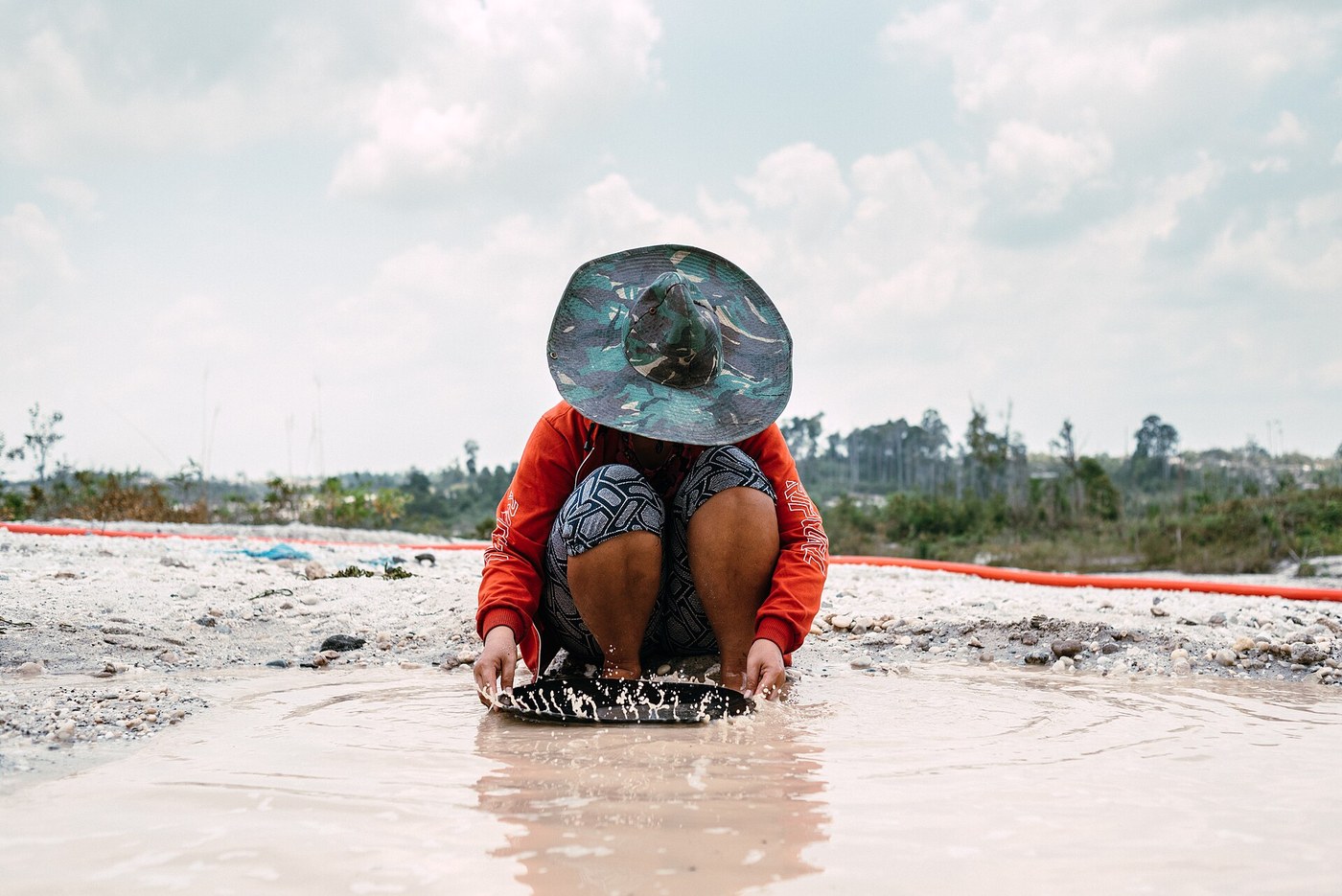


Gold Panning
Istruzioni
Prove density does the sorting
Prove density does the sorting
Use lead shot or steel nuts as a stand-in for gold — you are testing the physics, not prospecting.
- Mix a few dense pieces into a pan of sand and gravel.
- Submerge and shake the pan side to side.
- Stop and dig down to find where the dense pieces went.
Strumenti necessari:
 Piatto da cercatore d'oro
 Setaccio classificatore
Classify before you pan
Classify before you pan
Remove what you already know is worthless.
- Screen the material to remove everything above about 6 mm.
- Check the oversize pieces briefly and discard them.
- Pan only the fines.
Strumenti necessari:
 Setaccio da 60 mesh
Shake, then wash — in that order, repeatedly
Shake, then wash — in that order, repeatedly
The cycle is always settle first, remove second.
- Submerge, shake side to side to settle the heavies.
- Tilt and let the top layer wash over the lip.
- Level the pan, submerge, and shake AGAIN before removing more.
Deal with the black sand
Deal with the black sand
What remains at the end is not gold — it is mostly magnetite and other heavy minerals.
- Reduce to a spoonful of dark concentrate.
- Draw a magnet across it, in a bag, to lift the magnetite out.
- Examine what is left in good light.
Materiali per questo passaggio:
 Lente convessa1 pezzo
Strumenti necessari:
 Set di magneti a barra
History and context
History and context
Panning is prehistoric and essentially unchanged. The golden fleece of Greek legend is usually explained as a sheepskin pegged in a stream to catch fine gold — the wool's fibres trapping particles exactly as the riffles in a sluice do — and the technique is documented in the Caucasus.
Where the gold is follows from the same density argument. Flowing water carries light sediment further than heavy, so gold drops out wherever the current slows: on the inside of bends, behind boulders, in bedrock cracks, at the downstream end of gravel bars. A prospector reads a stream for places where the water gives up, and that is the actual skill.
The gold rushes were brief and the panning phase briefest. California in 1849, Victoria in 1851, the Klondike in 1897 — in each case individual panning gave way within a few years to sluicing, then hydraulic mining that blasted whole hillsides into rivers, then corporate dredging and hard-rock mining. Very few of the individuals who arrived first got rich; the people who consistently made money sold them shovels.
The environmental legacy is severe and still present. Hydraulic mining in California moved so much sediment that it buried farmland and choked rivers, and it was eventually enjoined by the courts in 1884 — an early and important environmental judgment. Worse, mercury was used to amalgamate fine gold in both California and Latin America, and that mercury is still in the sediment, still methylating into fish, more than a century later. Artisanal gold mining remains today the largest single source of mercury pollution worldwide.
Materiali
1- 1 pezzoSegnaposto
Strumenti richiesti
12- Segnaposto
- Segnaposto
- Segnaposto
- Segnaposto
- Segnaposto
- Segnaposto
- Segnaposto
- Segnaposto
- Segnaposto
- Segnaposto
- Segnaposto
- Segnaposto
Questo progetto realizza
CC0 Pubblico dominio
Questo progetto è rilasciato sotto CC0. Sei libero di copiare, modificare, distribuire e utilizzare quest'opera per qualsiasi scopo, senza chiedere permesso.
Supporta il Maker acquistando prodotti tramite il suo progetto dove guadagna una Commissione Maker stabilita dai venditori, oppure crea una nuova iterazione di questo progetto e includilo come collegamento nel tuo progetto per condividere i ricavi.