ARTE
BELLEZZA E BENESSERE
MESTIERE
CULTURA E STORIA
DIVERTIMENTO
AMBIENTE
CIBO E BEVANDE
INGEGNERIA INVERSA
SCIENZE
SPORT
TECNOLOGIA
INDOSSABILI
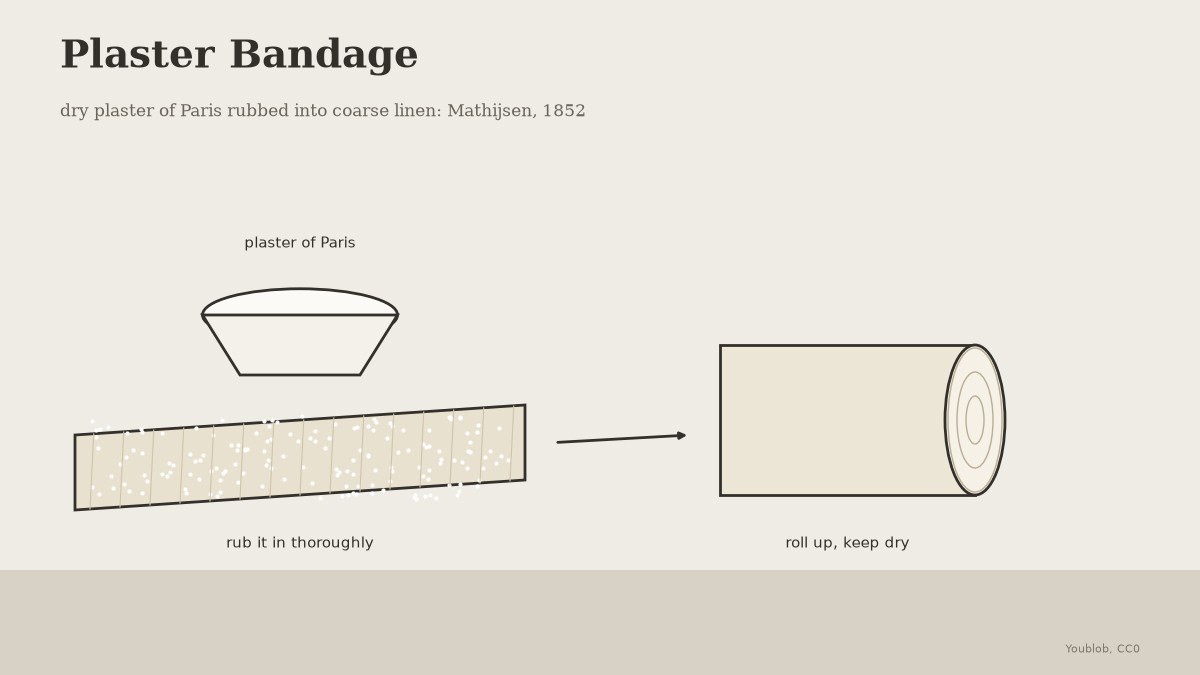


Plaster Bandage: Dry Plaster of Paris Rubbed into Coarse Linen, Mathijsen 1852
The plaster bandage of the Dutch army surgeon Antonius Mathijsen (1852): coarse linen with dry plaster of Paris rubbed well into it. Wetted as it goes on and rubbed by hand, it sets hard within minutes. Until 1931 hospitals made their own this way.
The picture: our own drawing.
Principiante
1 hour
Istruzioni
1
1
Cut coarse linen strips
Cut coarse linen strips
Cut a coarsely woven linen into long strips, bandage width.
Materiali per questo passaggio:
 Tessuto di lino1 sqm
Strumenti necessari:
 Forbici da sarto
2
2
Rub the plaster in
Rub the plaster in
Lay a strip flat and rub dry plaster of Paris thoroughly into the weave, working along its length. Do it slowly so the dust stays down.
Materiali per questo passaggio:
 Gesso da presa500 g
Strumenti necessari:
 Ciotola
 Mascherina respiratoria N95
3
3
Roll and keep dry
Roll and keep dry
Roll each strip loosely and store it closed and dry: any damp sets the plaster. To use, wet it as it goes on and rub it smooth by hand.
Strumenti necessari:
 Barattoli di vetro con coperchio
Materiali
2- 1 sqmSegnaposto
- 500 gSegnaposto
Strumenti richiesti
4- Segnaposto
- Segnaposto
- Segnaposto
- Segnaposto
Questo progetto realizza

CC0 Pubblico dominio
Questo progetto è rilasciato sotto CC0. Sei libero di copiare, modificare, distribuire e utilizzare quest'opera per qualsiasi scopo, senza chiedere permesso.
Supporta il Maker acquistando prodotti tramite il suo progetto dove guadagna una Commissione Maker stabilita dai venditori, oppure crea una nuova iterazione di questo progetto e includilo come collegamento nel tuo progetto per condividere i ricavi.