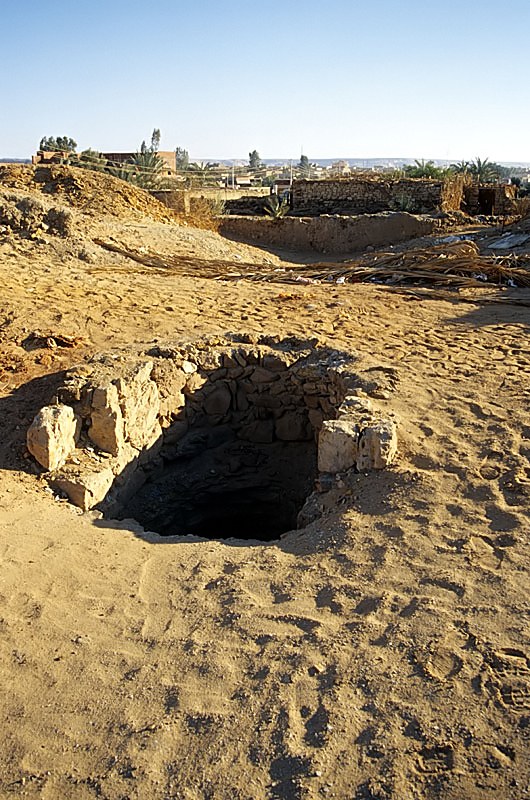


Qanat
Istruzioni
Find the water table and the ground slope
Find the water table and the ground slope
A qanat only works where the water is higher than the destination.
- Build a sloping tank of sand with a saturated zone at the high end.
- Mark the water table level and the ground surface profile.
- Note the vertical gap between them at each point.
Materiali per questo passaggio:
 Goniometro1 pezzo
Strumenti necessari:
 Righello
Set the gradient — the whole craft
Set the gradient — the whole craft
Too flat and it silts up; too steep and it destroys itself.
- Lay a tube through your model at a very gentle fall — of the order of 1 in 500 to 1 in 1000.
- Run water and watch the flow.
- Now try a steep gradient and watch the flow scour the channel.
Sink the shafts
Sink the shafts
Vertical shafts at intervals along the line, and they do three jobs.
- Sink shafts every 20-50 m along the route.
- Note that each provides spoil removal, ventilation, and later access.
- Ring each with its spoil — that ring keeps flood water and debris out of the shaft.
Materiali per questo passaggio:
 Pannello di compensato1 confezione
Compare against an open channel
Compare against an open channel
Measure the advantage that justifies all that digging.
- Run equal volumes through an open channel and through a covered tunnel.
- Leave both under a lamp or in sun for a set period.
- Measure what is left in each.
Materiali per questo passaggio:
 Becher in borosilicato2 pezzi
Strumenti necessari:
 Bilancia digitale da cucina
History and context
History and context
Qanats — karez in Afghanistan and western China, falaj in Oman, foggara in North Africa — are Iranian in origin and are attested from around the first millennium BC. The Persian Qanat is a UNESCO World Heritage listing, and some individual systems have run continuously for well over two thousand years.
The self-limiting property is the elegant part. A qanat cannot extract more than the aquifer naturally yields — it is a gravity drain, not a pump, so when the water table falls the flow simply reduces. It is physically incapable of over-extraction. That is a governance mechanism built into the hydraulics, and it is precisely what modern diesel and electric pumps removed.
Which is why they are failing now. Across Iran and the wider region, tube wells fitted with pumps draw the water table below the qanat tunnels, and the qanats go dry — not because they broke but because someone upstream can now take water they could not previously reach. A system that was sustainable for millennia is being emptied within decades by a technology that ignores its constraint.
The social structure went with it. Qanat water was traditionally allocated by timed shares, measured with a water clock and administered by the community, with maintenance obligations attached to the rights. The muqanni trade was hereditary and dangerous — collapses were common and the work was done in cramped, unlit tunnels. Both the engineering and the institution were needed for it to work, and both are being lost together.
Materiali
3- 1 pezzoSegnaposto
- 1 confezioneSegnaposto
- 2 pezziSegnaposto
Blueprint correlati
Questi blueprint condividono conoscenze — tecniche, materiali o principi
CC0 Pubblico dominio
Questo progetto è rilasciato sotto CC0. Sei libero di copiare, modificare, distribuire e utilizzare quest'opera per qualsiasi scopo, senza chiedere permesso.
Supporta il Maker acquistando prodotti tramite il suo progetto dove guadagna una Commissione Maker stabilita dai venditori, oppure crea una nuova iterazione di questo progetto e includilo come collegamento nel tuo progetto per condividere i ricavi.