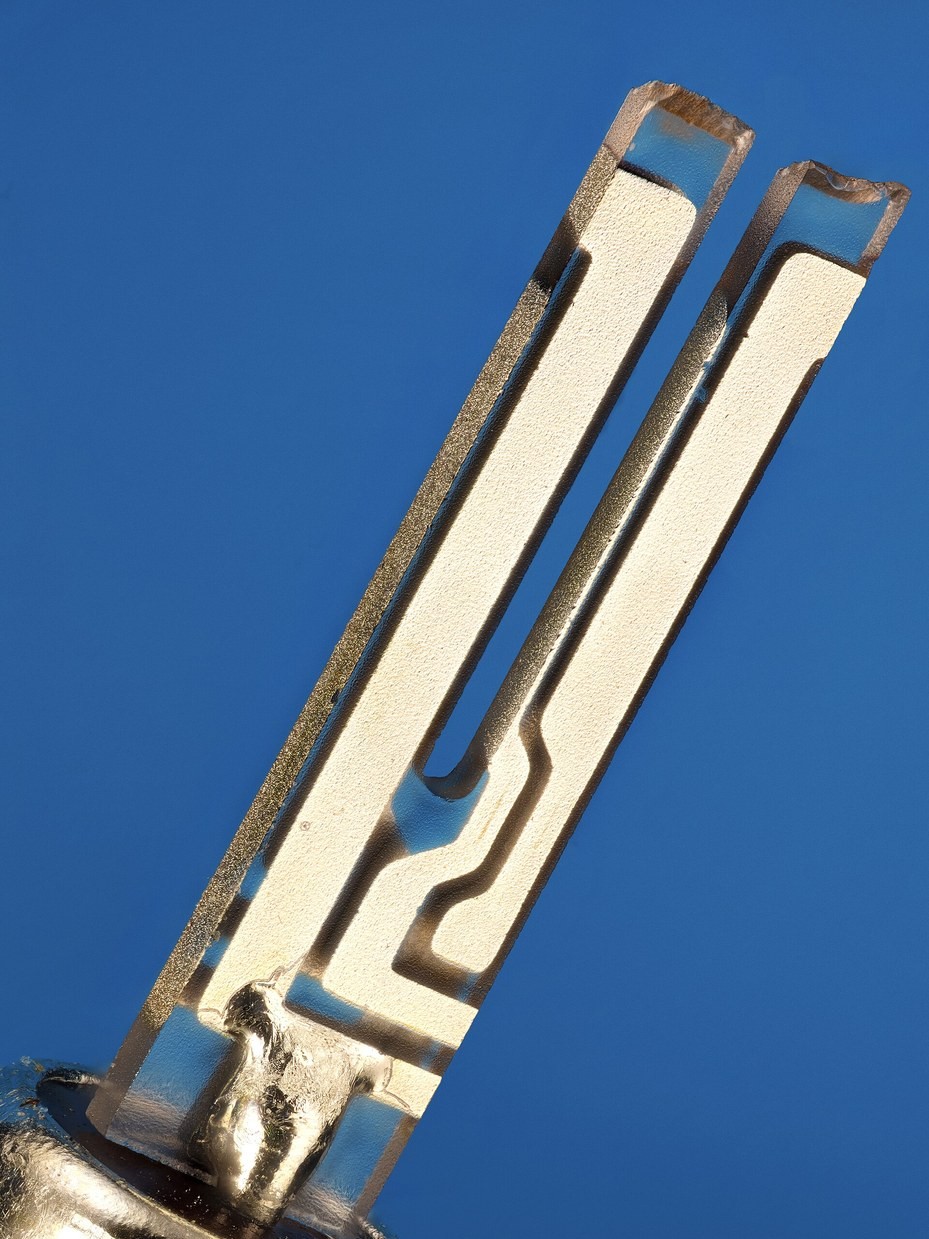


The Quartz Oscillator
Every fix in this batch removed one disturbance from a mechanical oscillator: recoil, wear, temperature, oil, position, contact. The chain ends where it must — with the realisation that the oscillator itself is the limit. A balance wheel is a machined lump of metal on jewelled pivots, and a pendulum is a rod hanging in air. Both lose energy fast, both are made of parts that wear, and both must be pushed by something that touches them.
Quartz replaces the lump of metal with a vibrating crystal, and it changes every one of those facts at once.
Quartz is piezoelectric: squeeze it and a voltage appears across it; apply a voltage and it deforms. So a crystal can be both the oscillator and its own sensor and actuator — an amplifier can keep it going through wires, touching it mechanically not at all.
And it is a superb resonator. Its frequency is set by the crystal's dimensions and the stiffness of the atomic lattice, not by gravity or by a spring's temper. It loses very little energy per cycle: Q of tens of thousands or more, against a few hundred for a good balance wheel.
A watch crystal is cut as a tiny tuning fork at 32,768 Hz — 215, so fifteen halvings give exactly one pulse per second.
Not a better escapement. No escapement.
Istruzioni
Make a crystal produce a voltage
Make a crystal produce a voltage
Take a piezoelectric element — a piezo disc from a buzzer is ideal — connect it to a sensitive meter or an oscilloscope, and tap or flex it.
Expect a clear voltage spike for every mechanical disturbance.
Now reverse the experiment: apply a voltage and feel or hear the element move.
Expect it to click, and to buzz if you apply an alternating voltage.
Write down the property that makes everything else possible: this is a two-way converter between electricity and motion, so an electrical circuit can both drive it and listen to it, with no mechanical linkage at all.
Strumenti necessari:
 Oscilloscopio analogico
 Cavetti di prova con pinze a coccodrillo
 Modulo cicalino attivo
Find its one preferred frequency
Find its one preferred frequency
Drive the element from a variable-frequency source through a resistor and watch the voltage across it as you sweep slowly.
Expect a sharp, dramatic peak at one frequency, far narrower than the tuned circuit in the syntonic tuning blueprint.
Measure the peak's width relative to its centre — that ratio is Q.
Expect a value orders of magnitude higher than any mechanical oscillator you have built in this batch.
That number is the entire argument. A resonator that loses almost no energy per cycle needs almost no push, and a push it barely needs is a push that barely disturbs it.
Close the loop and let it sustain itself
Close the loop and let it sustain itself
Put an amplifier around the crystal so its output drives the crystal and its input listens to it, arranged so the signal returns in phase.
Expect it to start on its own and settle at the crystal's frequency.
Note the two conditions you have just satisfied — gain greater than the losses, and feedback in phase — and note that they are the same conditions as the induction coil's self-interrupting contact and any other self-starting oscillator.
Then note the difference that matters here: the amplifier decides only WHETHER it oscillates. The crystal decides at what rate. An escapement had a say in the timing; this one does not.
Divide by two, fifteen times
Divide by two, fifteen times
Feed your oscillator into a chain of flip-flops, each halving the frequency, and observe the output after each stage.
Starting from 32,768 Hz, expect exactly one pulse per second after fifteen stages, because 32,768 = 215.
Then check the crucial property: introduce a brief disturbance and confirm that the count does not drift permanently.
Digital division is exact. A gear train has tooth errors, backlash and wear; a divider either counts or it does not. Choosing a frequency that is a power of two turns timekeeping from a mechanical problem into a counting problem — which is the real reason for that peculiar number.
Find the temperature curve, and where its top is
Find the temperature curve, and where its top is
Run your oscillator against a good reference while warming and cooling it, and plot frequency against temperature.
Expect a curve, not a straight line — for a watch tuning-fork cut, an inverted parabola with a maximum near room temperature.
Note what that shape buys: near the top of a parabola the slope is zero, so around the turnover temperature the frequency barely changes at all.
Crystals for watches are cut at an orientation that places that turnover near the temperature of a wrist. This is the same compensation strategy as the gridiron and the bimetallic balance — but achieved by choosing an angle in a crystal rather than by building a mechanism.
History & Context
History & Context
Piezoelectricity was found by the Curie brothers in 1880 — Jacques and Pierre — and put to work in the First World War for ultrasonic submarine detection. Walter Guyton Cady built the first quartz crystal oscillator around 1921, and Warren Marrison and J. W. Horton at Bell Telephone Laboratories built the first quartz clock in 1927. Within a decade quartz clocks were the world's timekeeping standard, displacing the Shortt free-pendulum clocks that had held the record.
They immediately proved the Earth is a bad clock. Quartz standards were stable enough to show that the Earth's rotation is irregular — it wobbles seasonally and is slowing over the long term. Time had been defined by the Earth's rotation, so a better clock meant the definition itself had to change, eventually to the caesium atom in 1967. Build an instrument better than your standard and you do not get a better measurement — you get a new standard.
The wristwatch took another forty years and then arrived all at once. Making a crystal small, low-power and cheap needed integrated circuits and low-current CMOS logic; the Seiko Astron of 1969 was the first quartz wristwatch. Within about fifteen years the Swiss mechanical industry had contracted severely — the 'quartz crisis'. Two hundred and fifty years of the refinements in this batch were beaten by a chip and a sliver of rock, and beaten on price at the same time, which is what made it a rout rather than a competition.
Yet the chain was not wasted. Every idea in this batch survives in the quartz watch: isochronism, compensation, detachment from the counting mechanism, and running the oscillator with the least disturbance you can manage. What changed is the material of the oscillator. The engineering principles were right; they were being applied to the wrong object.
Honest limits. It needs continuous electrical power, so a dead battery is a dead clock — a mechanical watch merely needs winding. Frequency drifts with age as the crystal and its mounting relax. It is sensitive to temperature away from the turnover point, and to shock and to how it is mounted. And it is unrepairable in any craft sense: a mechanical movement can be serviced for centuries, while a quartz module is replaced. That, rather than accuracy, is the argument mechanical watchmaking still wins.
Strumenti richiesti
3- Segnaposto
- Segnaposto
- Segnaposto
Materiali dei progetti collegati

Blueprint correlati
Questi blueprint condividono conoscenze — tecniche, materiali o principi

CC0 Pubblico dominio
Questo progetto è rilasciato sotto CC0. Sei libero di copiare, modificare, distribuire e utilizzare quest'opera per qualsiasi scopo, senza chiedere permesso.
Supporta il Maker acquistando prodotti tramite il suo progetto dove guadagna una Commissione Maker stabilita dai venditori, oppure crea una nuova iterazione di questo progetto e includilo come collegamento nel tuo progetto per condividere i ricavi.