

Roller Chain
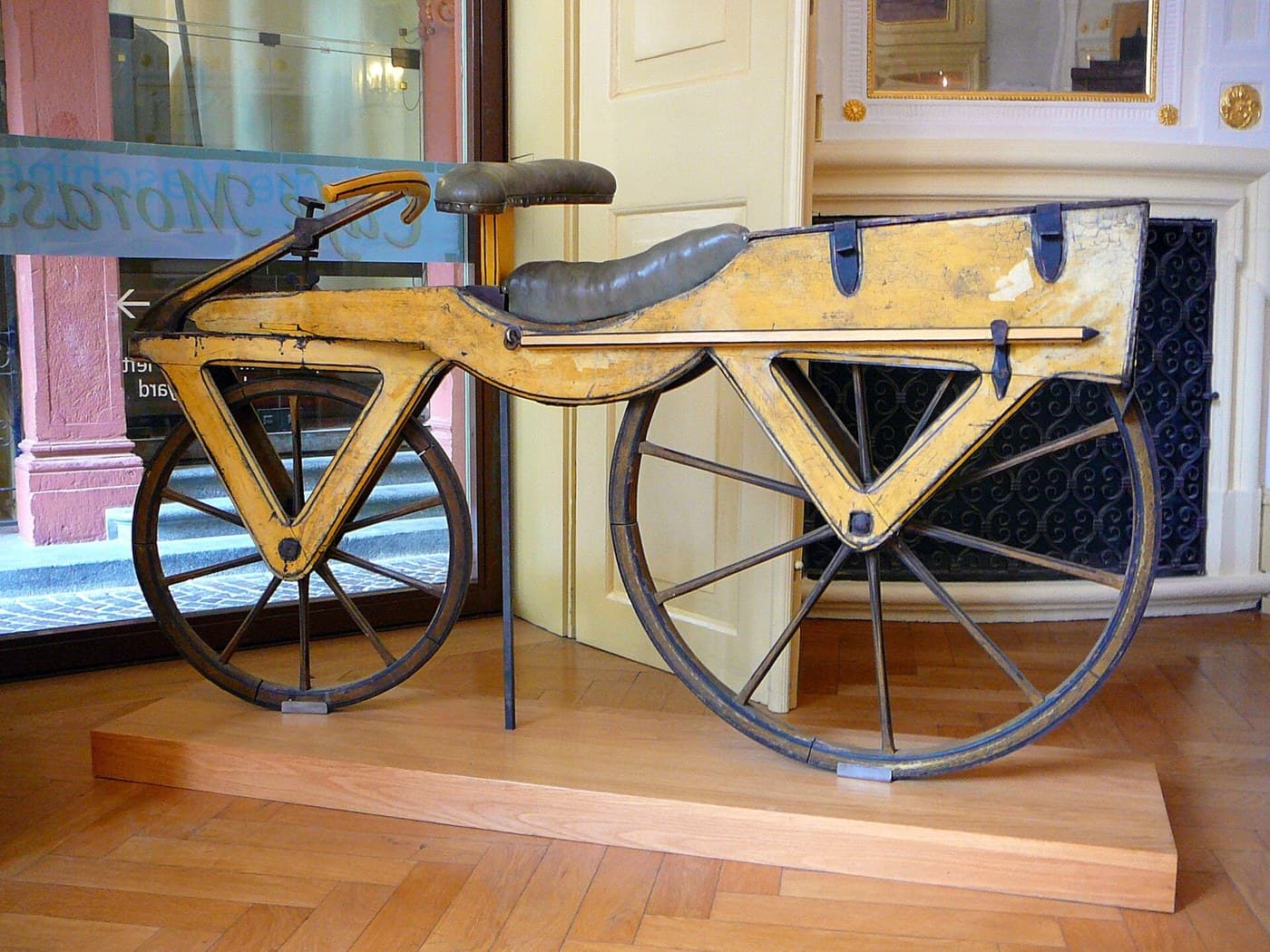
The early bicycle drove its rear wheel through a plain chain — links pinned together, each link dropping onto a sprocket tooth and dragging across it. It worked, but every tooth-meeting was a little scrape of steel on steel: friction, noise, and a chain that stretched and wore out fast.
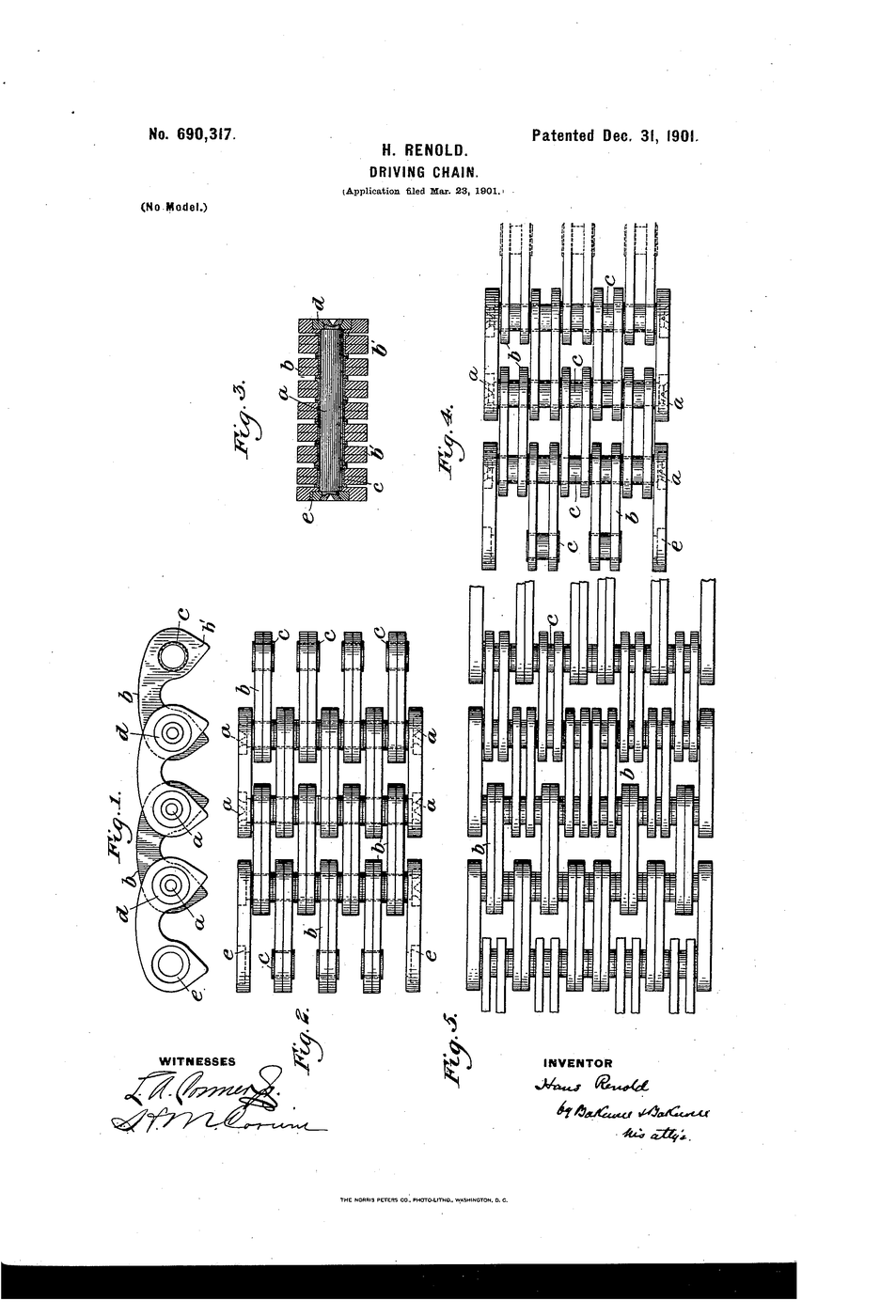
Renold's chain adds one part that changes everything: a free roller. Each pin carries a fixed bush, and over that bush spins a loose roller. When the chain meets a sprocket tooth, the roller rolls onto it instead of sliding — turning a scrape into a smooth contact.
The wear moves inside, where it can be managed. Sliding now happens between the pin and the bush, sealed and lubricated, not out on the tooth face. The chain runs quieter, lasts far longer, and transmits power at high speed without tearing itself apart.
US Patent 690,317, "Driving-chain", granted 31 December 1901 to Hans Renold of Manchester, England.
Istruzioni
Read the claim: the roller over the bush
Read the claim: the roller over the bush
Renold's "driving-chain" claims a chain in which a roller turns freely on a bush around each pin. The roller is the whole point — note it.
Cut two sprockets and mount them on a board
Cut two sprockets and mount them on a board
Cut two toothed wheels from plywood and mount them a fixed distance apart so a chain can run between them. This is your test rig.
Materiali per questo passaggio:
 Pannello di compensato1 foglio
Strumenti necessari:
 Seghetto per metalli
Build a plain block chain first
Build a plain block chain first
Make a short chain of rigid links joined by pins, with no rollers — a plain block chain, the thing Renold set out to beat.
Materiali per questo passaggio:
 Tondo di acciaio dolce1 pezzo
Strumenti necessari:
 Pinza universale
Run it and watch each link scrape onto a tooth
Run it and watch each link scrape onto a tooth
Turn the sprocket slowly and watch a link meet a tooth. It slides down the tooth face as it seats — a little scrape every time. Listen to it.
Mark the wear on the tooth faces
Mark the wear on the tooth faces
Chalk the teeth and run the block chain a while. The chalk rubs off where the links slid. That is where a real chain and sprocket wear out.
Add a bush over each pin
Add a bush over each pin
Slip a tube (the bush) over each pin, fixed to the inner link plates. The pin can rotate inside the bush. This is the first of Renold's two sleeves.
Materiali per questo passaggio:
 Tubo di cartone1 pezzo
Add a free roller over each bush
Add a free roller over each bush
Over each bush, fit a slightly larger tube that spins freely — the roller. Now every pin has pin, bush, and roller, one inside the next.
Run the roller chain and watch the roller turn
Run the roller chain and watch the roller turn
Run the new chain over the sprocket. As each roller meets a tooth it rotates and rolls onto it instead of scraping. The scrape is gone.
Chalk-test the teeth again and compare
Chalk-test the teeth again and compare
Chalk the teeth and run the roller chain the same distance. Far less chalk is rubbed off — the tooth face barely slides now. Photograph both for the record.
Find where the sliding went
Find where the sliding went
The sliding did not vanish — it moved inside, between pin and bush, where a drop of oil seals it away from grit. Note that the wear was relocated, not abolished.
Measure chain stretch under load
Measure chain stretch under load
Hang a weight on each chain and measure the length. The worn block chain has stretched more (its pins and links have worn oval). The roller chain holds its pitch.
Strumenti necessari:
 Calibro a corsoio
Spin it up fast and listen
Spin it up fast and listen
Drive the sprocket quickly. The roller chain runs smooth and quiet at speed where the block chain rattles and grabs. High-speed drive is what the roller unlocked.
History & Context — the chain that made the bicycle a machine
History & Context — the chain that made the bicycle a machine
The patent. US 690,317, "Driving-chain", granted 31 December 1901 to Hans Renold of Manchester, England, assigned to the Ewart Manufacturing Company of Chicago. Renold, a Swiss-born engineer who settled in Manchester, had bought a small chain business in 1879 and invented the bush roller chain in 1880; that original is a British patent with no clean number, so this verifiable US patent is the one to cite — his refined driving chain, at the turn of the century.
The two nested sleeves are the invention. A plain chain is just links and pins, and everywhere it touches a sprocket tooth, steel slides on steel (steps 3 to 5). Renold puts a fixed bush around each pin and a free roller around each bush. The genius is what each part does: the roller turns the chain-to-tooth contact into rolling instead of sliding (step 8), while the small unavoidable sliding is banished to the inside, between pin and bush, where it is sealed, lubricated and protected from grit (step 10). The chain does not eliminate friction so much as move it to a place it can be managed. That is why the tooth faces stop wearing and the chain stops stretching (steps 9 and 11).
Why it mattered exactly when it did. The 1885 safety bicycle — two equal wheels, rider over the middle, rear wheel driven — needed a chain drive to gear the pedals up to the wheel. A plain chain on a bicycle wore quickly, ran roughly and stretched, and a stretched chain skips and jams. Renold's roller chain made the chain-driven bicycle genuinely reliable, and the safety bicycle in turn was one of the most socially important machines of its age — cheap personal transport, and, famously, a large step toward women's mobility and dress reform. The chain in this build is the part that made the bicycle trustworthy.
Where it went after the bicycle. Precisely because it transmits power at speed without slipping or stretching, roller chain spread far beyond bikes: motorcycle final drives, camshaft and timing drives inside engines, conveyors, machine tools, agricultural machinery. The standard is so settled that a modern bicycle chain and a 1901 Renold chain share the same essential anatomy — inner and outer plates, pin, bush, roller — and any bike shop chain tool still separates them the same way. It is one of those rare inventions that arrived very nearly in its final form.
Materiali
3- 1 foglioSegnaposto
- 1 pezzoSegnaposto
- 1 pezzoSegnaposto
Strumenti richiesti
3- Segnaposto
- Segnaposto
- Segnaposto
Questo progetto realizza
Blueprint correlati
Questi blueprint condividono conoscenze — tecniche, materiali o principi


CC0 Pubblico dominio
Questo progetto è rilasciato sotto CC0. Sei libero di copiare, modificare, distribuire e utilizzare quest'opera per qualsiasi scopo, senza chiedere permesso.
Supporta il Maker acquistando prodotti tramite il suo progetto dove guadagna una Commissione Maker stabilita dai venditori, oppure crea una nuova iterazione di questo progetto e includilo come collegamento nel tuo progetto per condividere i ricavi.