
Cemented Carbide
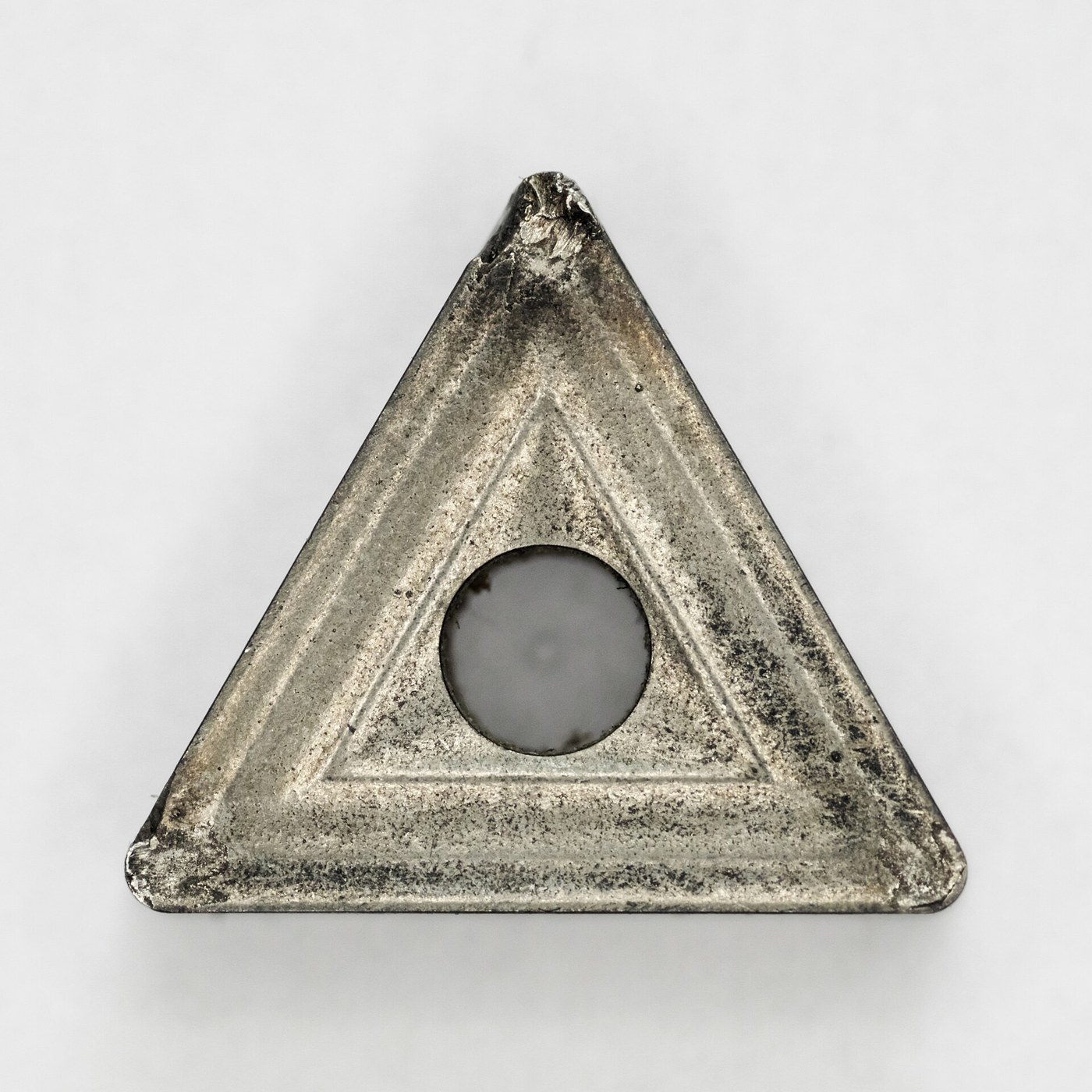
Tungsten carbide is nearly as hard as diamond and, on its own, useless: a pressed block of it shatters. The invention is not the carbide. It is the idea of cementing hard carbide grains in a small amount of tough metal, so the composite keeps most of the hardness and borrows the metal's resistance to cracking.
German patent DRP 420,689, filed 1923 by Osram Studiengesellschaft, for a method by Karl Schröter: hard materials made by pressing and sintering tungsten monocarbide with 10-20 weight-per-cent of an iron-group metal — iron, nickel or cobalt — with the binder briefly liquid so the mass densifies into a solid body. Krupp bought the patent in 1926 and marketed the product worldwide from 1927 as WIDIA, from wie Diamant, “like diamond”.
Osram's interest was not machining at all. They needed hard dies for drawing tungsten lamp filaments, and diamond dies were scarce and expensive. The cutting-tool industry was a side-effect.
Istruzioni
Write the composite idea down
Write the composite idea down
One line: hard grains carry the cutting, a tough binder carries the load. Neither component alone would work.
Weigh the carbide blank
Weigh the carbide blank
Weigh the tungsten carbide round blank on the 0.01 g scale. Record the mass.
Materiali per questo passaggio:
 Carta millimetrata1 foglio
Strumenti necessari:
 Tondino grezzo in carburo di tungsteno da 1/2"
 Bilancia digitale
Measure its volume by displacement
Measure its volume by displacement
Fill the graduated cylinder to 50 ml, lower the blank in, and read the new level. The difference is its volume in millilitres.
Strumenti necessari:
 Cilindro graduatoTondino grezzo in carburo di tungsteno da 1/2"
Calculate the density
Calculate the density
Density = mass ÷ volume. Expect roughly 14-15 g/cm³ for a cobalt-bonded carbide.
Materiali per questo passaggio:
Carta millimetrata1 foglioDo the same for steel
Do the same for steel
Weigh and displace a piece of the mild steel bar. Steel comes out near 7.85 g/cm³.
Materiali per questo passaggio:
 Barra quadra in acciaio dolce1 pezzo
Strumenti necessari:
Bilancia digitaleCilindro graduatoCompare the two densities
Compare the two densities
Carbide is roughly twice as dense as steel. Tungsten's atomic mass is doing that, and it is your evidence that the blank really is what it claims to be.
Materiali per questo passaggio:
Carta millimetrata1 foglioScratch-test steel with carbide
Scratch-test steel with carbide
Drag a corner of the carbide blank across the mild steel bar with light pressure. It marks the steel easily.
Materiali per questo passaggio:
Barra quadra in acciaio dolce1 pezzoStrumenti necessari:
Tondino grezzo in carburo di tungsteno da 1/2"Try the reverse
Try the reverse
Now try to scratch the carbide with an HSS cutter edge. It will not mark. Hardness is one-way, and that asymmetry is the whole ranking.
Strumenti necessari:
 Set di frese in acciaio rapidoTondino grezzo in carburo di tungsteno da 1/2"
 Lente d'ingrandimento
Build a hardness order
Build a hardness order
Test steel, HSS, carbide and glass against each other in pairs and write them in order. You have reconstructed the logic of the Mohs scale from your own bench.
Materiali per questo passaggio:
Carta millimetrata1 foglioLook at a carbide insert's edge
Look at a carbide insert's edge
Inspect an indexable insert under the loupe. Note the blunter included angle compared with HSS — hardness bought with brittleness must be supported by geometry.
Strumenti necessari:
 Set di inserti in metallo duro intercambiabili (CCMT/TCMT)Lente d'ingrandimento
Find the indexing corners
Find the indexing corners
Count the usable corners on one insert. When one dulls it is rotated, not resharpened — carbide is too hard to grind on an ordinary wheel.
Strumenti necessari:
Set di inserti in metallo duro intercambiabili (CCMT/TCMT)Test brittleness safely
Test brittleness safely
Rest the blank on the wooden board and press its edge firmly against the steel bar. Note how unforgiving it feels — carbide chips where steel would deform. Do not strike it.
Materiali per questo passaggio:
 Tavola di legno piatta1 pezzoBarra quadra in acciaio dolce1 pezzo
Strumenti necessari:
Tondino grezzo in carburo di tungsteno da 1/2"Write the selection rule
Write the selection rule
Interrupted cuts and flexible setups favour HSS; continuous cuts, hard material and high speed favour carbide. Write the rule in your own words.
Materiali per questo passaggio:
Carta millimetrata1 foglioHistory & Context
History & Context
German patent DRP 420,689, Osram Studiengesellschaft, filed 30 March 1923 and published 30 October 1925; method by Karl Schröter. Two things are claimed: a composition — tungsten monocarbide with 10-20 wt% of an iron-group metal — and a manufacturing route, pressing and sintering with a liquid phase present. Krupp acquired the patent in 1926 and launched WIDIA (wie Diamant) in 1927.
Why a lamp company invented a cutting tool. Osram drew tungsten wire for filaments through diamond dies, which were costly and wore out. A synthetic die material was the goal; machining was an application nobody had asked for. The pattern — a material developed for one industry that reshapes another — recurs constantly in materials history.
Cobalt won. The patent lists iron, nickel or cobalt as binder. Cobalt proved best because it wets tungsten carbide grains almost perfectly during liquid-phase sintering, giving a dense body with no voids. Modern grades are still overwhelmingly WC-Co, tuned by grain size and cobalt percentage: more cobalt is tougher and less hard, less cobalt is harder and more brittle.
Why this blueprint does not sinter anything. The process needs powders at 1,400 °C, and fine cobalt powder is a genuine inhalation hazard. Solid sintered carbide — the blank and inserts used here — is inert and safe to handle. The measurements in steps 2-9 establish everything the patent claims about the material without ever making it: density proves the tungsten content, and the scratch order proves the hardness ranking.
What it displaced. High-speed steel (Taylor and White, US 668,270, 1901) gave a tool that survived at 600 °C. Carbide survives past 1,000 °C and cuts several times faster again. It did not replace HSS — drills, taps and end mills for general shop work are still largely HSS, because it can be resharpened and it tolerates flex.
Materiali
3- 1 foglioSegnaposto
- Segnaposto
- 1 pezzoSegnaposto
Strumenti richiesti
6- Segnaposto
- Segnaposto
- Segnaposto
- Segnaposto
Materiali dei progetti collegati
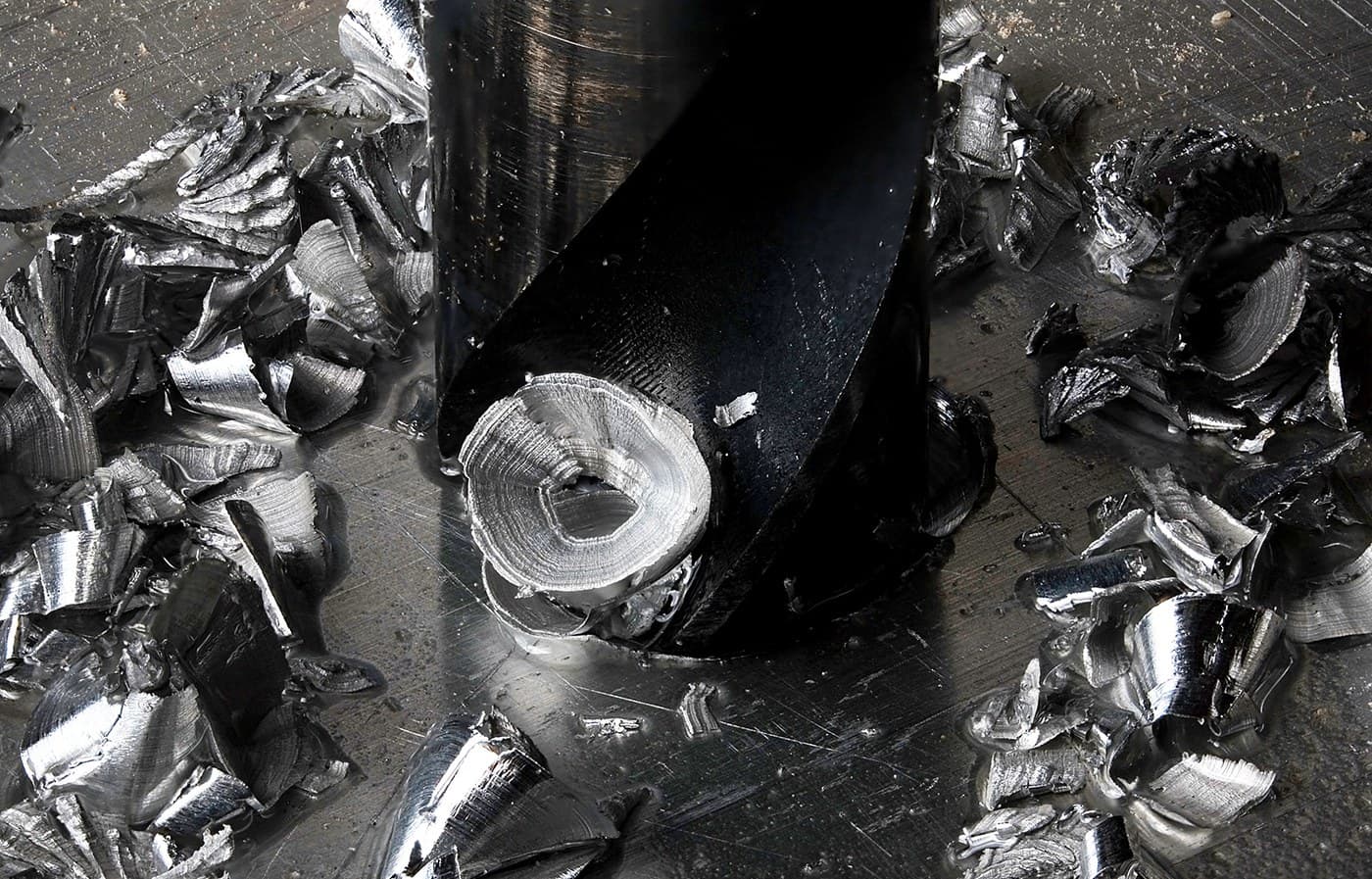

Blueprint correlati
Questi blueprint condividono conoscenze — tecniche, materiali o principi

CC0 Pubblico dominio
Questo progetto è rilasciato sotto CC0. Sei libero di copiare, modificare, distribuire e utilizzare quest'opera per qualsiasi scopo, senza chiedere permesso.
Supporta il Maker acquistando prodotti tramite il suo progetto dove guadagna una Commissione Maker stabilita dai venditori, oppure crea una nuova iterazione di questo progetto e includilo come collegamento nel tuo progetto per condividere i ricavi.