


Ship in a Bottle
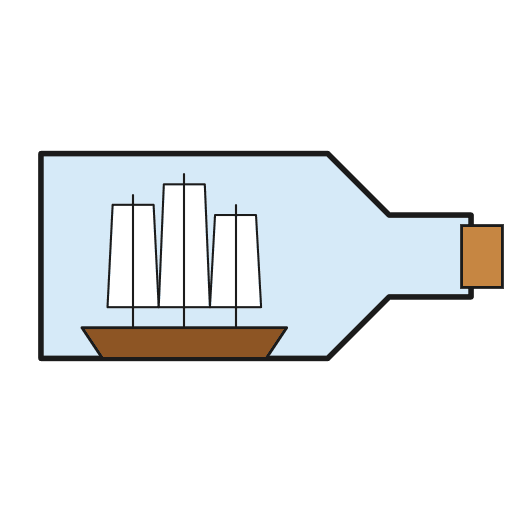
The ship goes in through the neck. That is the entire answer, and it disappoints people — but the engineering that makes it possible is genuinely clever.
The hull is carved narrow enough to pass the neck. The masts are not fixed: they are hinged at the deck and lie flat along the hull going in. Threads run from the mast tops, through the bow, and out of the bottle. Once the hull is seated in its sea, you pull the threads and the masts stand up, rigging and all. Then you trim the threads flush and seal the neck.
It is a deployable structure — the same idea as a folding solar array on a satellite. Everything must fold into a smaller envelope, then unfold reliably, once, with no hands inside.
Istruzioni
Measure the bottle neck first
Measure the bottle neck first
Measure the internal diameter of the neck and write it down. Every dimension of the ship is constrained by this one number. Design outward from the neck, never inward from the ship.
Materiali per questo passaggio:
 Bottiglia di vetro (trasparente)1 pezzo
Strumenti necessari:
 Righello
Carve the hull narrower than the neck
Carve the hull narrower than the neck
Carve the hull from soft wood, its beam at least 2 mm under the neck diameter. It must pass through easily — a hull that only just fits will jam at the worst moment.
Materiali per questo passaggio:
 Blocco di legno duro1 pezzo
Strumenti necessari:
 Taglierino di precisione
Test the hull through the neck
Test the hull through the neck
Pass the bare hull through the neck and back out before doing anything else. Finding out later that it does not fit means starting again.
Make the masts and hinge them
Make the masts and hinge them
Make masts from thin dowel. Flatten the base of each, drill a fine hole through it and through the deck, and pin it with wire so it swings fore-and-aft only.
Materiali per questo passaggio:
 Tondini di legno duro da 1/4"1 confezione
 Barra di ottone1 pezzo
Check the masts fold flat toward the stern
Check the masts fold flat toward the stern
All masts must lie flat along the deck pointing aft, and rise together. One mast hinged the wrong way will foul the others and lock the whole assembly.
Rig the standing lines slack
Rig the standing lines slack
Rig lines from the mast tops back to the stern with just enough slack for the masts to lie down. These become taut and hold the masts upright once raised.
Materiali per questo passaggio:
 Filo di cotone1 pezzo
Run the control threads forward
Run the control threads forward
Run a thread from each mast top forward through a small hole at the bow and leave a long tail. These are the pull lines, and they are the only thing you will control once the ship is inside.
Rehearse the raise outside the bottle
Rehearse the raise outside the bottle
Fold the masts flat and pull the threads. Do this until it works every time. Any hesitation or snag here becomes unfixable once the ship is through the neck.
Make the sea in the bottle
Make the sea in the bottle
Put putty or coloured wax into the bottle and shape it into waves with a long wire tool. Do this before the ship goes in — you cannot work around a ship.
Materiali per questo passaggio:
 Cera d'api in pastiglie100 g
Slide the ship in, masts folded
Slide the ship in, masts folded
Fold the masts flat, keep the threads out of the neck, and ease the hull through bow first. Do not rotate it once inside — turning is what snags rigging.
Seat the hull, then raise the masts
Seat the hull, then raise the masts
Press the hull into the soft sea with a long stick, then pull the threads steadily. The masts rise and the standing rigging comes tight. This is the moment the whole design exists for.
Glue, trim and seal
Glue, trim and seal
Put a drop of glue at the bow to lock the threads, let it set, then cut the tails flush with a blade on a long stick. Seal the neck with a cork and wax.
Materiali per questo passaggio:
 Colla di pelle30 ml
History & Context
History & Context
A deployable structure. The design constraint — pass through a small aperture, then unfold into a larger stable configuration, with no access afterwards — is exactly the constraint on a satellite's solar array, a folding antenna or a stent. The engineering vocabulary is the same: stowed configuration, deployment mechanism, single-shot actuation. A ship in a bottle is that problem in miniature, solved with thread.
Why hinges and not glue. Nothing can be assembled inside, because nothing but a thin stick can reach in. So every joint that must change state has to be made outside, tested outside, and then actuated remotely. That forces the hinge-and-pull-thread solution; there is no alternative that respects the constraint.
Rehearsal is the method. Step 8 is the one that separates success from an expensive bottle of broken matchwood. Deployment mechanisms are tested exhaustively before flight for precisely this reason — you get one attempt in the real configuration, and diagnosis afterwards is impossible.
Sailors, and a caution. Ships in bottles are strongly associated with nineteenth-century sailors, and the association is broadly reasonable — long voyages, time, skill with rigging, and glass bottles readily available. Be a little careful with confident origin stories, though; the popular accounts are tidier than the evidence, and similar objects in bottles predate the ship versions.
The disappointment is the point. Nearly everyone who is told the answer feels slightly cheated. That reaction is worth noticing: the object is designed to make an ordinary mechanism look impossible, which is the same trade the cups and balls makes. Understanding how it works does not make it less good — it makes it a different and better kind of interesting.
Materiali
8- Segnaposto
- 1 pezzoSegnaposto
- 1 confezioneSegnaposto
- 1 pezzoSegnaposto
- 1 pezzoSegnaposto
- Segnaposto
- 30 mlSegnaposto
- 100 gSegnaposto
Questo progetto realizza
CC0 Pubblico dominio
Questo progetto è rilasciato sotto CC0. Sei libero di copiare, modificare, distribuire e utilizzare quest'opera per qualsiasi scopo, senza chiedere permesso.
Supporta il Maker acquistando prodotti tramite il suo progetto dove guadagna una Commissione Maker stabilita dai venditori, oppure crea una nuova iterazione di questo progetto e includilo come collegamento nel tuo progetto per condividere i ricavi.