ARTE
BELLEZZA E BENESSERE
MESTIERE
CULTURA E STORIA
DIVERTIMENTO
AMBIENTE
CIBO E BEVANDE
INGEGNERIA INVERSA
SCIENZE
SPORT
TECNOLOGIA
INDOSSABILI
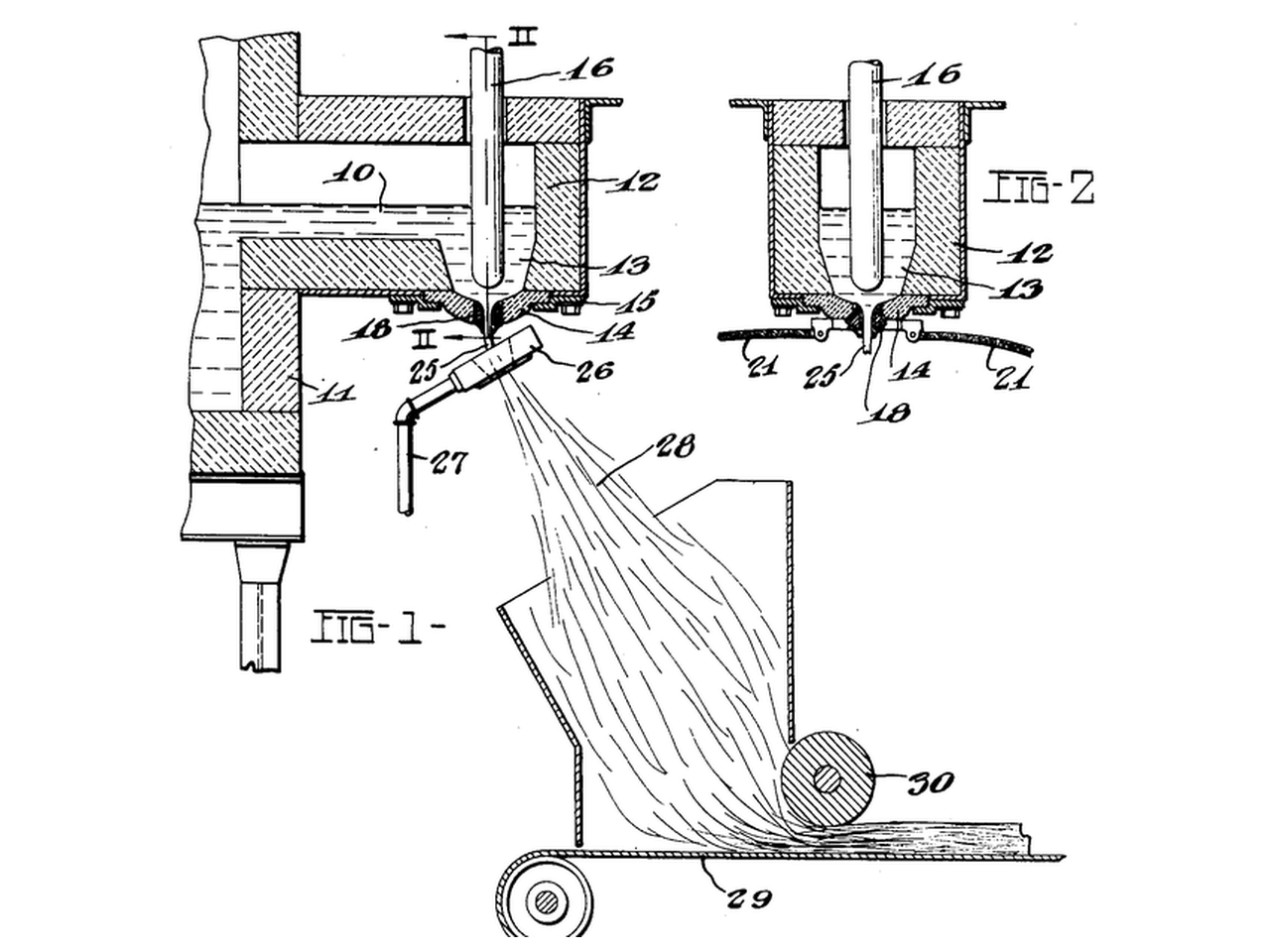


Glass Wool
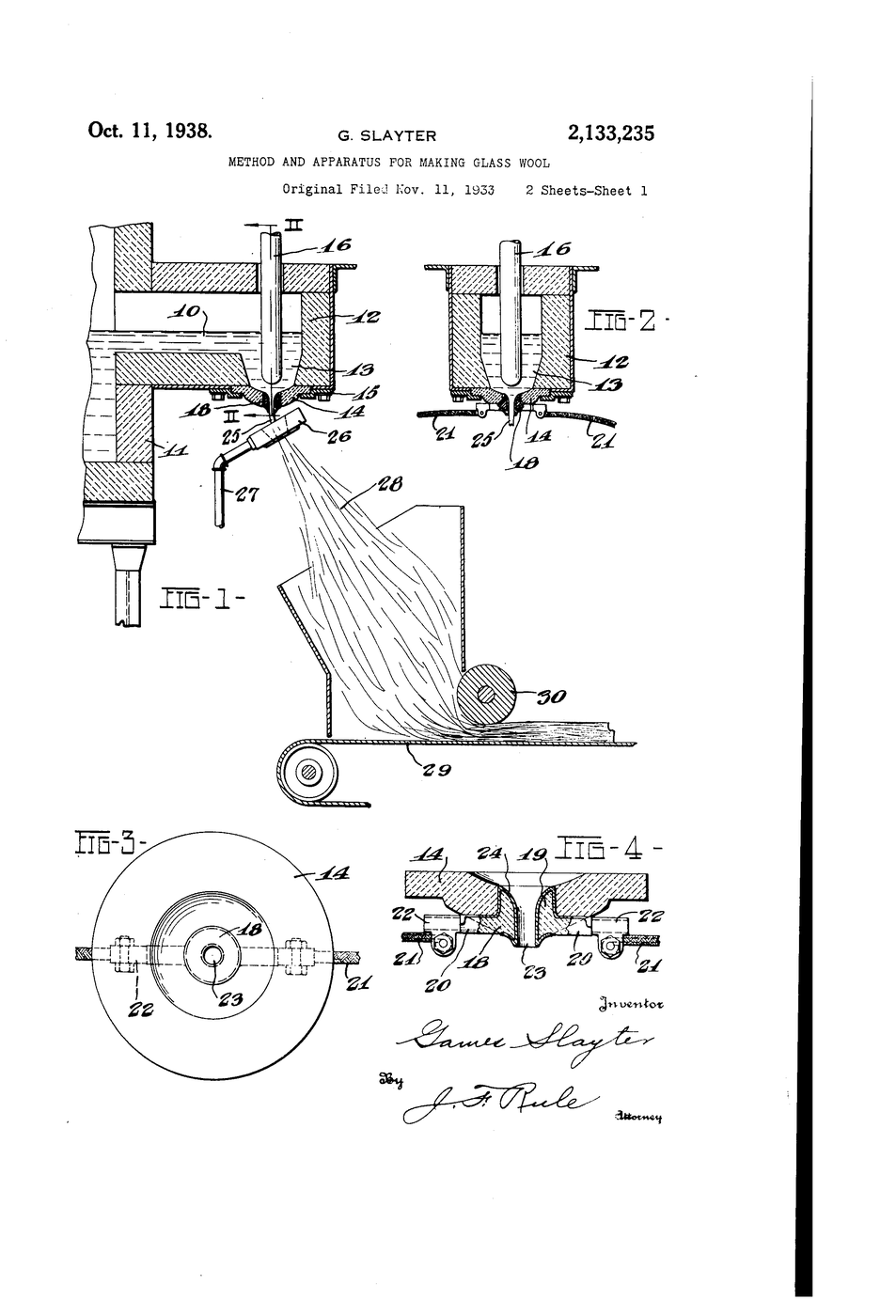
Glass wool was made before the 1930s by blowing steam at a falling thread of molten glass, but by the time the glass reached the blast it had cooled too far to draw really fine fibres. Games Slayter at Owens-Illinois brought the blast right up to the bushing the glass leaves the furnace through, while it was still at furnace heat.
**US 2,133,235**, "Method and apparatus for making glass wool", Slayter, assigned to Owens-Illinois, filed 11. November 1933, granted 11. October 1938. Its FIGURE 1 (the picture above) shows the furnace, the bushing, the steam blast and the wool piling onto a conveyor. The same work led to Owens-Corning Fiberglas in 1938.
**You measure what it is for**: three jars of hot water - bare, in glass wool, in cotton wool - logged by an Arduino, and the cooling curves turned into heat-loss figures.
Principiante
2 hours
Istruzioni
1
1
Wire the logger
Wire the logger
Probes' red to 5V, black to GND, data (yellow) together to D2, with a 4.7 kΩ resistor from D2 to 5V. Install the OneWire and DallasTemperature libraries. Warm each probe in your hand in turn to learn which index is which.
three_jar_cooling_logger.inocpp
Materiali per questo passaggio:
 Sensore di temperatura DS18B203 pezzi
 Kit di resistenze1 kit
 Set di cavi Dupont (maschio-femmina)1 set
Strumenti necessari:
 Arduino Uno R3
 Breadboard
 Cavo USB-B
2
2
Prepare three jars
Prepare three jars
Drill a 7 mm hole in each of three identical lids. Push a probe through each so its tip sits mid-jar. Seal the hole with tape.
Materiali per questo passaggio:
 Barattoli di vetro con coperchio3 pezzi
Strumenti necessari:
 Trapano a batteria
 Serie di punte da trapano
 Nastro di carta per mascherature
3
3
Wrap two of them
Wrap two of them
Gloves, long sleeves, mask, glasses. Put glass wool inside a plastic bag, then wrap jar 2 in it 30 mm thick all round and under, and tape. Wrap jar 3 the same way in cotton wool. Leave jar 1 bare.
Materiali per questo passaggio:
 Cotone idrofilo1 confezione
Strumenti necessari:
 Guanti da lavoro in pelle
 Mascherina antipolvere
 Occhiali di sicurezza trasparenti
 ForbiciNastro di carta per mascherature
 Isolante in lana di vetro
 Sacchetti di plastica
4
4
Fill and log
Fill and log
Boil water. Pour 500 ml into each jar, one after another, and close the lids. Start the serial monitor and log for 90 minutes. Note the room temperature.
Strumenti necessari:
 Bollitore elettrico in vetro
 Cilindro graduato
5
5
Fit the curves
Fit the curves
Caricamento del notebook Jupyter…
6
6
History & Context
History & Context
**What the patent specifies:** a steam blast applied at the bushing itself, so the glass stream is drawn while still at furnace temperature, giving very fine wool. **Modern build (derived):** commercial glass-wool insulation, handled wrapped.
Continuous glass filament for textiles and reinforcement followed from the same laboratory. Its limits: loose fibres irritate skin, eyes and lungs, so it is always handled covered, and like any fibrous insulation it loses most of its value when wet or compressed.
Materiali
5- Segnaposto
- Segnaposto
- Segnaposto
- Segnaposto
- 1 confezioneSegnaposto
Strumenti richiesti
14- 1 vendor sell this, none ship to you yetSegnaposto
- 1 vendor sell this, none ship to you yetSegnaposto
- 1 vendor sell this, none ship to you yetSegnaposto
- 1 vendor sell this, none ship to you yetSegnaposto
- Segnaposto
- Segnaposto
- Segnaposto
- Segnaposto
- Segnaposto
- Segnaposto
- Segnaposto
- Segnaposto
- Segnaposto
- Segnaposto
Blueprint correlati
Questi blueprint condividono conoscenze — tecniche, materiali o principi
CC0 Pubblico dominio
Questo progetto è rilasciato sotto CC0. Sei libero di copiare, modificare, distribuire e utilizzare quest'opera per qualsiasi scopo, senza chiedere permesso.
Supporta il Maker acquistando prodotti tramite il suo progetto dove guadagna una Commissione Maker stabilita dai venditori, oppure crea una nuova iterazione di questo progetto e includilo come collegamento nel tuo progetto per condividere i ricavi.