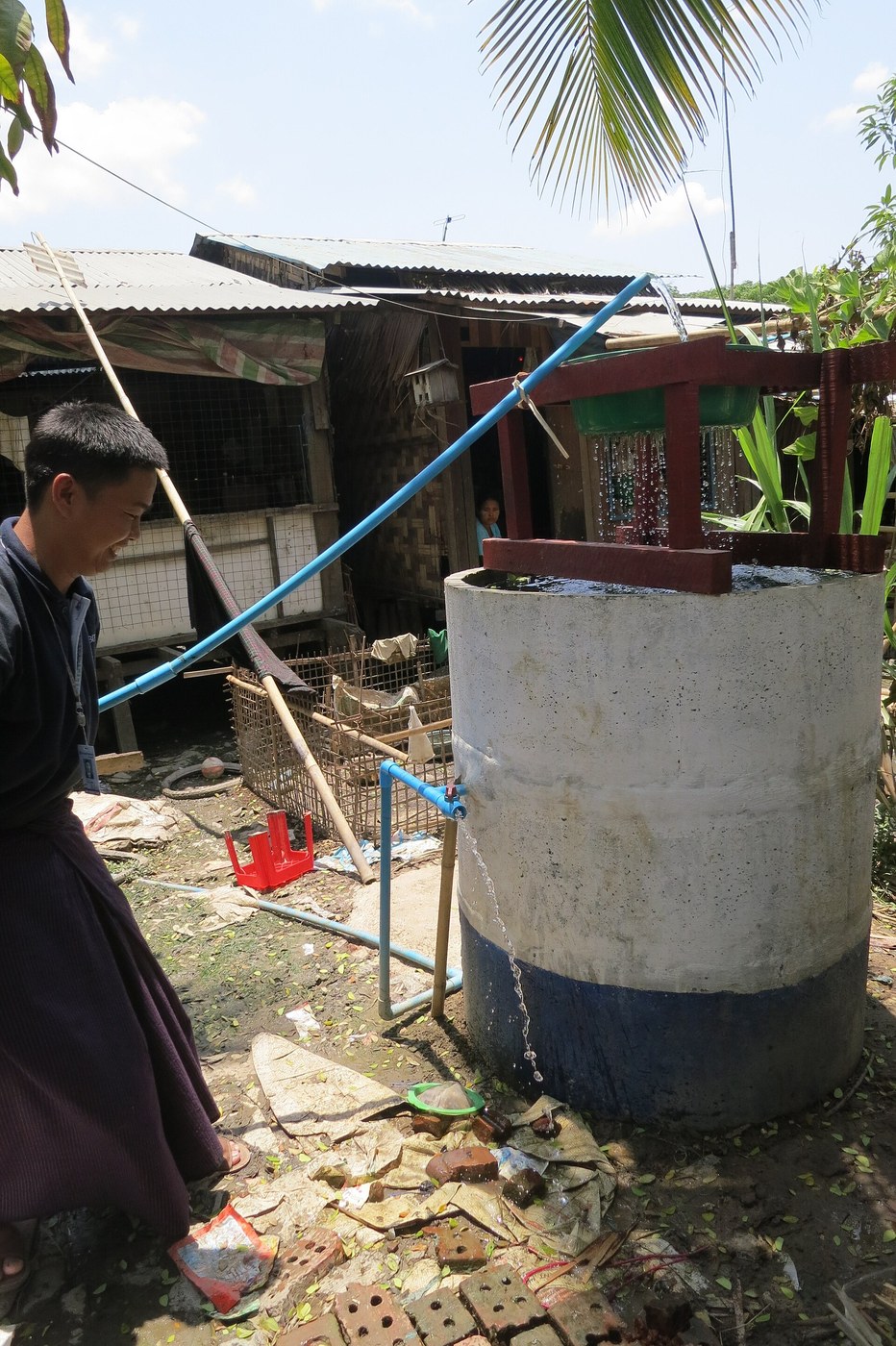


Slow Sand Filtration
Everyone assumes a sand filter works by sieving — that the grains are close enough together to catch the dirt. They are not, and it does not.
The gaps between grains of filter sand are enormous compared with a bacterium. Water passes through freely and so, at first, does almost everything harmful in it. A brand-new sand filter is a poor filter.
What cleans the water is a living layer that grows on the top few millimetres of the sand over the first weeks of operation. In it live bacteria, protozoa, algae and rotifers, and they treat the incoming water as food: they consume the organic matter, and the protozoa eat the pathogenic bacteria. The sand is not the filter. The sand is the substrate the filter grows on.
That single realisation explains everything else that is strange about the technique. It must run slowly, because the layer needs contact time. It must run continuously, because the ecosystem starves if you stop. It gets better with age, not worse. And when you finally clean it, you must scrape off only the top layer and let it regrow — because you are not unblocking a sieve, you are harvesting a crop and leaving the seed.
The method is credited to James Simpson for the Chelsea Waterworks, and it is still in municipal use two centuries later, unimproved in principle.
Istruzioni
Measure the gaps and prove sieving cannot be the answer
Measure the gaps and prove sieving cannot be the answer
Measure the grain size of your filter sand — typically 0.15 to 0.35 mm. The pore spaces between packed grains are a fair fraction of that, so call them tens of microns.
Now write down the size of a bacterium: about 1 to 2 microns. A virus is a hundred times smaller again.
The gaps are ten to a hundred times too big.
Whatever this filter does, it is not straining. Hold onto that before building, because every design decision below only makes sense once you have abandoned the sieve idea.
Materiali per questo passaggio:
 Sabbia da filtro10 kg
Strumenti necessari:
 Calibro digitale da 6 pollici
Build the bed, and keep it drowned
Build the bed, and keep it drowned
In a container, lay coarse gravel over the outlet, then finer gravel, then at least 500 mm of filter sand. Arrange the outlet so the water level always stands above the sand surface.
That standing water — the supernatant — is not a detail. It keeps the biological layer wet and fed, and it stops the incoming flow from cratering the surface.
Set the outlet so the flow is slow: 0.1 to 0.3 metres per hour of downward travel. That is far slower than seems reasonable, and step 4 shows why it cannot be hurried.
Materiali per questo passaggio:
Sabbia da filtro20 kg Ghiaia grossa10 kg
Wait, and watch it get better
Wait, and watch it get better
Run the filter continuously on the same source water for several weeks. Each week, record the clarity of the output and look closely at the sand surface.
Expect a thin brownish film to develop — the schmutzdecke, literally "dirt cover" — and expect the water quality to improve as it establishes.
This is the opposite of every other filter you have used, where day one is best and it declines from there.
Treat the output as non-potable for this exercise. You are studying the mechanism, not commissioning a drinking-water supply, which requires testing you cannot do at a bench.
Push the flow rate and watch it fail
Push the flow rate and watch it fail
Once mature, open the outlet and run the filter several times faster for a day. Compare the output with the slow-rate output.
Expect it to get worse, and quickly.
Two things happen at speed. The water spends less time in contact with the living layer, so less of it is consumed; and the faster flow drags material deeper than the biology reaches.
Then restore the slow rate and watch recovery take days, not minutes. A biological process cannot be rushed and does not restart instantly — which is the whole difference between this and a mechanical filter you can simply backwash.
Clean it the right way
Clean it the right way
When the flow has slowed because the surface has clogged, do not backwash or dig it over. Drain down and scrape off only the top 10-20 mm, then refill gently.
Record how long the filter takes to come back to full quality — usually days.
You have removed the clogged mat and left the deeper population intact to reseed it. Stirring the bed, or washing it thoroughly, destroys the thing doing the work and costs you weeks.
After many scrapes the bed becomes too shallow and clean sand is added back. This is husbandry, not maintenance, and the vocabulary matters because it tells you how to think about the machine.
History & Context
History & Context
The idea arrived before the reason for it. James Simpson built slow sand filtration for the Chelsea Waterworks in London decades before anyone accepted that microorganisms cause disease. It was installed to make water look and taste better. It happened to remove the thing that was killing people, and it did so through a biological mechanism nobody could have described at the time.
Then it proved the germ theory by accident. In the 1892 Hamburg cholera epidemic, Hamburg drew unfiltered river water and suffered terribly; neighbouring Altona drew from the same river downstream of Hamburg's sewage but filtered it, and was largely spared. Two cities, one river, one difference. It is one of the most quoted natural experiments in public health, and it turned filtration from an aesthetic amenity into a duty.
Why it survived being superseded. Rapid sand filtration with chemical coagulants is faster, smaller and cheaper to build, and it took over most large works. Slow sand filtration is still used — London and other cities run it today — because it needs no chemicals, no power beyond gravity, no skilled dosing, and produces water that keeps well. Where a plant must run for decades with little intervention, an ecosystem is a better machine than a chemical process.
What it is bad at. It needs a large footprint and a lot of patience. It handles turbid water poorly — heavy silt blinds the surface in days, so muddy sources need settling first. It cannot be started quickly, which makes it useless as emergency equipment. And it does not reliably remove viruses or dissolved chemicals, which is why modern practice puts a disinfectant residual after it rather than trusting it alone.
The idea to carry forward. The filter is alive, and the design task was to build a house for an ecosystem and then leave it alone. That is a different discipline from filtering, and it recurs — in trickling filters, reed beds, aquarium biofilters and septic drainfields. Wherever a process is cultivated rather than operated, these same rules apply: slowly, continuously, and do not scrub it clean.
Materiali
2- 30 kgSegnaposto
- 10 kgSegnaposto
Strumenti richiesti
1- Segnaposto
Materiali dei progetti collegati

CC0 Pubblico dominio
Questo progetto è rilasciato sotto CC0. Sei libero di copiare, modificare, distribuire e utilizzare quest'opera per qualsiasi scopo, senza chiedere permesso.
Supporta il Maker acquistando prodotti tramite il suo progetto dove guadagna una Commissione Maker stabilita dai venditori, oppure crea una nuova iterazione di questo progetto e includilo come collegamento nel tuo progetto per condividere i ricavi.