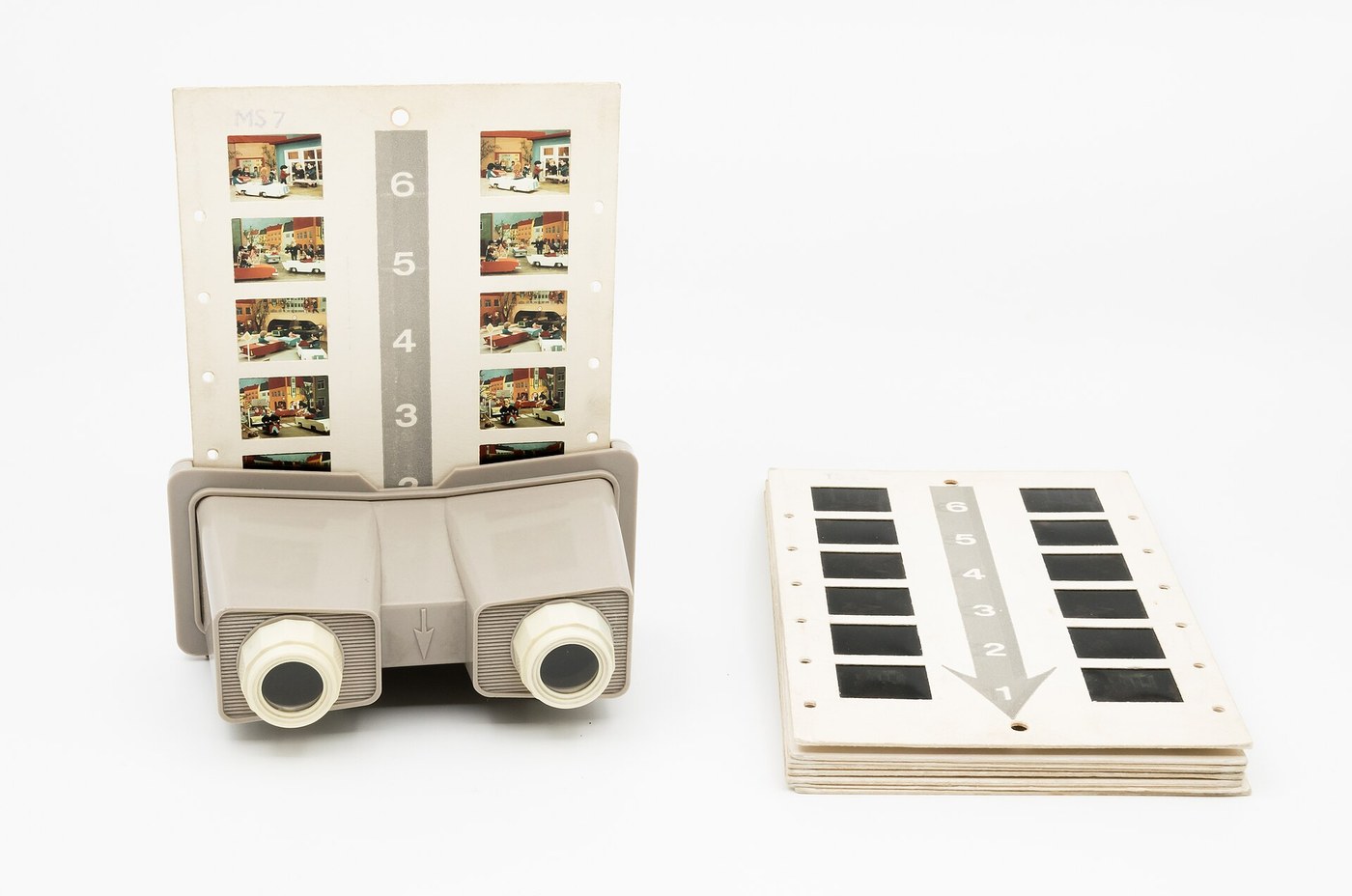

Stereoscope
Istruzioni
Measure your own disparity
Measure your own disparity
Find the effect in your own head before building anything.
- Hold a finger at arm's length and look past it at a far wall.
- Close one eye, then the other, alternately.
- Watch the finger jump sideways against the background.
- Bring the finger closer and repeat — the jump grows.
Strumenti necessari:
 Righello
Make a stereo pair
Make a stereo pair
Two images of the same scene, taken from two eye positions.
- Photograph or draw a scene from one position.
- Shift sideways by roughly your eye separation — no rotation, no tilt.
- Capture the second image.
Build the viewer
Build the viewer
Each eye must see one image only, and see it comfortably.
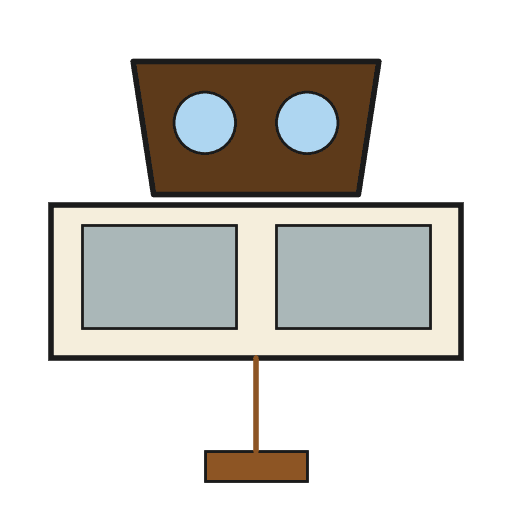
- Mount the two images side by side, separated by about your eye spacing.
- Fit a divider between them so neither eye sees the other's picture.
- Add simple convex lenses so the eyes can focus at a comfortable distance.
Materiali per questo passaggio:
 Lente convessa2 pezzi
 Specchio piano2 pezzi
Break it deliberately
Break it deliberately
Test the limits, which is where the brain's rules show themselves.
- Swap the left and right images and look again.
- Tilt one image slightly.
- Exaggerate the camera separation to 300 mm and view a landscape.
History and context
History and context
Charles Wheatstone described the stereoscope to the Royal Society in 1838, using mirrors and hand-drawn figures — necessarily, since photography was not yet announced. His point was theoretical: he was demonstrating that binocular depth arises from combining two disparate images in the mind, which was not obvious and had been argued about since antiquity.
Photography turned a demonstration into a craze. David Brewster produced a compact lens-based viewer around 1849, it was shown at the Great Exhibition in 1851, and Queen Victoria's enthusiasm did the rest. Stereo cards of the Alps, the pyramids, city streets and — inevitably — a considerable trade in erotica sold in enormous numbers. It was, in a real sense, the first mass visual entertainment medium in the home.
The same principle, over and over. The View-Master (1939) is a stereoscope with a rotating reel. Anaglyph glasses separate the two images by colour, polarised cinema by polarisation, and a VR headset simply puts a small screen where each of Wheatstone's pictures used to sit. None of these are new ideas about depth — they are new ways of delivering one image to each eye.
Worth knowing: a substantial minority of people cannot fuse stereo pairs at all, often because of childhood strabismus or amblyopia. They navigate the world perfectly well using motion parallax, occlusion, perspective and shading — which is a useful reminder that binocular disparity is one depth cue among many, not the only one.
Materiali
2- 2 pezziSegnaposto
- 2 pezziSegnaposto
Questo progetto realizza
Blueprint correlati
Questi blueprint condividono conoscenze — tecniche, materiali o principi

CC0 Pubblico dominio
Questo progetto è rilasciato sotto CC0. Sei libero di copiare, modificare, distribuire e utilizzare quest'opera per qualsiasi scopo, senza chiedere permesso.
Supporta il Maker acquistando prodotti tramite il suo progetto dove guadagna una Commissione Maker stabilita dai venditori, oppure crea una nuova iterazione di questo progetto e includilo come collegamento nel tuo progetto per condividere i ricavi.