Collaborazione
ARTE
BELLEZZA E BENESSERE
MESTIERE
CULTURA E STORIA
DIVERTIMENTO
AMBIENTE
CIBO E BEVANDE
INGEGNERIA INVERSA
SCIENZE
SPORT
TECNOLOGIA
INDOSSABILI
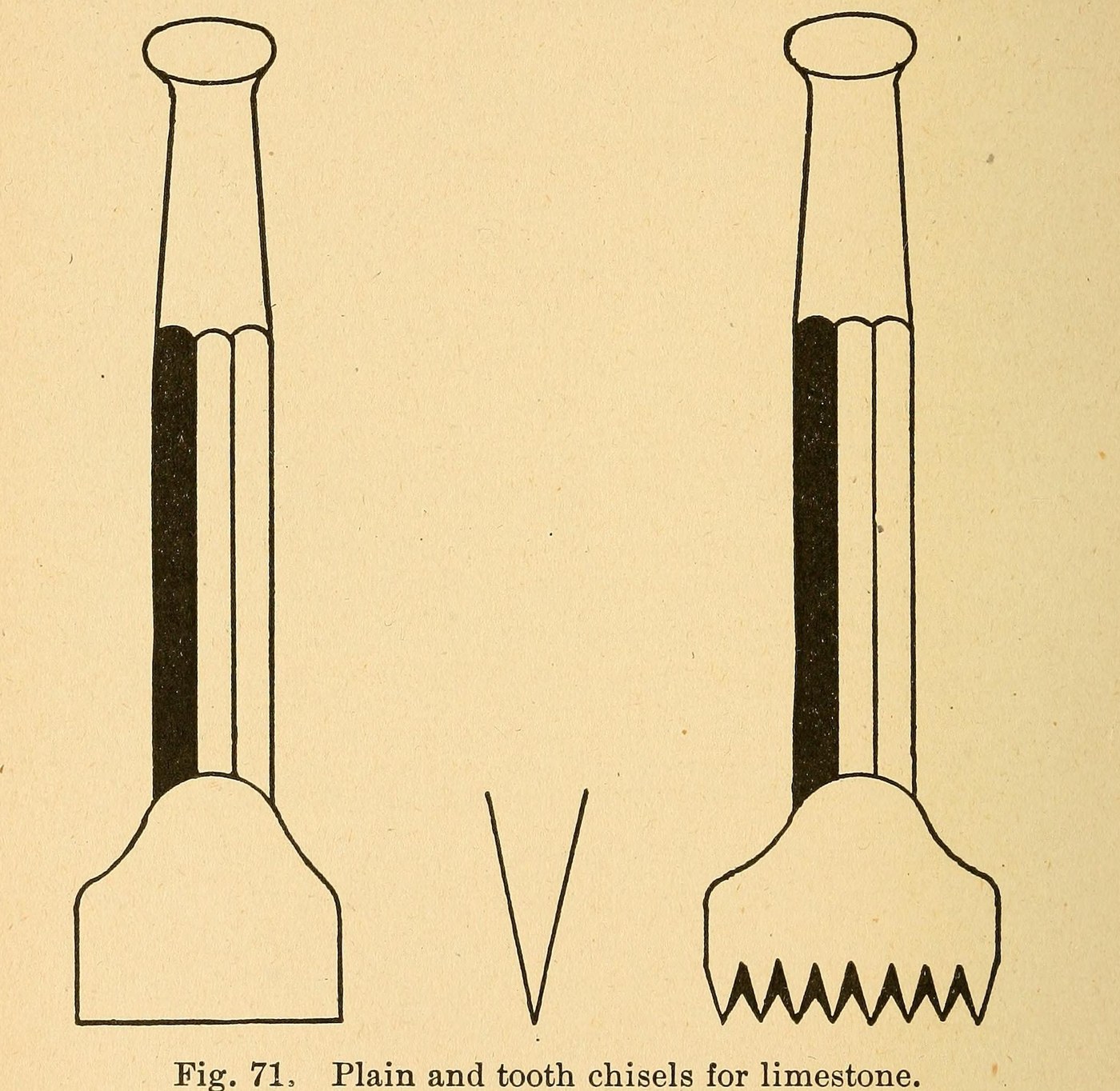


Stone Carving Chisels: Mallet-Headed Plain and Tooth Chisels and Points for Soft Stone (Holford, 1907)
Soft stone such as limestone and sandstone is cut with chisels struck by a wooden mallet, so their heads are broad and a little rounded. H. Holford's 20th Century Toolsmith and Steelworker (1907) shows a set: plain chisels, tooth chisels with a row of sharp teeth, and points, forged from 3/4 inch octagon steel of 75 points carbon and tempered a very pale blue.
He gives no lengths, widths or tooth spacing; those are unknown here. The brine bath is from his chapter on the hardening bath.
Source: H. Holford (1907), pp. 21, 131-133, 140-141. Picture: his Fig. 71.
Intermedio
A day for a set
Istruzioni
1
1
Read Holford
Read Holford
"In cutting soft stone of any description wooden mallets are used, consequently the heads of the tools are made broad and a little rounding, so as not to cut or bruise the mallet."
2
2
Forge the mallet heads
Forge the mallet heads
Use 3/4 inch octagon steel of 75 points carbon. For each tool, upset the head end a little, fuller it in, draw it out, then swage it to its broad, slightly rounded shape between top and bottom swages (Fig. 78). For a narrow chisel, forge the head first; for a wide one, forge the cutting end first. Sizes are not given (unknown).
Materiali per questo passaggio:
 Barra ottagonale di acciaio per utensili1 3/4 in octagon
Strumenti necessari:
 Forgia
 Incudine
 Martello da fabbro
 Slitta
 Fuller (ferro da scanalare)
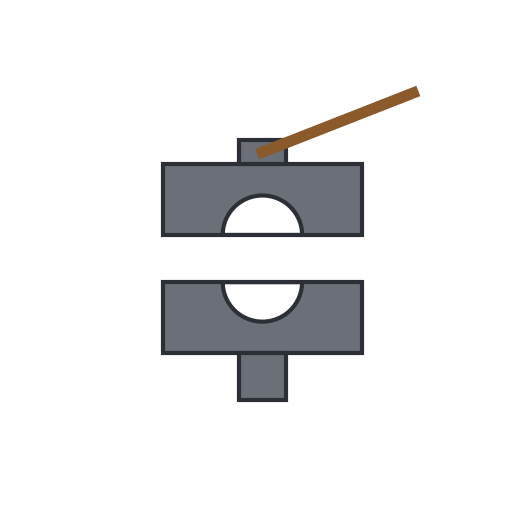 Stampi superiore e inferiore
 Tenaglie da fabbro
 Dimensioni sconosciute
 Occhiali di sicurezza
 Guanti resistenti al calore
3
3
Forge the chisels and points
Forge the chisels and points
For a wide chisel, upset the end to the width of the chisel before drawing it down to a thin cutting edge. Hammer the flat surfaces. Draw the points down to almost a square point (Fig. 72). For tooth chisels, punch the teeth into the edge in a punch machine after the flat surfaces have been hammered, then file each tooth to an extremely sharp point.
Strumenti necessari:
ForgiaIncudineMartello da fabbroTenaglie da fabbro Pressa punzonatrice
 Lima fine
4
4
Harden the chisels
Harden the chisels
Heat the cutting edge very evenly along its whole length and dip it at least one inch into the hardening bath (clean water, best as a strong brine, kept large and cold). Polish it bright by rubbing it across a board spread with fine clean sand near the forge, and draw the temper to a very pale blue, the right temper for all limestone tools.
Strumenti necessari:
Forgia Salamoia satura
 Tavola
 Sabbia fineTenaglie da fabbroGuanti resistenti al calore
5
5
Harden the points
Harden the points
Dip the points deep into the bath. Draw the temper so it shows at least 5/8 inch back from the point; if it runs so fast that only the very tip is tempered, the point bends and breaks easily.
Strumenti necessari:
ForgiaSalamoia saturaTavolaSabbia fineTenaglie da fabbroGuanti resistenti al calore6
6
History and honest limits
History and honest limits
Holford sets the soft-stone tools apart from those for granite and marble: soft stone takes wooden mallets, hence the broad heads, and a very pale blue temper. The finest stone carvers' tools, struck only lightly, he hardens without drawing any temper at all.
He gives no lengths, widths or tooth spacing; the tools used to make them are ours.
Materiali
1- 1 3/4 in octagonSegnaposto
Strumenti richiesti
15- Segnaposto
- Segnaposto
- Segnaposto
- Segnaposto
- Segnaposto
- Segnaposto
- Segnaposto
- Segnaposto
- Segnaposto
- Segnaposto
- Segnaposto
- Segnaposto
- Segnaposto
- Segnaposto
- Segnaposto
Questo progetto realizza
Blueprint correlati
Questi blueprint condividono conoscenze — tecniche, materiali o principi
CC0 Pubblico dominio
Questo progetto è rilasciato sotto CC0. Sei libero di copiare, modificare, distribuire e utilizzare quest'opera per qualsiasi scopo, senza chiedere permesso.
Supporta il Maker acquistando prodotti tramite il suo progetto dove guadagna una Commissione Maker stabilita dai venditori, oppure crea una nuova iterazione di questo progetto e includilo come collegamento nel tuo progetto per condividere i ricavi.