ARTE
BELLEZZA E BENESSERE
MESTIERE
CULTURA E STORIA
DIVERTIMENTO
AMBIENTE
CIBO E BEVANDE
INGEGNERIA INVERSA
SCIENZE
SPORT
TECNOLOGIA
INDOSSABILI
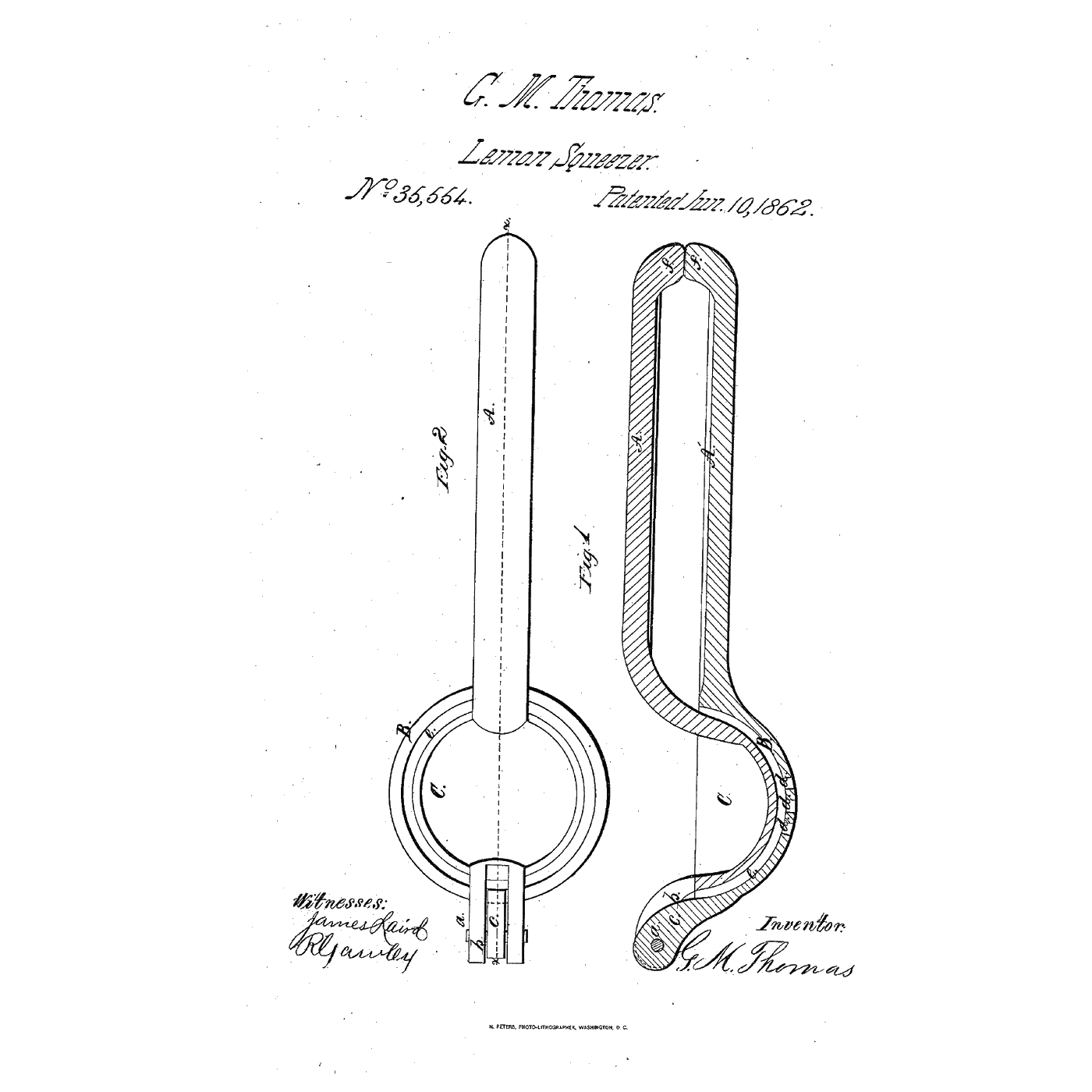


The Hinged-Bowl Lemon Squeezer: Two Cast Handles, One Bowl Inside the Other
The wooden lemon squeezers of the day soon soaked up stale juice and smelled of it.
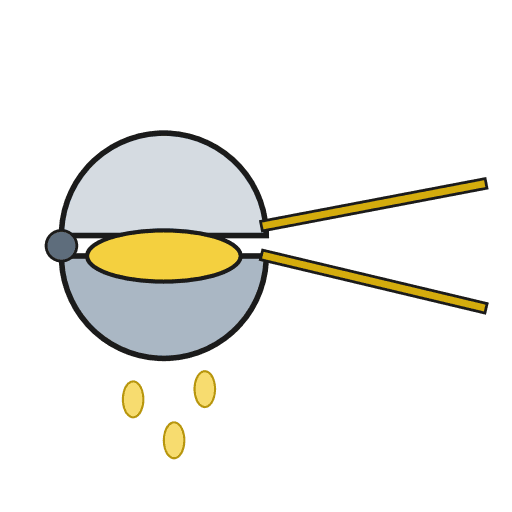
George M. Thomas of New York received US 35,554, dated 10 June 1862, for "constructing the squeezer of cast metal and of such form or in such a manner that a very durable, economical, and light implement for the purpose is obtained, and one that may be manipulated or operated with greater facility than the ordinary kinds in general use." Two handles are pinned together at their front ends; the lower carries a perforated bowl, the upper a smaller half-sphere that fits inside it with a space between; the half lemon is put in the lower bowl and the handles are pressed together. The lower bowl hangs below its handle, so the squeezer can rest on a glass.
This rung works out the force of the handles, with a work check, then makes the squeezer from flat bar, a tin cup and a hardwood dome and squeezes lemons with it.
Intermedio
About 4 hours
Istruzioni
1
1
Force at the bowls
Force at the bowls
Caricamento del notebook Jupyter…
2
2
A squeezer before it
A squeezer before it
The embedded blueprint presses the lemon on a cone under a lever-driven cap. Thomas puts the bowl and its half-sphere on the two handles themselves.
3
3
Read US 35,554
Read US 35,554
"The lower handle, A′, is provided with a bowl, B, of semispherical form, and perforated at its bottom, as shown at d in Fig. 1. The inner surface of the bowl B is enameled, or should be, in order to prevent oxidation. The bowl B and handle A′ are cast in one piece, and the bowl projects below the handle, the latter being on a level or in the same plane with the upper edge of the former."
"The lemon is squeezed by being divided, as usual, and one-half at a time placed in the bowl B, and forcing the bowl C down upon it by pressing the handles A A′ together."
4
4
Make the squeezer and press lemons
Make the squeezer and press lemons
**Handles.** Cut two 25 cm lengths of 20 × 5 mm mild steel flat bar. Drill both 1 cm from one end for an M6 pivot bolt, and bend the other ends slightly apart as the stops f.
**Lower bowl.** Cut the bottom 3 cm off a clean tin can about 7 cm across, punch holes in its base with a nail, and rivet its rim to the lower handle 5 cm behind the pivot so it hangs below.
**Upper dome.** Rasp a hardwood block into a half-sphere that fits inside the cup with about 5 mm to spare, and screw it to the upper handle opposite the cup.
**Test.** Bolt the handles together. Halve a lemon, put one half cut side down in the cup over a glass, and press the handles together, reading your squeeze with the spring scale hooked on the handles' ends. Weigh the juice, and compare with a half squeezed by hand.
Materiali per questo passaggio:
 Piatto di acciaio dolce0.5 metro
 Barattolo di latta1 pezzo
 Blocco di legno duro1 pezzo
 Viti da legno2 pezzi
 Rivetti in acciaio4 pezzi
 Assortimento di bulloni a testa esagonale1 pezzo
 Dado esagonale1 pezzo
 Limone2 pezzi
Strumenti necessari:
 Seghetto per metalli
 Trapano a batteria
 Serie di punte da trapano
 Lime (lima a mano)
 Morsa da banco
 Cesoie da lattoniere
 Chiodi
 Martello
 Set da ribadire
 Raspa
 Set di cacciaviti
 Chiave a rullino
 Coltello da cucina
 Bilancia digitale da cucina
 Dinamometro (bilancia a molla)
 Bicchiere
 Guanti da lavoro in pelle
5
5
A squeezer that sprays, slips or leaves juice
A squeezer that sprays, slips or leaves juice
Hinged-bowl lemon squeezer troubleshooting.
Flow
Loading...
6
6
History and honest limits
History and honest limits
**George M. Thomas** of New York, New York, received US 35,554, dated 10 June 1862. His handles A A′ were joined by a fulcrum pin a through a slot b in the upper handle, the bowl C was cast with the upper handle and smaller than B to leave a space e, and the handles' ends were curved at f as stops. He thought cast iron, japanned, the best material, and did not claim a cast-metal squeezer as such, but one with two handles on a fulcrum pin and bowls fitting one within the other below the handles.
**Honest limits.** Flat bar, a tin cup and a hardwood dome stand in for his cast-iron handles and bowls. The notebook ignores friction; its forces and lengths are examples. Your juice weights are the result.
Materiali
8- 0.5 metroSegnaposto
- 1 pezzoSegnaposto
- 1 pezzoSegnaposto
- 2 pezziSegnaposto
- 4 pezziSegnaposto
- Segnaposto
- 1 pezzoSegnaposto
- 2 pezziSegnaposto
Strumenti richiesti
17- Segnaposto
- 1 vendor sell this, none ship to you yetSegnaposto
- Segnaposto
- Segnaposto
- Segnaposto
- Segnaposto
- Segnaposto
- Segnaposto
- Segnaposto
- Segnaposto
- Segnaposto
- Segnaposto
- Segnaposto
- Segnaposto
- Segnaposto
- Segnaposto
- Segnaposto
Questo progetto realizza
Blueprint correlati
Questi blueprint condividono conoscenze — tecniche, materiali o principi



CC0 Pubblico dominio
Questo progetto è rilasciato sotto CC0. Sei libero di copiare, modificare, distribuire e utilizzare quest'opera per qualsiasi scopo, senza chiedere permesso.
Supporta il Maker acquistando prodotti tramite il suo progetto dove guadagna una Commissione Maker stabilita dai venditori, oppure crea una nuova iterazione di questo progetto e includilo come collegamento nel tuo progetto per condividere i ricavi.