ARTE
BELLEZZA E BENESSERE
MESTIERE
CULTURA E STORIA
DIVERTIMENTO
AMBIENTE
CIBO E BEVANDE
INGEGNERIA INVERSA
SCIENZE
SPORT
TECNOLOGIA
INDOSSABILI
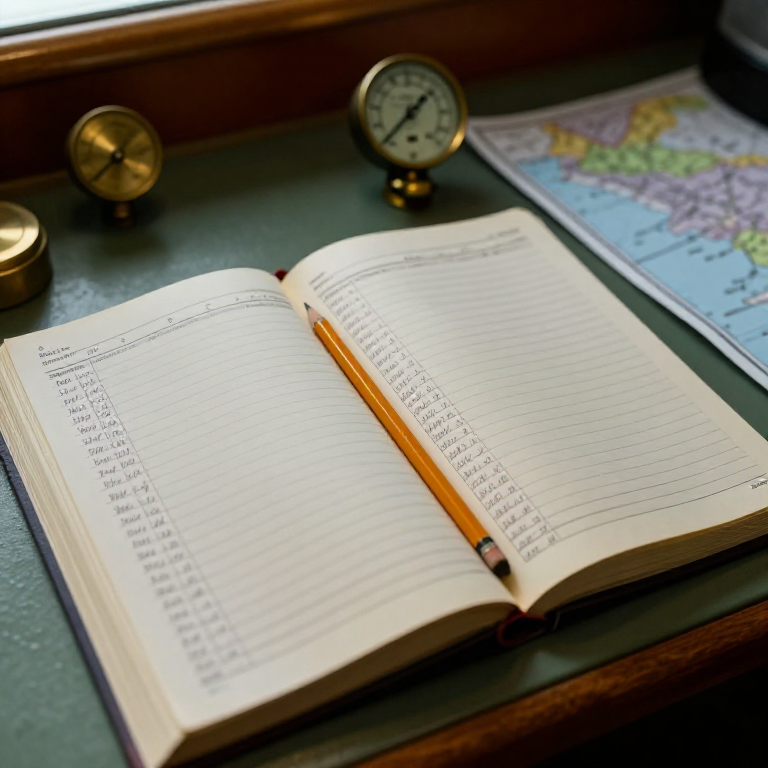


The Log Book: The Record That Makes a Position Defensible
Seven rungs of this batch produce positions. This one keeps them, and it is the rung that makes the other seven recoverable when something goes wrong.
A log book is not a diary. It is a contemporaneous record of the observations a position was built from — time, course, log reading, bearing, depth, weather — written as they happen and never afterwards. Its value is that when the plot and the depth sounder disagree at two in the morning, you can go back and find WHICH entry was wrong, instead of starting again from nothing.
It is also, in most jurisdictions, a legal document. A log that has been tidied up is worth less than no log at all, because it has stopped being evidence of anything except the tidying.
Principiante
ongoing
Istruzioni
1
1
Rule up columns that make entries quick
Rule up columns that make entries quick
Time, log reading, course steered, wind, barometer, depth, and a wide column for everything else. Rule the page before you sail.
If an entry takes more than fifteen seconds it will not get made in bad weather, which is when it matters most. The wide column is where the real value accumulates — 'thought I saw a light bearing 060, not certain' is exactly the kind of entry that turns out to matter later.
Materiali per questo passaggio:
 Quaderno2 pezzi
Strumenti necessari:
 Righello
 Matita
2
2
Write at fixed intervals AND at every event
Write at fixed intervals AND at every event
An hourly entry as routine, plus an entry every time anything changes: course, sail, engine, a fix, a light sighted, a decision taken.
The hourly entries give you the dead reckoning; the event entries give you the story. Together they let a position be reconstructed from any point. A log with only hourly entries hides a three-hour period in which the course changed twice, and that is exactly the period you will need to reconstruct.
Strumenti necessari:
Quaderno Cronometro
3
3
Record observations and conclusions separately
Record observations and conclusions separately
Write what you MEASURED and what you CONCLUDED as different things: 'Bearing castle 072, log 14.6' is an observation; 'R Fix 50 12.3N 004 08.7W' is a conclusion drawn from it.
Keeping them apart means a mistake in the working can be found and corrected without losing the underlying data. A log that records only positions has thrown away everything needed to check them — and this is the same discipline the reference-library and phenology rungs both insisted on, for the same reason.
Strumenti necessari:
Quaderno4
4
Never erase, and never write it up later
Never erase, and never write it up later
Correct a mistake by striking through with a single line, writing the correction beside it, and initialling. Do not rub out, do not overwrite, do not rewrite the page neatly.
A struck-through entry is evidence; an erased one is a hole. And an entry made from memory an hour later is not a log entry at all — memory reorders events and smooths out the confusion, which is precisely the information you needed. Write it wet, write it badly, but write it now.
Strumenti necessari:
Quaderno5
5
Reconstructing a passage from the book
Reconstructing a passage from the book
Caricamento del notebook Jupyter…
Strumenti necessari:
Quaderno6
6
Keep it, and keep it dry
Keep it, and keep it dry
Use pencil, which writes on damp paper and does not run, keep the book in a dry place, and retain it after the passage.
Old logs are how you learn what your boat actually does — what she makes to windward, how much leeway, how long that passage really takes against the tide. Nothing else accumulates that knowledge, and after a few seasons a shelf of log books is the most valuable navigational instrument you own.
Strumenti necessari:
MatitaBlueprint correlati
Questi blueprint condividono conoscenze — tecniche, materiali o principi



CC0 Pubblico dominio
Questo progetto è rilasciato sotto CC0. Sei libero di copiare, modificare, distribuire e utilizzare quest'opera per qualsiasi scopo, senza chiedere permesso.
Supporta il Maker acquistando prodotti tramite il suo progetto dove guadagna una Commissione Maker stabilita dai venditori, oppure crea una nuova iterazione di questo progetto e includilo come collegamento nel tuo progetto per condividere i ricavi.