ARTE
BELLEZZA E BENESSERE
MESTIERE
CULTURA E STORIA
DIVERTIMENTO
AMBIENTE
CIBO E BEVANDE
INGEGNERIA INVERSA
SCIENZE
SPORT
TECNOLOGIA
INDOSSABILI
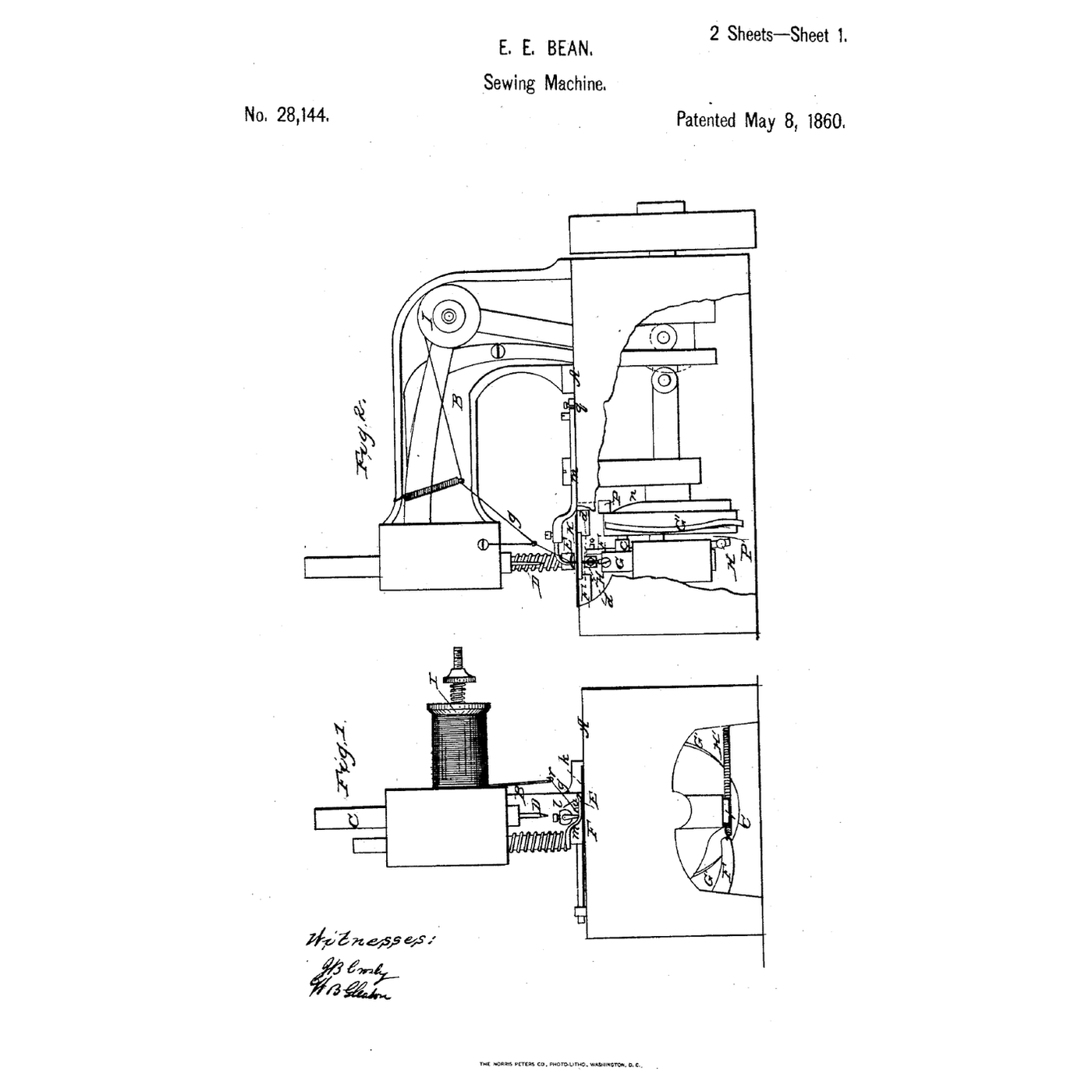

The Spring-Prong Looper: Two Springs That Take the Loop Off the Hook and Hold It Open for the Needle
In a chain-stitch machine for leather with a hooked needle rising from below, the loop must be taken off the hook and held open so the needle passes through it on the next stroke, and a slide over the hook frays the thread.
Edward E. Bean of Boston received US 28,144, dated 8 May 1860, for a looper that "consists of two flat springs, d d, and is seen particularly in Figs 9 and 10, the former of which represents the looper with its prongs sprung together, and the latter as it appears when opened by the needle." On a sliding bar below the table, it advances between the threads, rises to lift the loop from the hook, and carries it beyond the needle's path; on the next rise the needle forces the prongs apart and passes through the extended loop.
This rung works out the force the needle needs to spread the prongs, then makes a spring-prong looper on a slide, and forms a chain of loops with it and a crochet hook.
Intermedio
About 4 hours
Istruzioni
1
1
Spreading the prongs
Spreading the prongs
Caricamento del notebook Jupyter…
2
2
A looper drive before it
A looper drive before it
The embedded blueprint drives a curved needle or looper with a twisted shaft. Bean's looper is two springs on a slide that the needle itself spreads.
3
3
Read US 28,144
Read US 28,144
"The looper is shown at H. It consists of two flat springs, d d, and is seen particularly in Figs 9 and 10, the former of which represents the looper with its prongs sprung together, and the latter as it appears when opened by the needle. The springs approach at their front ends to each other, so as to form a looper point or beak, and at their opposite ends they are united to a horizontal sliding bar, e"
"Thus it will be seen that the looper-points operate to release the hook of or from its thread, and having so released it to carry it forward beyond the path of the needle in the form of a loop in such manner as that, when the needle next passes up to draw down or take another stitch, (above the table,) it shall pass through such loop"
4
4
Make the looper and form a chain
Make the looper and form a chain
**Prongs.** Cut two strips of thin spring steel 3 mm wide and 30 mm long. Rivet them together at one end to a hardwood slide, and bend their free ends toward each other so the tips touch in a point.
**Table and slide.** Fix a thin plywood plate over a box with a small hole for the hook, and run the slide in a groove under it so the looper's point passes just below the hole.
**Test.** Hold cloth on the plate. Push a crochet hook up through cloth and hole, catch the thread above, and draw it down as a loop. Advance the looper so its point enters the loop between the threads, lift it off the hook, and carry it past the hole. Push the hook up again between the prongs, spreading them, and through the held loop, catch the thread and draw it down. Repeat for a short chain, and compare with lifting the loop off the hook by hand.
Materiali per questo passaggio:
 Nastro di acciaio armonico0.1 metro
 Rivetti in acciaio2 pezzi
 Blocco di legno duro1 pezzo
 Pannello di compensato1 pezzo
 Viti da legno6 pezzi
 Filo di cotone1 pezzo
 Tessuto di cotone (leggero)1 pezzo
Strumenti necessari:
 Cesoie da lattoniere
 Lime (lima a mano)
 Set di lime ad ago
 Set da ribadire
 Trapano a batteria
 Serie di punte da trapano
 Sega a mano
 Set di uncinetti
 Pinze a becchi tondi
 Martello da ribattere
5
5
A looper that drops the loop, snags or will not open
A looper that drops the loop, snags or will not open
Spring-prong looper troubleshooting.
Flow
Loading...
6
6
History and honest limits
History and honest limits
**Edward E. Bean** of Boston, Suffolk County, Massachusetts, received US 28,144, dated 8 May 1860. His machine had an awl-feed for leather goods; the sliding bar e was worked by a lever F on a cam G′ and a spring H′; a thread-carrier l on a sliding bar m, moved by a cam n and a spring q, laid the thread against and partly round the needle. He noted a similar instrument by J. C. Seelye, applied for and rejected, worked differently. His claim is the crochet needle, thread-carrier and the looper of spring prongs operating together.
**Honest limits.** A hand-moved slide and a crochet hook stand in for his cam-driven machine, and the thread carrier is left out. The notebook treats the prongs as straight cantilevers; its sizes are examples. Your chain is the result.
Materiali
7- 0.1 metroSegnaposto
- 2 pezziSegnaposto
- 1 pezzoSegnaposto
- 1 pezzoSegnaposto
- 6 pezziSegnaposto
- 1 pezzoSegnaposto
- 1 pezzoSegnaposto
Strumenti richiesti
10- Segnaposto
- Segnaposto
- Segnaposto
- Segnaposto
- 1 vendor sell this, none ship to you yetSegnaposto
- Segnaposto
- Segnaposto
- Segnaposto
- Segnaposto
- Segnaposto
Blueprint correlati
Questi blueprint condividono conoscenze — tecniche, materiali o principi

The Twisted-Shaft Needle Rocker: A Straight Push That Swings the Needle, Then Holds It Still
di Martin
Cucito
36
0
0
0
0
0
The Stationary-Hook Chain Stitcher: A Vibrating Needle Lays Its Loop Over a Fixed Hook
di Tex
Cucito
39
0
0
0
0
0
Crochet — The Chain Stitch and Single Crochet Foundation
di Tex
Tessile e pelle
40
0
0
0
2
0
CC0 Pubblico dominio
Questo progetto è rilasciato sotto CC0. Sei libero di copiare, modificare, distribuire e utilizzare quest'opera per qualsiasi scopo, senza chiedere permesso.
Supporta il Maker acquistando prodotti tramite il suo progetto dove guadagna una Commissione Maker stabilita dai venditori, oppure crea una nuova iterazione di questo progetto e includilo come collegamento nel tuo progetto per condividere i ricavi.