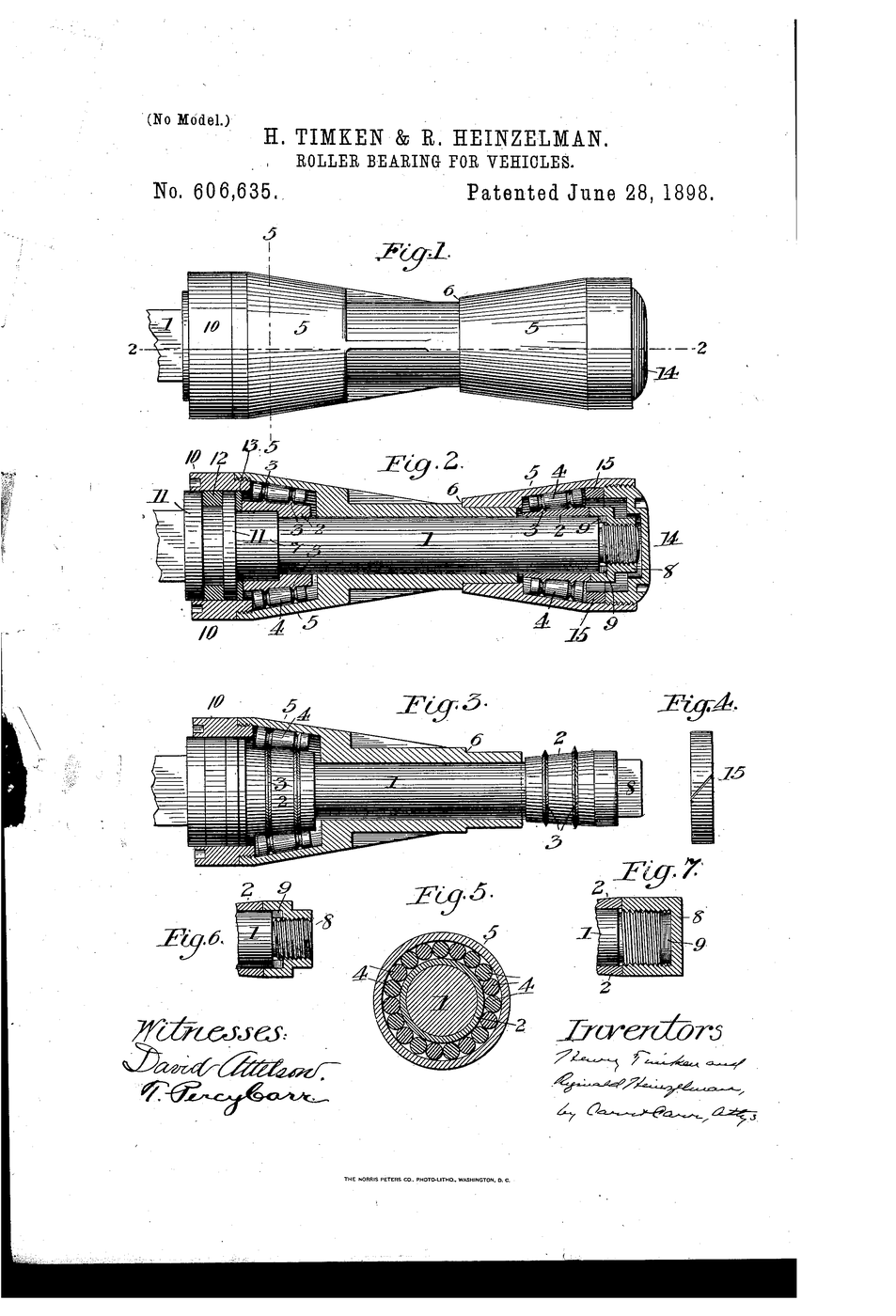


Tapered Roller Bearing
A cart wheel on a plain axle wastes much of the horse in friction, and worse, it has no good answer to side loads — every time the cart corners, the wheel tries to slide along the axle and grinds. Plain cylindrical rollers cut the rolling friction, but they still cannot take that sideways thrust.
Timken's answer is to taper everything. The rollers are cones, running between two coned races. Cones rolling in a cone track will carry a load pushing down and a load pushing sideways at the same time — exactly what a cornering wheel needs.
But a cone only rolls true if the geometry is exact. Every roller-cone and both race-cones must share one imaginary apex point on the axle's centre-line. Get that right and the rollers roll without a whisper of scrubbing; get it wrong and they fight themselves.
US Patent 606,635, "Roller-bearing for vehicles", granted 28 June 1898 to Henry Timken and Reginald Heinzelman of St. Louis, Missouri.
Istruzioni
Read the claim: rollers for vehicles
Read the claim: rollers for vehicles
Timken and Heinzelman claim a roller bearing whose rollers and races are tapered, made for the wheel of a vehicle. Note that it is two inventors, not one.
Measure friction of a plain bushing first
Measure friction of a plain bushing first
Spin a wheel on a plain dowel axle and time how long it coasts. Record the coast-down time — the friction baseline everything improves on.
Materiali per questo passaggio:
 Pannello di compensato1 foglio
 Tondino di legno (spina)1 pezzo
Strumenti necessari:
 Cronometro
Roll a CYLINDRICAL roller along a cone
Roll a CYLINDRICAL roller along a cone
Set a straight cylindrical dowel to roll along the slope of a cone. Watch closely: the ends travel different distances, so one end must skid. Mark the scrub.
Materiali per questo passaggio:
 Tondo di acciaio dolce1 pezzo
Understand why a cone must roll on a cone
Understand why a cone must roll on a cone
A cylinder's whole length moves at one speed; a cone track's inner edge is slower than its outer edge. Only a tapered roller matches the track's speed all along its length. Write down why.
Shape tapered rollers from clay or dowel
Shape tapered rollers from clay or dowel
Make several small cone-shaped rollers, all identical. These replace the cylinders.
Materiali per questo passaggio:
 Argilla1 set
Strumenti necessari:
 Taglierino di precisione
Build the inner and outer coned races
Build the inner and outer coned races
Make a coned inner race (the "cone") and a coned outer race (the "cup"). The tapered rollers sit in the wedge-shaped gap between them.
Extend every cone — check the apexes meet
Extend every cone — check the apexes meet
Lay a straightedge along each cone surface toward the axle. All the lines must cross at ONE point on the centre-line. This shared apex is the whole secret.
Strumenti necessari:
 Falsa squadra
Roll the assembled bearing and listen
Roll the assembled bearing and listen
With the apexes aligned, spin the assembly. The cone rollers roll silently, no scrubbing — compare with the skid you marked in step 3.
Deliberately mis-align an apex and feel it fight
Deliberately mis-align an apex and feel it fight
Swap in a roller with the wrong taper so its apex misses the point. It drags and squeals and tries to climb out. Geometry, not lubrication, is doing the work.
Load it straight down and measure coast-down
Load it straight down and measure coast-down
Put the wheel on the tapered bearing, load it, spin it, and time the coast. Far longer than the plain bushing in step 2. Record the ratio.
Now push sideways and try again
Now push sideways and try again
Add a side load — the cornering case. A ball or cylinder bearing would complain; the tapered bearing takes the thrust and keeps rolling. This is why it went on wheels.
Adjust the endplay
Adjust the endplay
Slide the cup slightly along the axis. There is one setting with the rollers snug but free. Tapered bearings are adjustable — you set their own clearance, unlike a ball bearing.
Strumenti necessari:
 Calibro a corsoio
History & Context — the carriage-maker who fought friction
History & Context — the carriage-maker who fought friction
The patent. US 606,635, "Roller-bearing for vehicles", granted 28 June 1898 to Henry Timken AND Reginald Heinzelman of St. Louis, Missouri, assigning half to William R. and Henry H. Timken. It is a two-inventor patent, and the drawing sheet names both — a good habit to check, because "the Timken bearing" quietly drops Heinzelman.
Timken came to bearings from carriages. He was a successful carriage-builder with patents on carriage springs, and he understood better than most where a horse's effort actually went: into friction at the wheel, and into the grinding a plain axle suffers every time the vehicle turns. His bearing is aimed squarely at the vehicle wheel, which is why the granted title says so.
The geometry is the invention, and it is exact. Plain cylindrical rollers already beat a plain bushing for straight-ahead friction, but a cylinder rolling in a cone-shaped track must scrub, because the two ends of the cylinder are being asked to travel different distances (steps 3 and 4). Timken's rollers are cones, and the rule that makes them roll true is that every cone in the system — both rollers and both races — must project to a single common apex on the axis. Meet that condition (step 7) and every point of every roller matches the speed of the track it touches, so there is pure rolling and no sliding. Miss it (step 9) and the bearing tears at itself. This is a case where a bearing is really a piece of solid geometry that happens to be made of steel.
Why the taper earns its keep on a wheel specifically. A cornering wheel is pushed both down (its share of the vehicle's weight) and sideways (the cornering thrust). A ball bearing or a straight-roller bearing handles the down-load well and the side-load poorly. A tapered bearing, because its rolling surfaces are angled, resolves a side thrust into forces the cones can carry — so a single pair of them, mounted facing each other, holds a wheel firmly against loads from any direction (step 11). That is why they are still in the hub of essentially every car, truck and trailer wheel today, and why a mechanic "sets the bearing preload" by adjusting exactly the endplay you found in step 12.
What it became. Timken founded a company on this patent in 1899, just as the automobile arrived to give it an enormous market, and the tapered roller bearing carried the weight of the century's vehicles and machines. The humble insight underneath it — that a rolling element in an angled track must itself be angled to a shared apex, or it will scrub — is one of the most quietly important pieces of geometry in mechanical engineering.
Materiali
4- 1 foglioSegnaposto
- 1 pezzoSegnaposto
- 1 pezzoSegnaposto
- 1 setSegnaposto
Strumenti richiesti
4- Segnaposto
- Segnaposto
- Segnaposto
- Segnaposto
Blueprint correlati
Questi blueprint condividono conoscenze — tecniche, materiali o principi


CC0 Pubblico dominio
Questo progetto è rilasciato sotto CC0. Sei libero di copiare, modificare, distribuire e utilizzare quest'opera per qualsiasi scopo, senza chiedere permesso.
Supporta il Maker acquistando prodotti tramite il suo progetto dove guadagna una Commissione Maker stabilita dai venditori, oppure crea una nuova iterazione di questo progetto e includilo come collegamento nel tuo progetto per condividere i ricavi.