ARTE
BELLEZZA E BENESSERE
MESTIERE
CULTURA E STORIA
DIVERTIMENTO
AMBIENTE
CIBO E BEVANDE
INGEGNERIA INVERSA
SCIENZE
SPORT
TECNOLOGIA
INDOSSABILI
Understanding Radon from Radioactive Decay — The Invisible Killer in Your Basement
Intermedio
Istruzioni
1
1
Understand Radon's Discovery
Understand Radon's Discovery
Friedrich Ernst Dorn discovered radon in 1900 while studying the radioactive emanation from radium at the University of Halle. He found that radium released a radioactive gas that could be collected and studied independently. Earlier observations by Pierre and Marie Curie (1899) and Ernest Rutherford (1899) had noted this gaseous emission. Rutherford called it 'emanation.' The element was eventually named radon in 1923, derived from radium. It is the heaviest noble gas.
2
2
Trace Radon Through Decay Chains
Trace Radon Through Decay Chains
Radon-222 (half-life 3.82 days) is produced by alpha decay of radium-226 in the uranium-238 decay chain: U-238 → ... → Ra-226 → Rn-222. Thoron (Rn-220, half-life 55.6 seconds) comes from the thorium-232 chain. Actinon (Rn-219, half-life 3.96 seconds) comes from the uranium-235 chain. As a noble gas, radon atoms escape from soil and rock into the atmosphere, where they decay through a series of short-lived daughters (polonium, bismuth, lead) before reaching stable lead-206.
3
3
Understand Indoor Radon Accumulation
Understand Indoor Radon Accumulation
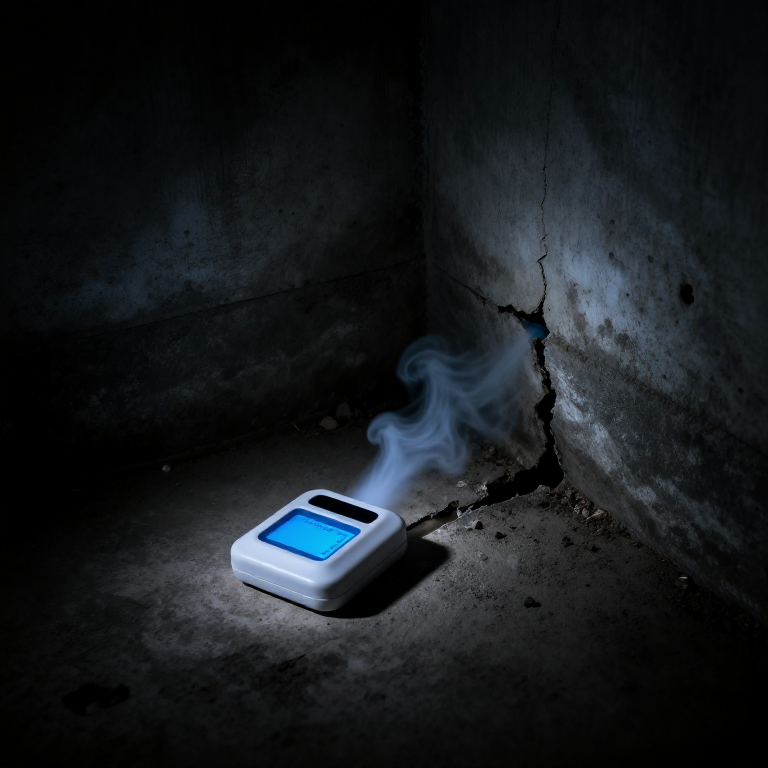
Radon seeps from soil through cracks in foundations, gaps around pipes, and sump pits into buildings. Indoor concentrations can reach 100 times outdoor levels because buildings trap the gas. The EPA estimates 1 in 15 US homes has radon levels above the action level of 4 picocuries per liter. Radon concentration depends on local geology (granite, shale, and phosphate-rich soils produce more), building construction, ventilation, and barometric pressure. Testing requires a 48-hour to 90-day detector.
4
4
Examine Lung Cancer Risk
Examine Lung Cancer Risk
Radon is the second leading cause of lung cancer after smoking, responsible for approximately 21,000 deaths per year in the United States alone. When radon decays inside the lungs, its short-lived alpha-emitting daughters (Po-218 and Po-214) lodge in lung tissue and irradiate cells at close range. Alpha particles cause double-strand DNA breaks that are difficult for cells to repair correctly. The risk is synergistic with smoking — a smoker exposed to radon has 25 times the lung cancer risk of a non-smoking, non-exposed person.
5
5
Discover Radon Mitigation Systems
Discover Radon Mitigation Systems
Active soil depressurization (ASD) is the standard radon mitigation technique. A PVC pipe inserted through the basement slab connects to a radon fan that creates negative pressure beneath the foundation, drawing radon-laden soil gas outdoors before it enters the house. A properly installed ASD system reduces indoor radon by 80-99% and costs $800-2,500. Passive systems use convection instead of fans and are installed during new construction. Sealing cracks alone is insufficient without pressure management.
6
6
Explore Earthquake Prediction Research
Explore Earthquake Prediction Research
Radon concentration anomalies in groundwater and soil gas have been observed before some earthquakes. The hypothesis is that pre-seismic stress fractures rock, releasing trapped radon from uranium-bearing minerals. The 1995 Kobe earthquake was preceded by elevated radon in nearby well water. However, radon monitoring has produced both successful predictions and false alarms — tectonic deformation, barometric changes, and groundwater fluctuations all affect radon levels. Radon remains a promising but unreliable seismic precursor.
7
7
Survey Radon Spa Therapy
Survey Radon Spa Therapy
Radon therapy (balneotherapy) is practiced in Austria, Germany, Czech Republic, Japan, and Russia, where patients bathe in naturally radon-rich thermal waters or breathe radon-enriched air in tunnels. The Gastein Healing Gallery in Austria exposes patients to radon at 44 kBq/m³ for rheumatoid arthritis, ankylosing spondylitis, and chronic pain. Proponents cite anti-inflammatory effects from low-dose radiation hormesis. Critics note the cancer risk. The therapy remains medically controversial but culturally established in Europe.
8
8
Examine Radon in Geological Surveys
Examine Radon in Geological Surveys
Radon emanometry — measuring radon flux from soil — is used to locate uranium deposits, map geological faults, trace groundwater flow paths, and identify geothermal reservoirs. Elevated soil radon marks fracture zones where gas migrates upward from depth. The technique has been used to map the San Andreas Fault system and locate hidden faults in urban areas. Radon measurements in cave air help scientists understand ventilation patterns and can identify previously unknown cave passages.
9
9
Understand Noble Gas Chemistry of Radon
Understand Noble Gas Chemistry of Radon
Radon is the heaviest noble gas and predicted to be the most chemically reactive of the group. Radon difluoride (RnF₂) was synthesized in 1962 but its properties are poorly characterized due to radon's intense radioactivity and short half-life. Relativistic effects may give radon significant covalent bonding capability. All radon chemistry is performed with trace quantities on surfaces or in matrices. The element exists as a colorless, odorless gas with the highest boiling point of any noble gas at -61.7°C.
Strumenti necessari:
 Bilancia di precisione
10
10
Document Findings and Public Health Impact
Document Findings and Public Health Impact
Record radon's key data: atomic number 86, density 9.73 g/L (heaviest noble gas), boiling point -61.7°C, colorless and odorless radioactive gas. Radon is the invisible threat in the built environment — an odorless, colorless gas seeping from the ground that kills thousands annually. Yet it also provides tools for geological exploration and, controversially, therapy. The lesson of radon is that understanding radioactive decay is not just academic — it directly affects the safety of the homes we live in.
11
11
Half-life: what is left, and when
Half-life: what is left, and when
Caricamento del notebook Jupyter…
Strumenti richiesti
1- Segnaposto
Materiali dei progetti collegati
10% Attribuzione
Understanding Xenon from Air Separation — The Strangest Noble Gas
di Peter
Estrazione mineraria
18
0
0
0
1
0
10% Attribuzione
Understanding Krypton from Air Separation — The Hidden Gas That Once Defined the Meter
di Peter
Estrazione mineraria
23
0
0
0
2
0
Pericoloso
10% Attribuzione
Understanding Uranium from Uraninite — The Element That Changed Everything
di Peter
Estrazione mineraria
96
0
0
0
8
0
Pericoloso
10% Attribuzione
Understanding Thorium from Monazite — The Nuclear Fuel That Could Replace Uranium
di Peter
Estrazione mineraria
16
0
0
0
4
0
Pericoloso
10% Attribuzione
Extracting Lead from Galena — Humanity's Oldest Smelted Metal
di Peter
Lavorazione dei metalli
78
0
0
0
12
0
Blueprint correlati
Questi blueprint condividono conoscenze — tecniche, materiali o principi
Understanding Helium from Natural Gas — The Element That Escapes Earth Forever
di Peter
Estrazione mineraria
21
0
0
0
4
0
Understanding Argon from Air Separation — The Invisible Shield Gas
di Peter
Estrazione mineraria
13
0
0
0
2
0
Extracting Iron from Hematite — Bloomery Smelting from Ore to Bloom
di Peter
Lavorazione dei metalli
160
0
0
0
12
0
CC0 Pubblico dominio
Questo progetto è rilasciato sotto CC0. Sei libero di copiare, modificare, distribuire e utilizzare quest'opera per qualsiasi scopo, senza chiedere permesso.
Supporta il Maker acquistando prodotti tramite il suo progetto dove guadagna una Commissione Maker stabilita dai venditori, oppure crea una nuova iterazione di questo progetto e includilo come collegamento nel tuo progetto per condividere i ricavi.