ARTE
BELLEZZA E BENESSERE
MESTIERE
CULTURA E STORIA
DIVERTIMENTO
AMBIENTE
CIBO E BEVANDE
INGEGNERIA INVERSA
SCIENZE
SPORT
TECNOLOGIA
INDOSSABILI



Weight Loss Is the Clock: A Dry Cure Is Finished by the Scale, Not the Calendar
A dry-cured ham is not ready after three months. It is ready when it has lost 35% of its starting weight, and how long that takes depends on the piece, the cellar and the season.
This is the one measurement that cannot be faked or eyeballed. The outside of a half-dried piece looks exactly like the outside of a finished one, and a hand cannot tell 25% from 35%.
This rung is the arithmetic of weight loss: what the traditional targets are, why they are those numbers, and why the drying rate falls away so sharply that the second half takes three times as long as the first.
Intermedio
3 hours
Istruzioni
1
1
Weigh it, label it, hang it, weigh it again
Weigh it, label it, hang it, weigh it again
**Weigh after curing and before hanging.** That is the number the loss is measured from, and it is not the same as the green weight used for the salt — a piece gains a little in a brine and loses a little in a dry cure. Record both, and be explicit about which one a percentage refers to. Most published targets are against the green weight.
**Write it on the tag, tied to the piece.** Not on a note in a drawer. The tag should carry the green weight, the post-cure weight, the date it was hung and the target weight, worked out in advance so the answer is a comparison and not a calculation each time.
**Weigh weekly.** More often tells you nothing and disturbs the chamber; less often and a problem has three weeks to develop.
**A stalled weight is information.** A piece that stops losing weight has usually case-hardened — a dry, sealed crust with wet meat inside. That is the curing chamber's problem and the next rung's subject.
A kitchen scale reading to a gram is plenty. A 1400 g piece losing 35% ends at 910 g, and single grams do not matter.
Materiali per questo passaggio:
 Spalla di maiale (con osso)1 pezzo
Strumenti necessari:
 Bilancia digitale da cucina
 Telo da formaggio
2
2
The targets, and what they buy
The targets, and what they buy
Caricamento del notebook Jupyter…
Strumenti necessari:
 Computer da tavolo
3
3
Jerky and dried fish: the fast end of the same scale
Jerky and dried fish: the fast end of the same scale
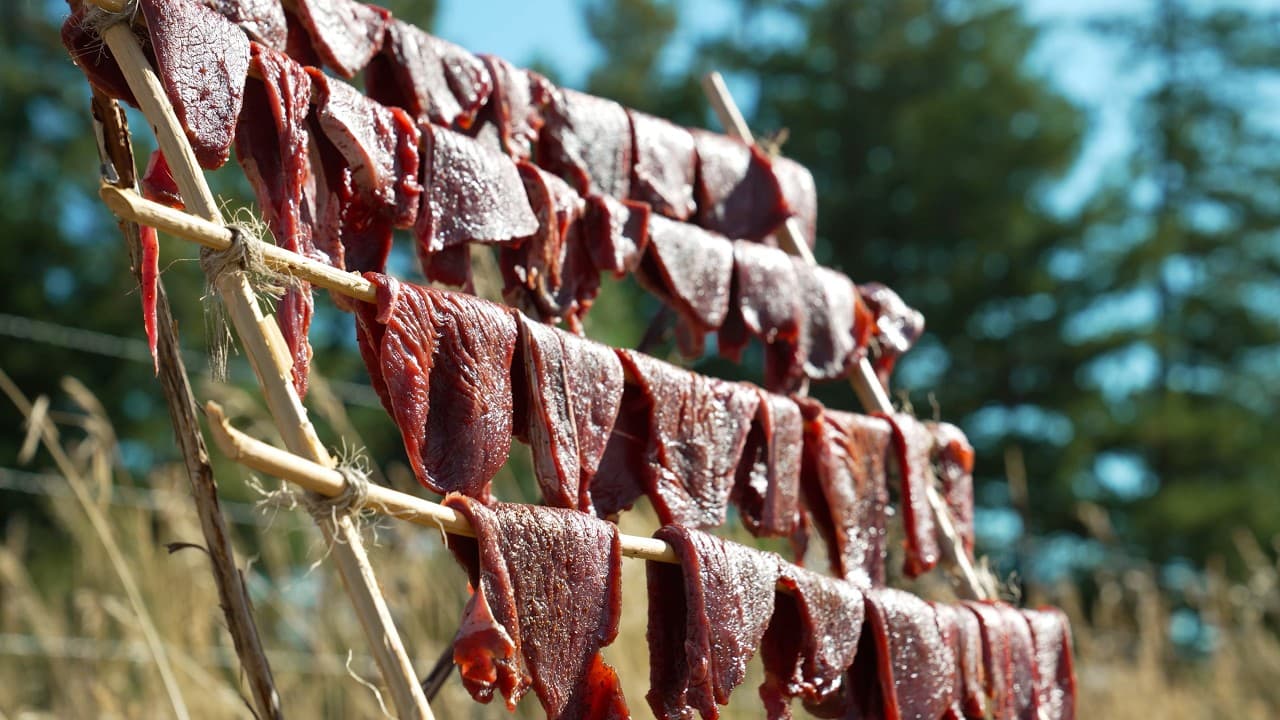
Jerky is the same measurement with a much larger number. A 60 to 70% loss takes it well below 0.75 water activity, which is why it keeps at room temperature with no nitrite and no refrigeration.
It is also why jerky is cut thin. The drying time goes with the square of the thickness, exactly as salt penetration does, so 5 mm strips dry in hours and 20 mm strips take days and spoil on the way.
**The bend test** is the traditional endpoint and it works: a finished strip bends and cracks but does not snap cleanly, and shows no moisture at the crack. A strip that snaps is over-dried; one that folds without cracking is not done.
**The safety step people skip.** Drying alone does not reliably kill the pathogens that were on the raw meat — it only stops them multiplying. Published guidance is to heat the meat to **71 C** either before drying or after, which a low dehydrator never reaches. Ten minutes in a 135 C oven after drying does it and costs almost nothing in texture.
Air-dried fish goes further still, to 60% loss and beyond, and traditionally adds salt, cold air and wind. Stockfish keeps for years on those three alone.
Materiali per questo passaggio:
 Manzo magro1 pezzo
 Sale1 pezzo
Strumenti necessari:
Bilancia digitale da cucina Griglia di asciugatura per carne secca
 Termometro a lettura immediata
 Serie di coltello da macellaio e lavorazione
4
4
What to do when the number is wrong
What to do when the number is wrong
**Losing too fast** — more than about 2% a day on a whole muscle. The air is too dry or moving too hard. The risk is case hardening: the outside seals before the inside has dried, and the piece stalls with wet meat trapped under a hard crust. Raise the humidity, slow the air, or wrap the piece in cloth or a net to slow the surface.
**Losing too slowly** — under about 0.3% a day. The air is too damp or too still. The risk is the opposite: the surface stays wet long enough for the wrong moulds and for slime. Lower the humidity a little or improve the airflow, and check the piece is not touching anything.
**Stalled completely.** Almost always case hardening. Vacuum-seal the piece and leave it a week in the fridge: the moisture redistributes from the wet centre to the dry outside, and it can then be hung again. This genuinely rescues pieces that look ruined.
**Overshot the target.** A piece dried to 50% is not dangerous, it is hard. Slice it thinner and use it where that suits — it is why some traditions dry deliberately far past the shelf-stable point.
The one thing not to do is decide it is probably fine. The scale gives a number; the number is the answer.
Materiali per questo passaggio:
Spalla di maiale (con osso)1 pezzoStrumenti necessari:
Bilancia digitale da cucina Macchina per sottovuoto
 Igrometro (misuratore di umidità)
 Sacchetti per sottovuoto
Materiali
3- 1 pezzoSegnaposto
- 1 pezzoSegnaposto
- 1 pezzoSegnaposto
Strumenti richiesti
9- Segnaposto
- Segnaposto
- Segnaposto
- Segnaposto
- Segnaposto
- Segnaposto
- Segnaposto
- Segnaposto
Blueprint correlati
Questi blueprint condividono conoscenze — tecniche, materiali o principi

CC0 Pubblico dominio
Questo progetto è rilasciato sotto CC0. Sei libero di copiare, modificare, distribuire e utilizzare quest'opera per qualsiasi scopo, senza chiedere permesso.
Supporta il Maker acquistando prodotti tramite il suo progetto dove guadagna una Commissione Maker stabilita dai venditori, oppure crea una nuova iterazione di questo progetto e includilo come collegamento nel tuo progetto per condividere i ricavi.