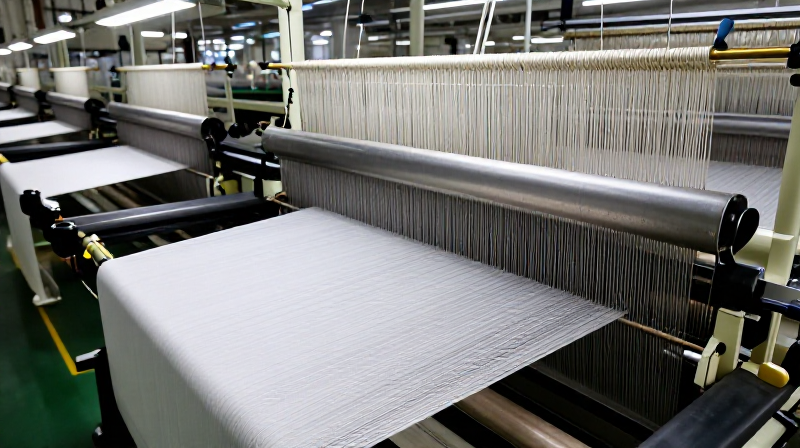


The Air-Jet Loom — Weaving Fabric with Compressed Air at 2,000 Picks Per Minute
In 1950, Vladimír Svatý at the Výzkumný ústav textilních strojů (VÚTS) in Liberec, Czechoslovakia, patented the first air-jet weaving system — a loom that inserts the weft yarn across the warp shed using a precisely timed blast of compressed air instead of a shuttle, rapier, or projectile. The concept was simple: if air could blow a lightweight yarn across a gap, no mechanical carrier was needed. But making it work reliably at industrial speeds required decades of engineering.
The breakthrough came in the 1970s–1980s when Japanese manufacturers — Toyota Industries, Tsudakoma, and later Picanol (Belgium) and Dornier (Germany) — developed relay nozzle systems: a main nozzle accelerates the weft yarn, and a row of secondary relay nozzles along the reed channel provides booster air jets that carry the yarn across the full fabric width. This solved the fundamental problem of air-jet weaving: air loses velocity rapidly over distance, so a single blast cannot propel yarn across a wide loom. With relay nozzles, the yarn 'surfs' from one air boost to the next.
Modern air-jet looms are the fastest weaving machines in existence. A Toyota JAT910 runs at 1,500–2,000 picks per minute on standard fabrics — three to four times faster than rapier looms and ten times faster than the projectile looms they replaced. The trade-off is air consumption: an air-jet loom uses 0.1–0.15 m³ of compressed air per pick, making compressed air the largest operating cost. Air-jet looms dominate the production of commodity cotton and polyester-cotton fabrics — shirts, bedsheets, denim, and industrial cloth — where speed and cost per meter matter more than yarn flexibility. Over 70% of all woven fabric produced globally is woven on air-jet looms.
手順
Understand the evolution from shuttle to shuttleless
Understand the evolution from shuttle to shuttleless
For over 200 years after the flying shuttle (1733), all looms inserted the weft yarn by propelling a wooden shuttle — a heavy, blunt carrier weighing 300–500 grams — back and forth across the loom. The shuttle's mass limited loom speed to 200–250 picks per minute (noise, vibration, and the danger of a shuttle flying off the loom at high speed). Shuttleless looms — rapier (1950s), projectile (Sulzer, 1953), and air-jet (1950s–1970s) — eliminated the shuttle entirely, using lighter, faster mechanisms to insert only the yarn. Air-jet is the lightest of all: the yarn carries itself, propelled by air alone.
Prepare the warp beam
Prepare the warp beam
Wind thousands of parallel warp yarns onto a warp beam — identical preparation to any loom. A typical air-jet loom for commodity fabrics uses 4,000–8,000 warp ends across a 190–340 cm width. The warp yarns must be sized (coated with a starch or PVA film) to withstand the abrasion of shedding and beating-up at high speed. Draw each warp yarn through a heddle eye on the appropriate harness frame, then through a dent in the reed. Warp preparation is the same for air-jet, rapier, and projectile looms — the differences are entirely in weft insertion.
このステップの材料:
 経糸用毛糸2 kg
Load the weft yarn
Load the weft yarn
Place a cone or package of weft yarn on the creel beside the loom. The weft yarn is fed through a tension device, a weft accumulator (a drum that pre-measures and stores exactly one pick length of yarn), and then to the main nozzle. Air-jet looms can use 2–8 different weft colors from separate creels, with a weft selector that switches between them pick by pick — enabling stripes, checks, and color patterns. The yarn must be smooth and uniform: any slub, knot, or irregularity will be caught by the air stream unpredictably and cause a mispick.
Fire the main nozzle
Fire the main nozzle
The weaving cycle begins: the harness frames raise and lower to create the shed (the V-shaped opening between warp yarns). A solenoid valve opens the main nozzle — a precision air nozzle positioned at the entry side of the loom — for a precisely timed blast of compressed air (4–6 bar pressure, lasting 20–40 milliseconds). The air jet accelerates the leading end of the weft yarn to 30–50 meters per second, launching it into the reed channel — the narrow tunnel formed between the dents of a profiled reed. The reed channel guides the yarn and confines the air jet to minimize energy loss.
Boost with relay nozzles across the width
Boost with relay nozzles across the width
As the weft yarn travels across the loom, it passes a series of relay nozzles (also called sub-nozzles or booster nozzles) mounted along the top of the reed at 30–50 mm intervals. Each relay nozzle fires a short burst of compressed air as the yarn tip passes its position — detected by electronic weft sensors or timed by the loom controller. The relay nozzles maintain the yarn's velocity across the full fabric width, overcoming the rapid deceleration that would otherwise stop the yarn partway across. A 190 cm wide loom may have 40–60 relay nozzles; a 340 cm loom may have 80–100.
Catch and cut the weft yarn
Catch and cut the weft yarn
When the weft yarn tip arrives at the far side of the loom (the catch side), a stretch nozzle pulls it taut and a sensor confirms arrival — the pick is complete. A cutter on the entry side severs the weft from the supply, and a cutter on the catch side trims the selvage. The entire weft insertion — from main nozzle firing to yarn arrival — takes 15–30 milliseconds across a 190 cm loom. If the weft sensor does not detect yarn arrival within the expected time window, the loom stops instantly — a mispick. Mispick detection and automatic weft repair systems minimize downtime.
Beat up with the reed
Beat up with the reed
The reed — which also served as the air channel during weft insertion — swings forward and pushes the newly inserted weft yarn against the cloth fell (the edge where woven fabric meets unwoven warp). This beat-up action compacts the weft into the fabric structure. The shed then changes for the next pick, and the cycle repeats. At 2,000 picks per minute, the complete cycle — shedding, weft insertion, beat-up — occurs 33 times per second. The reed is the most stressed component, vibrating at high frequency with enormous forces; it is made from precision-ground stainless steel strips.
Manage compressed air consumption
Manage compressed air consumption
Air-jet looms consume 0.1–0.15 cubic meters of compressed air per pick — at 1,500 picks per minute, that is 150–225 m³ per hour. A weaving shed with 200 air-jet looms requires a compressor plant delivering 30,000–45,000 m³/hour at 5–7 bar. Compressed air is the largest operating cost of air-jet weaving — typically 40–60% of total energy consumption. Modern looms reduce air use through optimized nozzle geometry, shorter blast duration, reduced relay nozzle pressure on lightweight yarns, and profiled reeds that contain the air jet more efficiently. Toyota's ECO nozzle system claims 30% air reduction versus conventional designs.
Understand yarn suitability
Understand yarn suitability
Air-jet looms work best with smooth, round, medium-weight yarns — the type that air can grip and propel predictably. Cotton ring-spun yarn (Ne 20–60), polyester-cotton blends, and filament yarns are ideal. Heavy yarns (denim weft, coarse wool) require higher air pressure and slower speeds. Fancy yarns (bouclé, slub, chenille), hairy yarns (mohair, loosely twisted wool), and fragile yarns (fine silk, glass fiber) are difficult or impossible for air-jet — the air cannot grip them consistently or they break under the acceleration forces. Rapier looms remain preferred for these specialty yarns because the rapier physically grips the yarn regardless of its surface character.
Compare air-jet to rapier and projectile looms
Compare air-jet to rapier and projectile looms
Air-jet looms are 2–4 times faster than rapier looms (2,000 vs. 500–700 picks per minute) but limited in yarn range. Rapier looms handle any yarn type but are slower. Projectile looms (Sulzer) are fast (1,000–1,500 ppm) and handle heavy yarns but have been largely replaced by rapier and air-jet. The industry has settled on a clear division: air-jet for commodity fabrics (70%+ of all woven fabric), rapier for specialty and fashion fabrics, and water-jet (which uses a water droplet instead of air) for hydrophobic synthetic filaments. Each technology coexists because each has an optimal niche.
Apply air-jet weaving to commodity textiles
Apply air-jet weaving to commodity textiles
Air-jet looms produce the majority of the world's basic woven fabrics: cotton sheeting and shirting, polyester-cotton broadcloth, denim (Picanol OmniPlus air-jet looms dominate denim production), bed linens, and industrial fabrics. A single Toyota JAT910 at 1,800 picks per minute on 190 cm width with a 30 picks/cm fabric density produces approximately 36 meters of fabric per hour. A mill with 500 such looms produces over 150 million meters of fabric per year. This scale and speed explain why basic cotton and poly-cotton fabrics cost $1–3 per meter at wholesale — air-jet weaving has driven commodity fabric costs to historic lows.
Understand the air-jet loom's place in textile technology
Understand the air-jet loom's place in textile technology
The air-jet loom represents the final evolution of weft insertion: from the hand-thrown shuttle (human muscle, 60 picks per minute), to the flying shuttle (spring mechanism, 120 ppm), to the power loom (mechanical shuttle, 200 ppm), to the Northrop automatic loom (self-replenishing shuttle, 200 ppm), to the rapier (mechanical fingers, 700 ppm), to air-jet (compressed air, 2,000 ppm). Each transition eliminated a heavier, slower mechanism. The air-jet loom eliminated the mechanism entirely — the weft carrier is weightless air. This progression from solid matter to energy as the insertion medium mirrors a broader theme in textile technology: from human hands, to wooden tools, to metal machines, to electronics, and finally to physics itself as the manufacturing agent.
接続ブループリントの材料
この設計図で作るもの
関連ブループリント
これらのブループリントは知識を共有しています — 技術、材料、原理
CC0 パブリックドメイン
このブループリントはCC0で公開されています。許可を求めずに、自由にコピー、修正、配布、あらゆる目的で使用できます。
メイカーを応援するには、ブループリント経由で製品を購入してください。メイカーには メイカーコミッション がベンダーにより設定されています。または、このブループリントの新しいイテレーションを作成し、自分のブループリントにコネクションとして含めて収益を共有できます。