

Building a Shaduf Irrigation Lever — Counterweighted Water Lift
手順
Erect the Upright Support
Erect the Upright Support
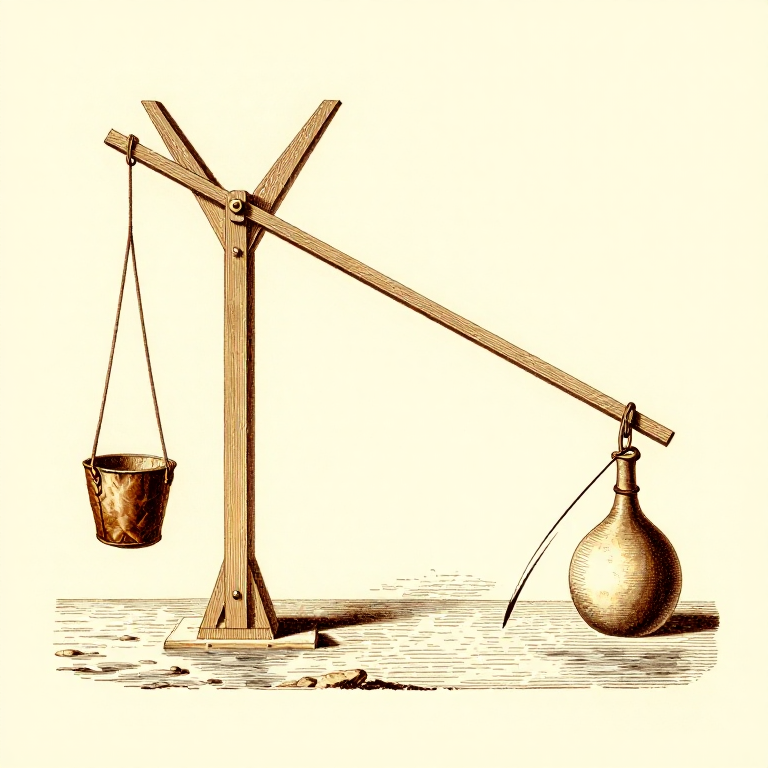
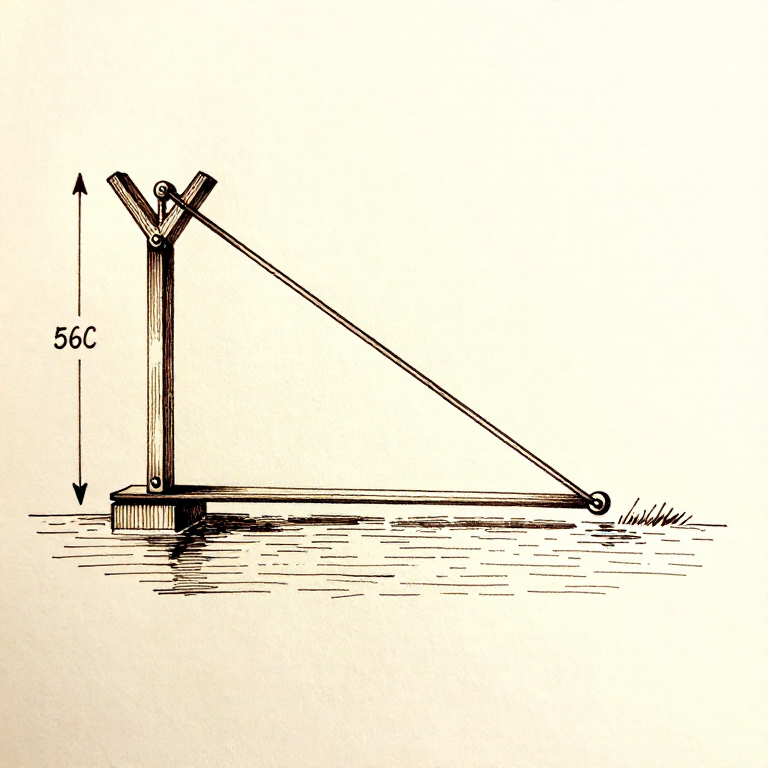
Choose a location on the canal bank or riverbank where you need to lift water to a higher level — typically a rise of 1-3 metres. Erect a sturdy Y-shaped post (or two parallel uprights with a cross-pin) 2-3 metres from the water's edge. Sink the base 50-60 cm into the ground and pack earth firmly around it for stability. The fork of the Y (or the cross-pin between paired uprights) serves as the pivot point for the lever beam. The pivot height should be roughly equal to the lift height plus 1 metre — for a 2-metre lift, the pivot should be approximately 3 metres above ground level.
このステップの材料:
 丈夫な Y 字形の支柱1 post, 2-3 m tall m
 長い梁1 beam, 3-5 m long m
 綱3-5 m for bucket suspension m
 革1, holding 10-20 litres 個
 野の粘土15-30 kg kg
必要な工具:
 ちょうな
ちょうな 縄・紐
縄・紐Mount the Lever Beam
Mount the Lever Beam
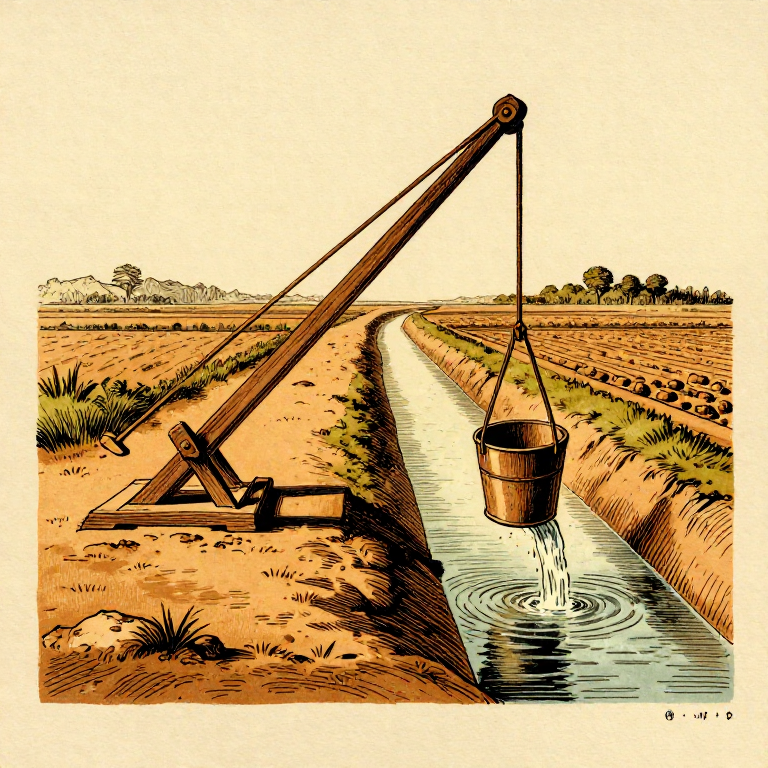
Balance a long, straight beam (3-5 metres) across the fork of the upright. The beam divides into a long arm (extending over the water, about two-thirds of the total length) and a short arm (extending inland, about one-third). The beam must pivot freely — grease the contact point with animal fat to reduce friction. The unequal arm lengths create mechanical advantage: the counterweight on the short arm travels a shorter distance but exerts a proportionally greater lifting force on the bucket. This is a class 1 lever with the fulcrum between the effort (counterweight) and the load (bucket of water).
Attach the Bucket and Counterweight
Attach the Bucket and Counterweight
Attach a leather bucket or woven basket to the end of the long arm using a rope long enough that the bucket can reach the water surface when the long arm is lowered. A bucket capacity of 10-20 litres is manageable for one operator. On the short arm, attach a counterweight — a large lump of dried clay, a stone, or a mud-brick — heavy enough to nearly balance the weight of the full bucket plus the rope. The counterweight should be slightly lighter than the full bucket so the bucket sinks into the water under its own weight, but heavy enough that it lifts the full bucket with only minimal additional effort from the operator.
Calibrate the Balance
Calibrate the Balance
Test the shaduf by filling the bucket and checking the effort required to lift it. If the counterweight is too light, the operator must pull hard to raise the full bucket — add more weight. If too heavy, the empty bucket rises uncontrollably and the operator must push hard to lower it into the water — remove weight. The ideal balance point requires the operator to exert only a gentle downward pull to submerge the empty bucket and a gentle upward tug to start the full bucket rising, with the counterweight doing most of the lifting work. Fine-tune by adjusting the counterweight mass or its position along the short arm.
Operating Technique and Capacity
Operating Technique and Capacity
To operate, pull the long arm down to submerge the bucket, allow it to fill, then release. The counterweight swings the full bucket upward. When the bucket reaches the top of its arc, swing it over the irrigation channel and tip it to empty the water. One operator can complete a cycle every 15-20 seconds, lifting approximately 10-15 litres per cycle. At this rate, a shaduf raises roughly 2,000-3,000 litres per hour — enough to irrigate a small garden plot. For lifting water to greater heights, multiple shadufs can be arranged in series, each lifting water to an intermediate level. Egyptian tomb paintings show teams of shadufs operating in cascaded series along the Nile, lifting water 5-6 metres in three stages. The shaduf is one of the most energy-efficient pre-industrial water-lifting devices ever invented.
材料
8- 3-5 m for bucket suspension mプレースホルダー
- 1, holding 10-20 litres 個プレースホルダー
- 15-30 kg kgプレースホルダー
- 1 post, 2-3 m tall 個プレースホルダー
- 1 beam, 3-5 m long 個プレースホルダー
- 15-30 kg 個プレースホルダー
- 1 個プレースホルダー
- 1 個プレースホルダー
CC0 パブリックドメイン
このブループリントはCC0で公開されています。許可を求めずに、自由にコピー、修正、配布、あらゆる目的で使用できます。
メイカーを応援するには、ブループリント経由で製品を購入してください。メイカーには メイカーコミッション がベンダーにより設定されています。または、このブループリントの新しいイテレーションを作成し、自分のブループリントにコネクションとして含めて収益を共有できます。