
Binary Arithmetic
手順
Build a physical binary counter
Build a physical binary counter
Make the places real objects you can flip.
- Lay out cards for 1, 2, 4, 8, 16, 32 — face up is on, face down is off.
- Count from 0 to 20 by flipping cards.
- Watch what happens each time a place fills.
このステップの材料:
 カードストック1 パック
Convert both ways
Convert both ways
Two procedures, and one of them you have already met.
- Decimal to binary: repeatedly halve, discarding remainders, and record odd (1) or even (0). Read from the bottom up.
- Binary to decimal: add the place values where there is a 1.
- Convert a dozen numbers each way and check against each other.
このステップの材料:
 方眼紙1 pad
Add, and find the carry
Add, and find the carry
Four rules, and that is the whole of binary addition.
- 0+0=0 · 0+1=1 · 1+0=1 · 1+1=0 carry 1.
- Add 1011 and 0110 column by column.
- Check your answer in decimal: 11 + 6 = 17.
Multiply by shifting
Multiply by shifting
Show that multiplication needs no new machinery.
- Take a binary number and add a zero on the right.
- Convert before and after.
- Repeat — each added zero doubles the value.
History and context
History and context
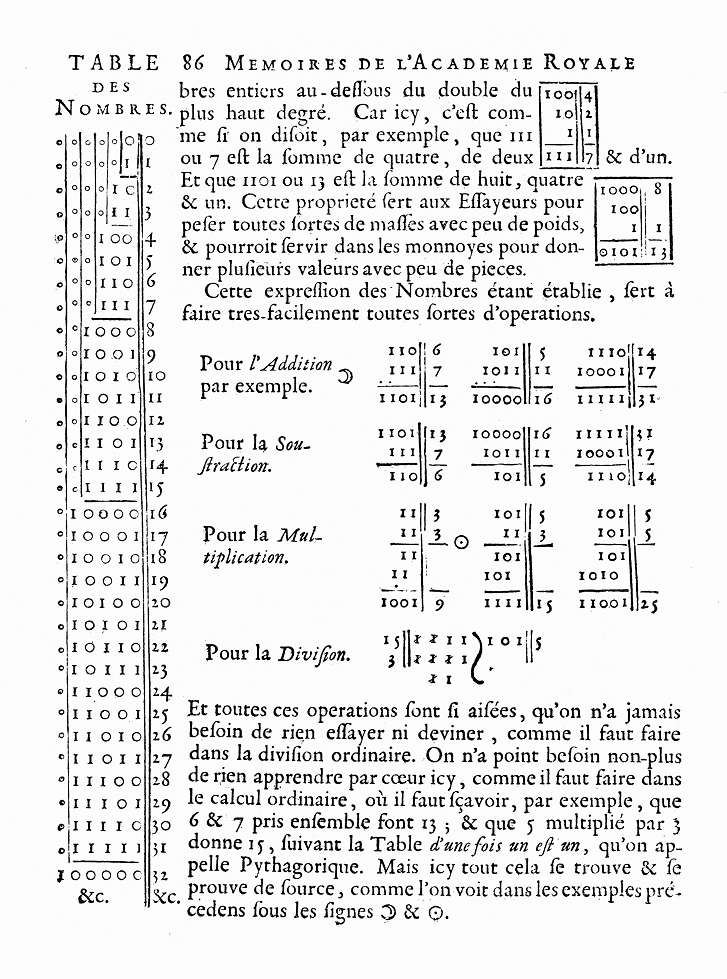
Gottfried Wilhelm Leibniz published his account of binary in 1703, and was struck by finding the same two-state structure in the hexagrams of the Chinese I Ching, which a Jesuit correspondent had sent him. He attached theological significance to a system that creates everything from one and nothing — a reading that is his own and not part of the mathematics.
Earlier and elsewhere: binary and near-binary systems appear independently in the I Ching itself, in Indian prosody — Pingala described binary patterns of long and short syllables around the third century BC — and in African divination systems. Two-state encoding is something people keep arriving at.
The reason it won is engineering, not mathematics. A decimal computer needs a component that reliably distinguishes ten voltage levels; a binary one needs a component that distinguishes on from off, which almost any switch, relay, valve or transistor does robustly and cheaply. Claude Shannon's 1937 master's thesis made the connection explicit by showing that relay circuits implement Boolean algebra — arguably the most consequential master's thesis ever written.
Decimal computers did exist — ENIAC was one, and IBM built decimal machines for business — so the outcome was not inevitable. Binary won on component cost and reliability, and the survival of binary-coded decimal in financial software is a reminder that the argument was once genuinely open.
CC0 パブリックドメイン
このブループリントはCC0で公開されています。許可を求めずに、自由にコピー、修正、配布、あらゆる目的で使用できます。
メイカーを応援するには、ブループリント経由で製品を購入してください。メイカーには メイカーコミッション がベンダーにより設定されています。または、このブループリントの新しいイテレーションを作成し、自分のブループリントにコネクションとして含めて収益を共有できます。