アート
美容とウェルネス
工芸
文化と歴史
エンターテインメント
環境
食品と飲料
リバースエンジニアリング
科学
スポーツ
テクノロジー
ウェアラブル
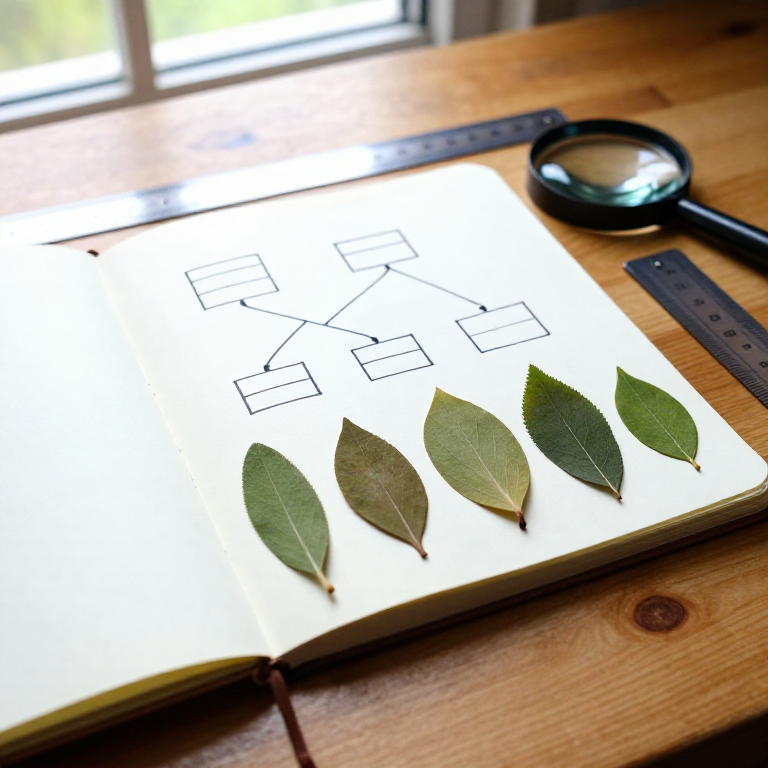


Building a Dichotomous Key
Every survey in this batch ends with the same problem: you have a plant or an animal in front of you and no idea what it is. Photographs and field guides work by recognition, which fails exactly when the thing is unfamiliar — which is when you needed help.
A dichotomous key works the other way. It asks a series of either/or questions about features you can actually see, and each answer halves the possibilities. Carl Linnaeus and Jean-Baptiste Lamarck built the first ones in the eighteenth century, and the structure has not been improved on because it cannot be: a binary question is the most information a single observation can give.
Building your own key for your own site is the fastest way to learn a local flora, and it produces something genuinely useful — a key to the twenty grasses in one meadow beats a national flora of nine hundred species for that meadow, every time.
中級者
1 day
手順
1
1
Limit the scope, and say what it is
Limit the scope, and say what it is
Decide exactly what your key covers: 'the trees of this wood in summer leaf', 'the ground beetles caught in these traps'. Write that at the top.
A key is only valid within its scope, and the commonest way one gives a confident wrong answer is being used on something it never contained. Stating the scope also makes the key possible: twenty species is a comfortable key, nine hundred is a career.
必要な工具:
 野帳
野帳2
2
Tabulate the features before writing any questions
Tabulate the features before writing any questions
Make a grid: species down the side, observable features across the top. Fill it in from specimens, and record 'variable' where a species genuinely varies.
Writing the key first and checking later is how a key ends up with a couplet no specimen satisfies. The table also shows you immediately which features are useful — one that is the same in every species carries no information at all, however striking it looks.
このステップの材料:
 方眼紙10 個
必要な工具:
 虫眼鏡野帳
虫眼鏡野帳3
3
Choose features that are present, stable and binary
Choose features that are present, stable and binary
Prefer features that are on the specimen all year, do not depend on size or colour judgement, and genuinely fall into two states — hairy or smooth, opposite or alternate, five petals or six.
Avoid flowers if the thing is identifiable without them, because a key that only works for three weeks in June is not much of a key. Avoid 'large' and 'small' unless you give a number. And never use a feature that requires killing the specimen when a visible one will do.
必要な工具:
 定規虫眼鏡
定規虫眼鏡4
4
Write couplets that are true opposites
Write couplets that are true opposites
Each numbered couplet offers exactly two alternatives that between them cover every possibility and overlap nowhere. Each leads either to a name or to another couplet number.
'Leaves hairy' versus 'leaves smooth' is a true pair. 'Leaves hairy' versus 'leaves large' is not — a specimen can be both, or neither, and the user is stuck with no way forward and no way to tell they went wrong. Reading your own couplets aloud catches most of these.
必要な工具:
野帳5
5
Test it on someone who has never seen it
Test it on someone who has never seen it
Hand the key and a specimen to someone else and watch WITHOUT helping. Note every couplet where they hesitate.
Hesitation marks ambiguity, and you cannot find it yourself because you already know the answer. Test with the hardest specimens you have — the atypical, the damaged, the juvenile — because a key that only works on perfect material is a key that works in a museum.
必要な工具:
野帳6
6
How good is your key, measured
How good is your key, measured
Jupyter ノートブックを読み込み中…
必要な工具:
野帳7
7
Give every endpoint a confirming description
Give every endpoint a confirming description
At each species, add two or three features NOT used to get there, plus a note of what it is most likely to be confused with.
This is what turns a key from a machine that always produces an answer into one that can tell you the answer is wrong. Without it, a user who misread couplet three arrives at a confident name and never finds out. The confirmation costs one line per species and it is the difference between a key and a guess generator.
必要な工具:
野帳関連ブループリント
これらのブループリントは知識を共有しています — 技術、材料、原理


CC0 パブリックドメイン
このブループリントはCC0で公開されています。許可を求めずに、自由にコピー、修正、配布、あらゆる目的で使用できます。
メイカーを応援するには、ブループリント経由で製品を購入してください。メイカーには メイカーコミッション がベンダーにより設定されています。または、このブループリントの新しいイテレーションを作成し、自分のブループリントにコネクションとして含めて収益を共有できます。