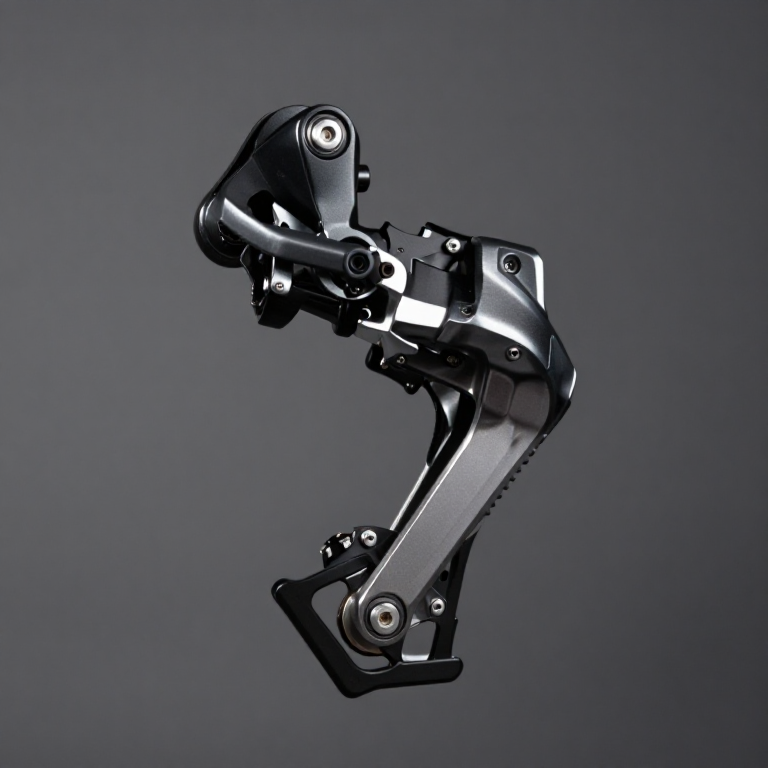


Bicycle Derailleur
Changing gear on a racing bicycle used to mean stopping. Early multi-speed machines carried a sprocket on each side of the rear wheel: to change ratio you dismounted, loosened the wing nuts, pulled the wheel, turned it round and refitted it. In a race that is a lost minute.
A derailleur changes gear by derailing the chain sideways onto a different sprocket while it is still running. That sounds violent and it works because of two things: the chain is flexible enough laterally to be pushed off its sprocket, and a spring-loaded arm takes up the slack, since a chain that fits a 24-tooth sprocket is far too long for an 11-tooth one.
The mechanism has two independent jobs, and seeing them as separate is the key to understanding it: a guide pulley that steers the chain sideways to select the sprocket, and a tension pulley on a sprung cage that swallows the length difference. One selects, one takes up slack.
The design that settled the modern form is Tullio Campagnolo's Gran Sport of 1949 — the parallelogram derailleur, where the body moves on a four-bar linkage so the guide pulley stays at a consistent distance from the sprockets across the whole range. Every rear derailleur since is this shape.
⚠ Campagnolo did not invent the derailleur — French makers had them decades earlier, and the Tour de France banned them until 1937. He produced the arrangement that worked well enough to become universal.
手順
Measure the slack problem first
Measure the slack problem first
On a bike in a stand, note the sprocket tooth counts — say 11 to 32.
Chain wrapped around a sprocket covers roughly half its circumference. The difference in chain needed between smallest and largest is about (32 − 11) / 2 ≈ 10 teeth of length.
Write that number down. The derailleur cage has to absorb it, and cage length is chosen from exactly this arithmetic — which is why a long-cage derailleur is required for a wide-range cassette.
Separate the two pulleys' jobs
Separate the two pulleys' jobs
Find the upper (guide/jockey) pulley and the lower (tension) pulley.
Turn the cranks and shift while watching only the upper pulley: it moves sideways, and the chain follows it onto the next sprocket.
Now watch only the lower pulley: it swings fore and aft as the cage rotates, taking up slack.
Two motions, two jobs. Confusing them is why derailleurs look more complicated than they are.
Watch the parallelogram
Watch the parallelogram
Look at the four-bar linkage in the body as you shift across the full range.
Expect the guide pulley to move sideways while staying at a roughly constant distance from the sprocket teeth.
That is Campagnolo's contribution. A simple pivoting arm would swing the pulley away from the large sprockets and into the small ones, so shift quality would vary across the block. The parallelogram holds the geometry constant.
必要な工具:
 リアディレイラー(ロード、ショートケージ)
Set the limit screws
Set the limit screws
Find the two screws marked H and L. Shift to the smallest sprocket and turn H until the guide pulley sits directly under it. Repeat with L on the largest.
These are hard mechanical stops, not adjustments to shift quality.
Get L wrong and the derailleur pushes the chain into the spokes. Get H wrong and it drops the chain off the outside, into the frame. Both are the classic ways a bicycle destroys its own transmission, and both are one screw.
必要な工具:
 六角レンチセット
Index the shifting
Index the shifting
With modern indexed shifters, one click must equal exactly one sprocket. Adjust the barrel adjuster until it does across the whole range.
Test in both directions. Expect it to need slightly different tension going up than coming down — the chain is being pushed one way and released the other.
Indexing is why a derailleur that worked yesterday rattles today: cable stretch of a millimetre is enough to put the pulley between sprockets.
History & Context
History & Context
Campagnolo's actual contribution. The Gran Sport of 1949 established the parallelogram rear derailleur, which is the layout still used. He did not invent gear-changing by derailing the chain — French manufacturers were selling derailleurs in the 1920s and 30s, and the concept goes back further still.
The story about the freezing pass. Campagnolo is said to have conceived his quick-release skewer, and by extension his interest in gearing, after losing a race in 1927 on the Croce d'Aune pass because his hands were too cold to undo the wing nuts and flip his wheel. It is a good story, it is told by the company, and it should be read as company history rather than documented fact.
The Tour de France banned derailleurs until 1937. Henri Desgrange considered them unmanly and required riders to flip their wheels to change gear. That is not a footnote — it held back the technology's adoption at the top of the sport for years, which is a reminder that governing bodies shape engineering as much as engineers do.
Why it survived against better ideas. A derailleur is mechanically crude: it changes gear by deliberately misaligning a chain under load, it is exposed to everything the road throws at it, and it cannot shift at rest. Hub gears are none of those things. The derailleur won because it is light, cheap, efficient and offers a huge ratio range — around 95–97% efficient against a hub gear's 90–95%, and a fraction of the weight. It is a case where the crude solution is genuinely the better engineering answer.
接続ブループリントの材料
CC0 パブリックドメイン
このブループリントはCC0で公開されています。許可を求めずに、自由にコピー、修正、配布、あらゆる目的で使用できます。
メイカーを応援するには、ブループリント経由で製品を購入してください。メイカーには メイカーコミッション がベンダーにより設定されています。または、このブループリントの新しいイテレーションを作成し、自分のブループリントにコネクションとして含めて収益を共有できます。