アート
美容とウェルネス
工芸
文化と歴史
エンターテインメント
環境
食品と飲料
リバースエンジニアリング
科学
スポーツ
テクノロジー
ウェアラブル
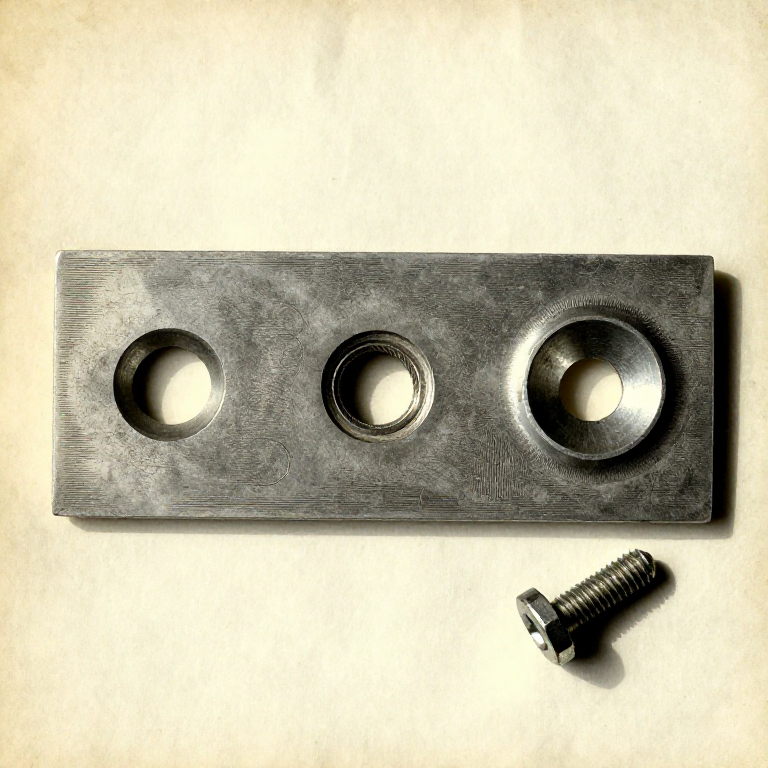


The Clearance Hole: Why the Bolt Should Not Touch the Top Part
When a bolt clamps two parts together, only the far part should be threaded. The near part gets a CLEARANCE hole — a plain hole slightly bigger than the bolt, which the bolt passes through without touching.
This is the single most commonly skipped step in amateur assembly, and skipping it quietly destroys the joint. A bolt threaded into both parts cannot pull them together: it jacks against the top part's threads and the parts stay apart no matter how hard it is tightened.
The same logic runs through countersinking, counterboring and wood screws — the top part must always be free to be pulled down.
中級者
2 hours
手順
1
1
Why a bolt threaded into both parts cannot clamp
Why a bolt threaded into both parts cannot clamp
Picture two plates with a threaded hole through both, and a bolt wound into them. As the bolt turns it advances through BOTH sets of threads at the same rate. Nothing moves relative to anything: the gap between the plates never closes.
Clamping force comes from stretching the bolt between the head and the threads it is engaged in. That needs the top part to be able to slide along the shank, which it cannot do if it is threaded.
Test it once and it is unforgettable. Two plates, one threaded pair of holes, tighten hard, and they will still rattle. Drill the top one out to clearance and they lock together instantly with much less effort.
このステップの材料:
 軟鋼板2 個
必要な工具:
 ドリルビットセット
 六角ボルト詰め合わせ
 スパナセット
2
2
How much clearance, and the three standard fits
How much clearance, and the three standard fits
CLOSE fit is about 0.1 to 0.3 mm over the bolt — an M6 in a 6.4 mm hole. It locates the parts precisely and demands accurate hole positions.
NORMAL fit is around 0.5 mm over — M6 in 6.6 mm. This is the everyday default and absorbs ordinary marking-out error. LOOSE fit is a millimetre or more over, for assemblies where the holes cannot be positioned accurately or where thermal movement must be allowed for.
Choose deliberately, because the clearance hole is where you decide how much adjustment the assembly will have. Too tight and the parts fight you; too loose and nothing lines up where you intended.
このステップの材料:
軟鋼板1 個必要な工具:
ドリルビットセット ノギス六角ボルト詰め合わせ
3
3
Countersink, counterbore, and getting the depth right
Countersink, counterbore, and getting the depth right
Jupyter ノートブックを読み込み中…
必要な工具:
 皿取りビットセット
 計算機ノギス
4
4
The same rule in wood: the shank hole
The same rule in wood: the shank hole
A wood screw needs two holes, not one: a PILOT hole in the lower piece that the thread bites into, and a SHANK hole in the upper piece that the thread passes through freely.
It is the identical principle. A screw whose thread grips the top piece jacks the two apart instead of pulling them together, and in wood this leaves a visible gap in the joint that no amount of driving will close. Modern screws with an unthreaded upper shank do the same job by being shaped for it.
In hardwood the pilot hole also stops the screw splitting the piece, and near an end grain edge it is not optional at all. Match the pilot to the screw's root diameter — not its outside diameter — and the thread has full material to bite.
このステップの材料:
 堅木の板2 個
必要な工具:
ドリルビットセット ドライバーセット皿取りビットセット
関連ブループリント
これらのブループリントは知識を共有しています — 技術、材料、原理

CC0 パブリックドメイン
このブループリントはCC0で公開されています。許可を求めずに、自由にコピー、修正、配布、あらゆる目的で使用できます。
メイカーを応援するには、ブループリント経由で製品を購入してください。メイカーには メイカーコミッション がベンダーにより設定されています。または、このブループリントの新しいイテレーションを作成し、自分のブループリントにコネクションとして含めて収益を共有できます。