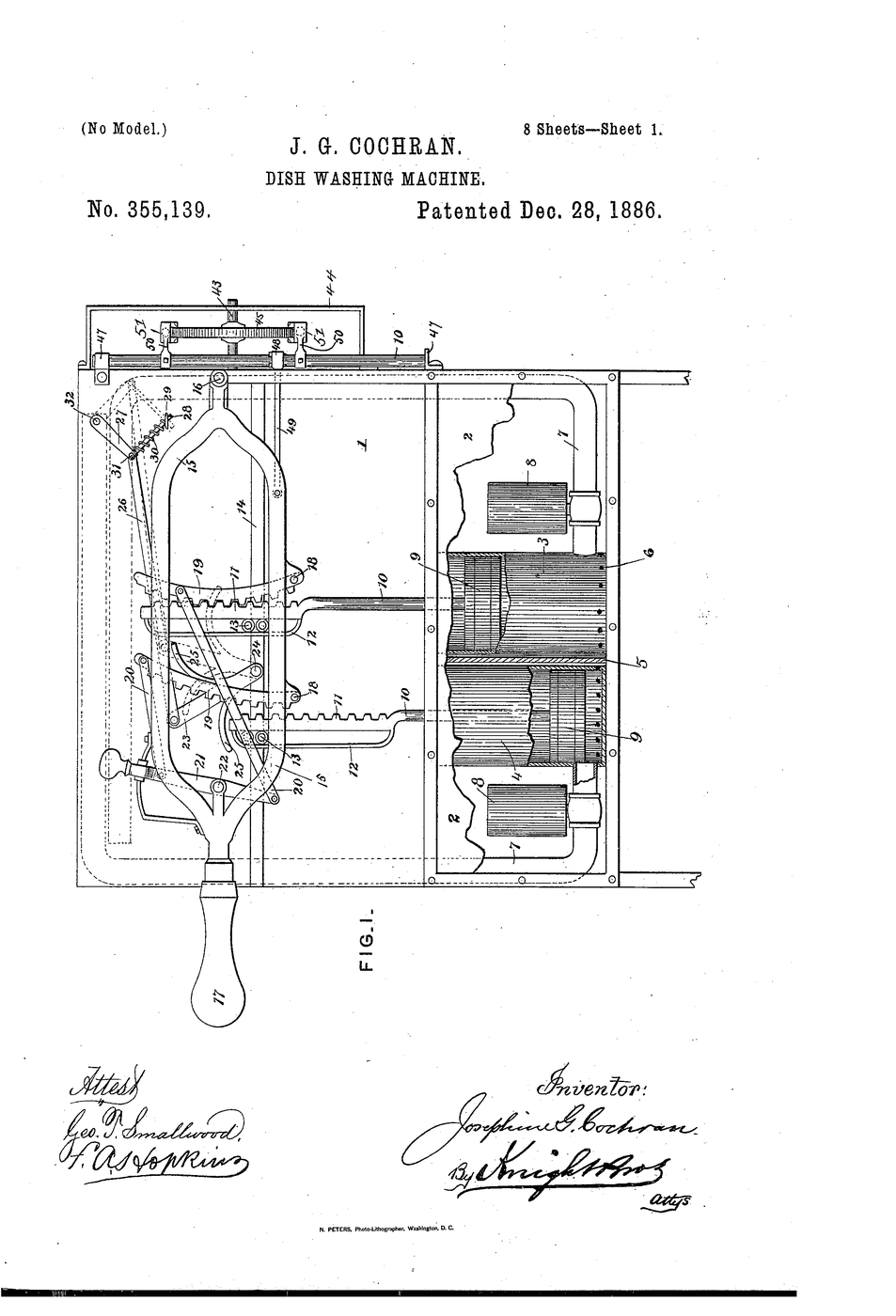


Dishwasher
Washing dishes by hand means standing over a sink, scrubbing each plate in water that gets greasier and colder by the minute — and fine china chips against the tap. Josephine Cochran, a wealthy hostess tired of her servants chipping her heirloom porcelain, asked a better question: could the water do the scrubbing instead of your hands?
Her machine holds the dishes still in wire racks and blasts hot soapy water at them. Each plate, cup and saucer sits in a fitted wire compartment; the rack sits over a boiler, and a pump drives jets of hot suds up and over the crockery, then clean water to rinse. Nothing rubs the china — the moving water carries the dirt away.
Because the dishes never touch each other or a scrubbing hand, they come out clean AND unchipped — and far faster than a person could wash them.
US Patent 355,139, "Dish-Washing Machine", granted 28 December 1886 to Josephine G. Cochran of Shelbyville, Illinois — the first practical dishwasher.
手順
Read the claim: hold the dishes, jet the water
Read the claim: hold the dishes, jet the water
Cochran claims dishes held in fitted wire racks while jets of hot soapy water are thrown at them. Note the key idea: the water moves, the dishes don't.
Bend wire racks that fit the dishes
Bend wire racks that fit the dishes
Bend stiff wire into slotted cradles sized to hold a plate on edge and a cup upside-down. Each dish gets its own compartment so nothing knocks together.
このステップの材料:
 亜鉛めっき鋼線2 メートル
必要な工具:
 コンビネーションプライヤ
Stand the rack in a basin
Stand the rack in a basin
Set the loaded rack inside a basin that will catch the water. This is the wash chamber.
必要な工具:
 洗い桶
洗い桶Smear a plate with grease and food
Smear a plate with grease and food
Dirty a dinner plate with a little butter and crumbs, and rack it. This is the mess the machine must clear without scrubbing.
必要な工具:
 食事皿
食事皿Make a hot-water jet
Make a hot-water jet
Fill a large syringe with hot water and a drop of dish soap. Squeezing it fires a focused jet — your hand-powered pump.
必要な工具:
 実験用シリンジ
Blast the racked plate
Blast the racked plate
Aim the jet across the plate's face. The moving hot suds lift the grease and wash it away — no cloth, no rubbing. Watch the food go.
Hit every face by aiming, not turning the plate
Hit every face by aiming, not turning the plate
Play the jet over the whole plate. In the real machine a spinning arm or rack does this so every surface is struck in turn. The plate stays put.
Compare with a hand-wash
Compare with a hand-wash
Wash a second greasy plate by hand in the same water. Your hand rubs the china and the water turns greasy fast — the jet kept clean water hitting the plate.
Show why hotter water wins
Show why hotter water wins
Jet one plate with lukewarm and one with hot (safely warm) soapy water. The hot jet cuts grease far faster — heat melts fat, which is why the machine boils its water.
Rinse with a clean jet
Rinse with a clean jet
Refill with plain hot water and jet the plate again to rinse off the suds. Two cycles — wash, then rinse — exactly as the machine does.
Let it drip-dry in the rack
Let it drip-dry in the rack
Leave the dishes in their wire cradles to drain and air-dry. The rack doubles as a drying stand — you never touched the clean china.
Check the china for chips
Check the china for chips
Inspect the jetted plate: clean and unchipped. Because nothing rubbed or knocked it, delicate porcelain survives — Cochran's whole reason for building it.
History & Context — the hostess who mechanised the sink
History & Context — the hostess who mechanised the sink
The patent. US 355,139, "Dish-Washing Machine", granted 28 December 1886 to Josephine G. Cochran of Shelbyville, Illinois. (Her surname is often spelled "Cochrane" today.) A well-off widow, she was furious that hand-washing chipped her inherited china, and reputedly declared, "If nobody else is going to invent a dishwasher, I'll do it myself." She measured her dishes, designed a wire rack for each, and had the machine built in a shed behind her house.
The principle is jet-washing, not scrubbing. Earlier "dishwashers" had scrubbing brushes or a hand that raked the dishes — they broke crockery and cleaned poorly. Cochran's insight was to hold each dish motionless in its own compartment and let pressurised hot soapy water do the work (steps 5-7): moving water shears grease off a surface without any abrasion, and hot water melts the fat so it lifts away (step 9). A boiler heated the water, a motor-or-hand pump drove the jets, and the wash-then-rinse cycle (step 10) left the dishes clean and, crucially, unchipped (step 12).
Why it mattered — and why it waited. Cochran's machine won an award at the 1893 Chicago World's Fair and sold to hotels and restaurants, which had mountains of dishes and staff who broke them. But home kitchens of the 1890s often lacked the plentiful hot water and, later, the electricity the machine wanted, and many households still had cheap labour to wash up — so the domestic dishwasher did not become common until the mid-twentieth century, when piped hot water, electric motors and a smaller servant class finally arrived together. Her company survived and became part of KitchenAid; every dishwasher today still does exactly what your syringe did — holds the dishes and throws hot water at them.
この設計図で作るもの

CC0 パブリックドメイン
このブループリントはCC0で公開されています。許可を求めずに、自由にコピー、修正、配布、あらゆる目的で使用できます。
メイカーを応援するには、ブループリント経由で製品を購入してください。メイカーには メイカーコミッション がベンダーにより設定されています。または、このブループリントの新しいイテレーションを作成し、自分のブループリントにコネクションとして含めて収益を共有できます。